Intel Offers $1 Million App Challenge – All Tablets to Ship With RealSense 3D Scanners Next Year

It’s quite incredible to think how quickly 3D scanning technology has come in only a few short years. If you were to step into your Delorean, and travel all the way back to a time when having access to a 3D scanner likely meant you worked in the medical field, you would have to set your dial all the way back to the year of 2010. Yeah not too long ago, right?
With the spread in popularity of 3D scanners, and with CAD software getting much less complicated to use, the number of applications for 3D scanning has exploded. Imagine a future where every consumer tablet sold, or better yet, the billions of smartphones sold each year, had a 3D scanner built into them. How would the world change? 3D selfies anyone?

Intel, one of the world’s largest semiconductor chip manufacturers, envisions a future just like this, and it all begins next year! Yesterday, Intel CEO Brian Krzanich spoke at MakerCon in New York, where he revealed that the company is  aiming to integrate their RealSense technology in all of their new tablets in 2015.
“Our goal is to just have a tablet that you can go out and buy that has this capability,” Krzanich said, according to Gizmag. “Eventually within two or three years I want to be able to put it on a phone.”
Could you imagine what such technology will do, not only for the 3D selfie industry (half joking), but for that of the 3D printing space? The total number of 3D printable models will explode, and if you can’t find something to print online, just go out and take a 3D scan of an object with your phone. Surely just about every manufacturer is cringing right about now, as they begin to picture the bootlegging of just about everything. See a cool necklace your friend has? Just take a quick scan with your phone, and print one out for yourself.
“The idea is you go out, you see something you like and you just capture it,” Krzanich explained.
Intel has high hopes for their RealSense platform, and has thus announced a contest which they hope will spur on the development of innovative applications for their 3D scanning technology. The Intel RealSense Technology App Challenge 2014 will pit developers against each other, competing for $1 million in prizes by creating applications that combine imnersive human-computer interaction with the 3D Intel cameras on their soon to launch tablets and smartphones. More details on this challenge can be found here.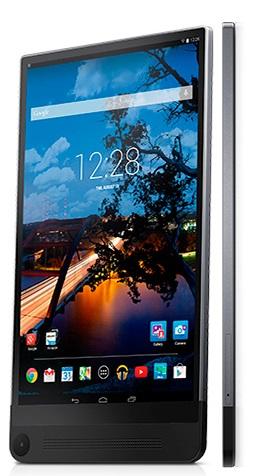
For those of you looking for a tablet with this RealSense technology in it, the Dell Venue 8 7000 series, which is the thinnest tablet to date at just 6mm thick, will be the very first offered, and it was just unveiled last week.
Let’s hear your thoughts on what a world filled with billions of 3D scanners may look like, and the implications of such a technological shift for the 3D printing space. Discuss in the Intel RealSense 3D scanner forum thread on 3DPB.com.
Subscribe to Our Email Newsletter
Stay up-to-date on all the latest news from the 3D printing industry and receive information and offers from third party vendors.
Print Services
Upload your 3D Models and get them printed quickly and efficiently.











You May Also Like
Roboze Opens U.S. Aerospace & Defense Headquarters in El Segundo
The manufacturing sector is made up of clusters: “geographic concentrations of interconnected companies” that both cooperate and compete with each other. Of course, this is true about any sector in...
EOS Invests $3M In Its Texas Manufacturing & Logistics Facilities to Serve North American Customers
The trajectory of reshoring under President Trump has been largely a mixed bag so far. While tariffs still seem to be doing more harm than good to the U.S. domestic...
At AIAA SciTech 2026, 3D Printing Was Part of the Workflow — Part I
The AIAA SciTech Forum 2026 brought much of the aerospace community together in one place. With roughly 6,000 attendees, 115 exhibitors, 21 sponsors, and nearly 3,000 technical paper presentations, the...
€73 Million Investment Round into SWISSto12
SWISSto12 is on the move. I think that the firm owns one of the most promising and profitable applications for 3D printing, RF components, and it is showing real growth...