Creating a Better 3D Printed Hip Replacement

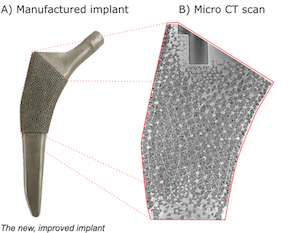 The number of hip replacement surgeries undertaken in the US is on the rise and in no small way. Over the ten years examined by a government study, hip replacements have doubled across age groups, with the largest increase occurring among those aged 45 – 54. The reasons behind this increase are still not completely clear, but it may be because of the increase in quality of the hip replacements themselves, which means that they can improve the mobility and quality of life of a larger number of people. According to the National Institute of Arthritis and Musculoskeletal and Skin Diseases, part of the National Institute of Health:
“In the past, doctors reserved hip replacement surgery primarily for people over 60 years of age. The thinking was that older people typically are less active and put less stress on the artificial hip than do younger people. In more recent years, however, doctors have found that hip replacement surgery can be very successful in younger people as well. New technology has improved the artificial parts, allowing them to withstand more stress and strain and last longer.”
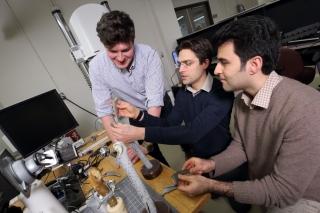 Now, researchers at McGill University are using 3D printers to create a hip replacement that works to ‘trick’ the body’s host bone into believing that the implant is part of the bone itself. This newly developed replacement should not only last longer but also create fewer problems for those receiving it. Counter to what might be initially assumed, the problem with past implants isn’t that they aren’t strong enough, but rather that they are too strong. The rigid material from which they have traditionally been constructed ends up absorbing most of the stress and leaves the bone without the necessary stimulation required to continue cell generation. As a result, the original bone begins to deteriorate, causing pain and eventually necessitating further replacement interventions.
The 3D printed titanium replacement engineered at McGill is porous in nature, composed of a series of tetrahedrons, somewhat akin to the lattice work in the legs of the Eiffel Tower. The man behind the development of this new hip implant, Damiano Pasini, explained how such a structure is beneficial to the patient:
“So because the implant loosely mimics the cellular structure of the porous part of the surrounding femur, it can ‘trick’ the living bone into keeping on working and staying alive. This means that our implant avoids many of the problems associated with those in current use.”
This is good news for patients, and project collaborator Dr. Michael Tanzer of the Jo Miller Orthopaedic Research Laboratory at McGill is very hopeful for the benefits this new implant will provide:
“Because people engage in various sports where they may be injured more than they did in the past, we see younger people needing hip replacements more frequently. And because people are also living longer, they often need to have the same hip replaced a second time. Unfortunately, I’ve seen many cases where people simply don’t have enough living bone for that to work easily. We are optimistic that this implant will reduce these kinds of problems.”
You can read the full study from the McGill University researchers here. Discuss in the 3D Printed Hip Replacement forum at 3DPB.com.
[Source: McGill University]
Subscribe to Our Email Newsletter
Stay up-to-date on all the latest news from the 3D printing industry and receive information and offers from third party vendors.
Print Services
Upload your 3D Models and get them printed quickly and efficiently.











You May Also Like
Axtra3D Brings Full “Axtra Workflow” and New Materials to Formnext 2025
Axtra3D hits Formnext 2025 with a big shift in strategy. The company isn’t just selling printers anymore; it’s selling a complete workflow. At the show, Axtra3D unveiled its new Axtra...
From Hobby to Hustle: How the Prosumer 3D Printing Market Is Rewriting the Industry
When many hear 3D printing, they still think of hobbyists tinkering in garages, making figurines, models, or toys. But that image has changed. A new wave of users exists between...
Bambu Lab Launches P2S: Expanding the P1 Legacy with Smarter, Faster Printing
See the addendum to this article for an update from 11/25/2025. Just two years after shaking up desktop 3D printing with the P1 Series, Bambu Lab is back with the...
Trust Bambu
Bambu Lab‘s relentless rise has galvanized the industry into a furious response, making desktop 3D printers much faster and more reliable. Other competitors are in denial and, like deer in...