3D Matter Tests Their Finite Element Analysis for FDM 3D Printing


 In order to take the capabilities of 3D printing technology to the next level of innovation, it’s critical that we enhance the materials that are utilized with additive manufacturing. One company helping to take up this task is 3D Matter, a New York City-based startup aiming to unearth the properties of 3D printing materials and optimize their use for functional products. Earlier this year the startup released an in-depth study detailing the properties of 3D printing polymers, a comprehensive report that laid out the benefits and disadvantages of each type of 3D printing filament.
 Now, 3D Matter has taken their research to the next level in the latest report on Finite Element Analysis (FEA) for FDM 3D printing. Generally speaking, FEA is a tool used by engineers to solve solid mechanics problems, allowing them to predict how a part will function with a given set of loads and constraints. In regard to 3D printing, the success of the produced part will be heavily dependent on the properties of the material used. The emerging technology has a number of challenges with the layering process that hinders optimal functionality, including imperfect bonding between layers, the wide range of printing parameters, and the material properties’ dependency on geometry, the latter of which is the subject of their latest report.
Though 3D Matter’s recently launched OptiMatter platform helps users calculate the optimal printing configuration for specific materials and printing parameters, it does not account for the impact that the geometrical shape has on the functionality of the part. That’s why they’ve developed a proprietary methodology to conduct Static Linear Finite Element Analysis, which will help to accurately predict if a printed part will yield or not. At the start of their FEA study, 3D Matter showcases the differences in the FEA for injection molding and 3D printing with PLA. Testing out the Ocke Stool, which was designed by Big Rep, 3D Matter went on to test the 3D printed and injection molded objects for displacement and stress, using a high load of 500 kg as the basis of their findings.
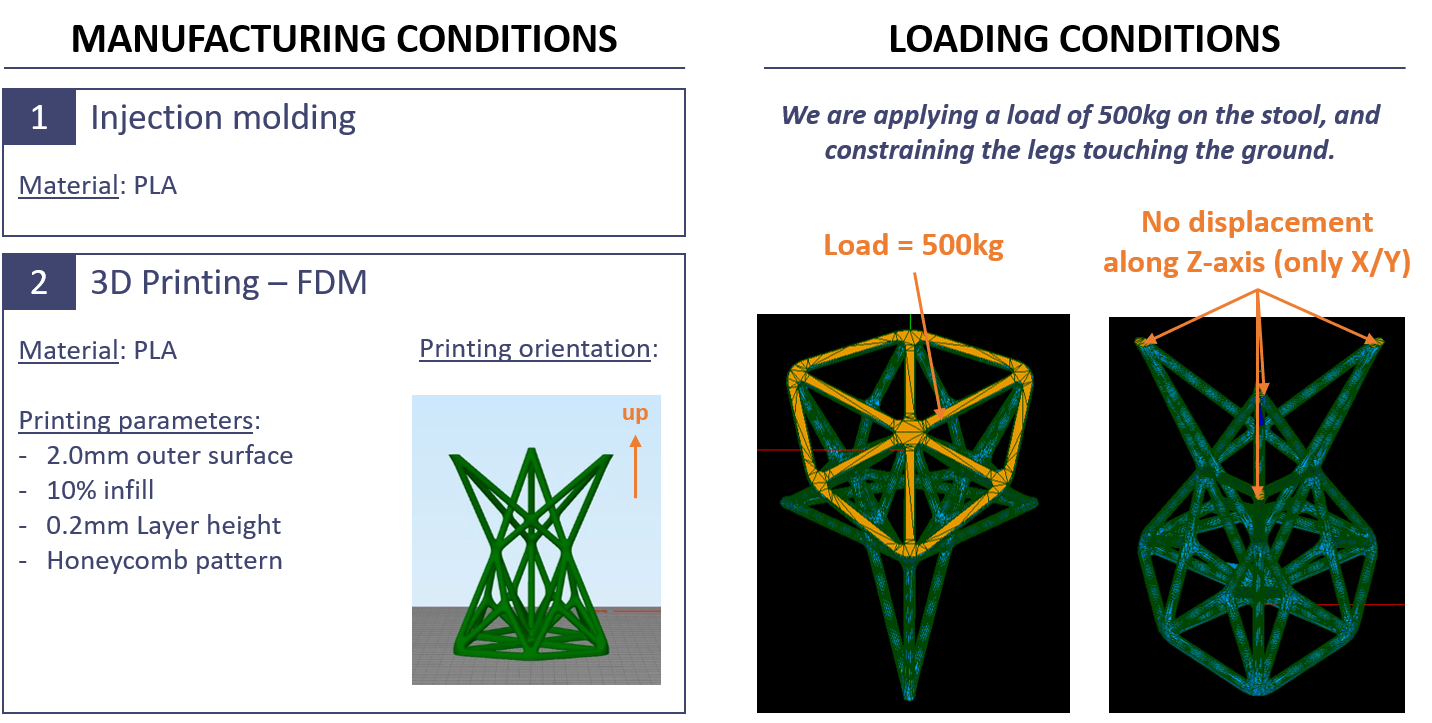
Testing parameters for FDM 3D printing vs. injection molding
What they found was that, under the high load, the injection molded Ocke Stool fared much better than the FDM 3D printed object. But when the infill was upped from 10% to 50%, they found that the stool could support the 500kg of weight. This FEA information was recently integrated into the OptiMatter platform, which they hope will help users optimize the materials they use and the parameters they set for functional parts.
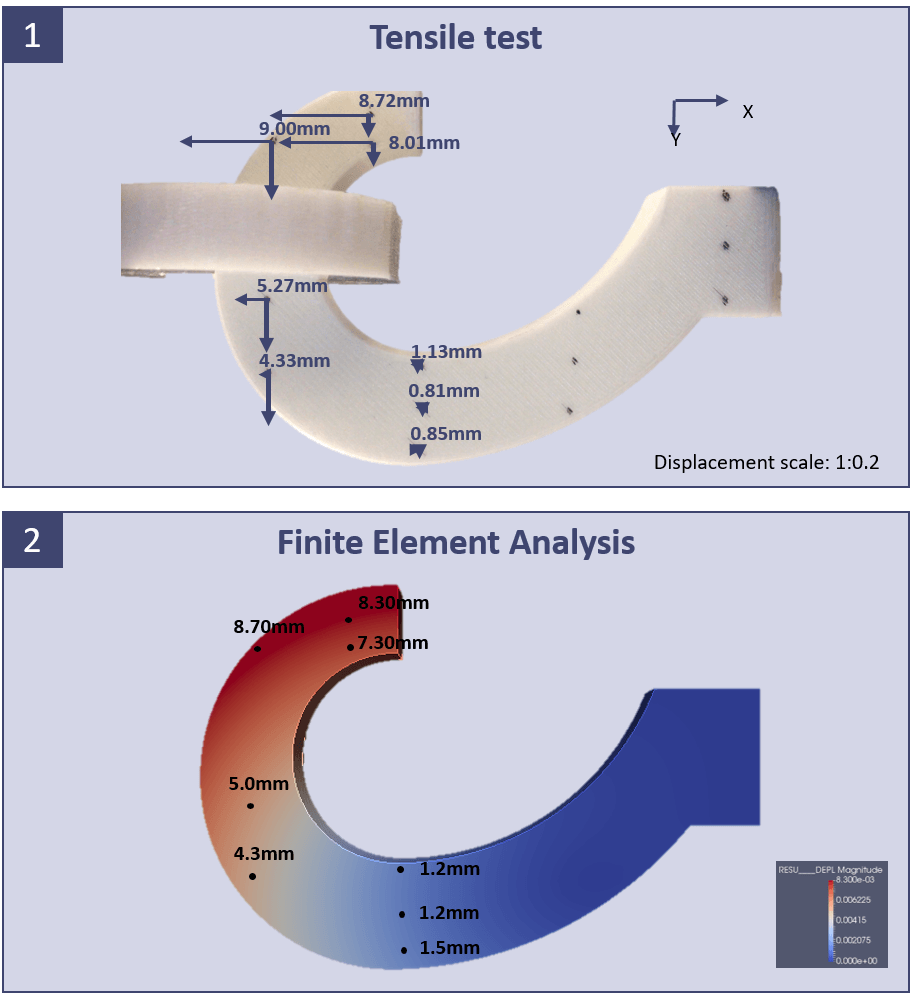 3D Matter conducted two tests to confirm the accuracy of their FEA tool, one for displacement accuracy and another for stress accuracy. The first test measured the displacement of a tensile test against the displacement predicted from the FEA. The researchers found that the displacement predicted by their FEA matched very closely to that of the tensile test, and even showed the same trend in increasing displacement as they moved away from the constrained area.
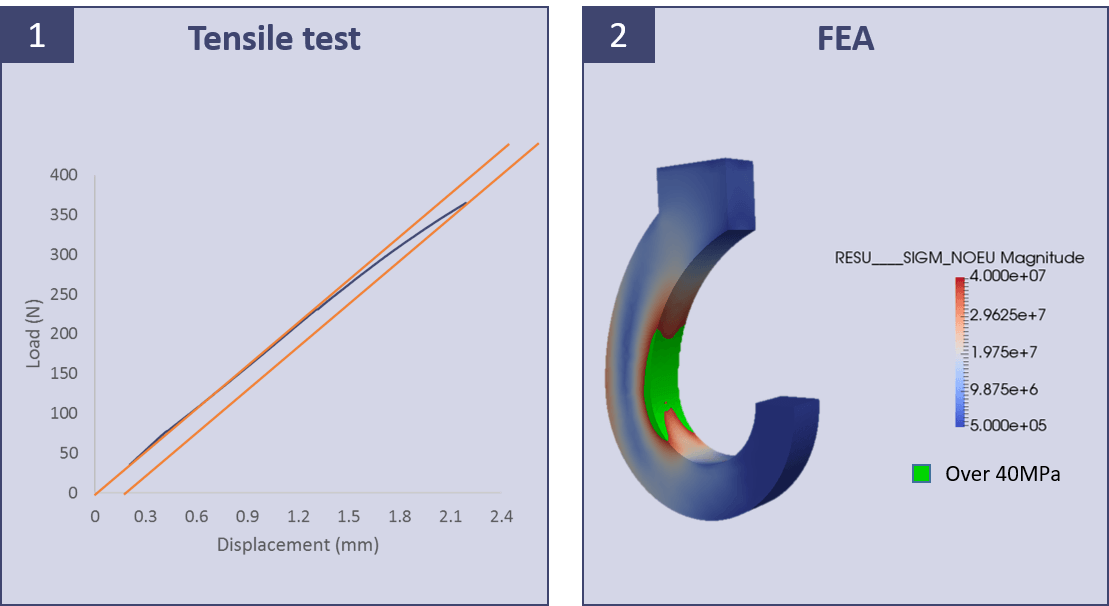
The second confirmation tests was for stress accuracy, which was focused on yield stress. 3D Matter first used their FEA to simulate the behavior of the tested hook under three different loads around the yield stress that was given by the stress-strain curve. By comparing their FEA with a tensile test again, the researchers were able to compare the yield stress for the hook’s out surface, which was 40 MPa, The stress-strain plot graph, which was used to show the results of the tensile test, was comparable to the FEA.
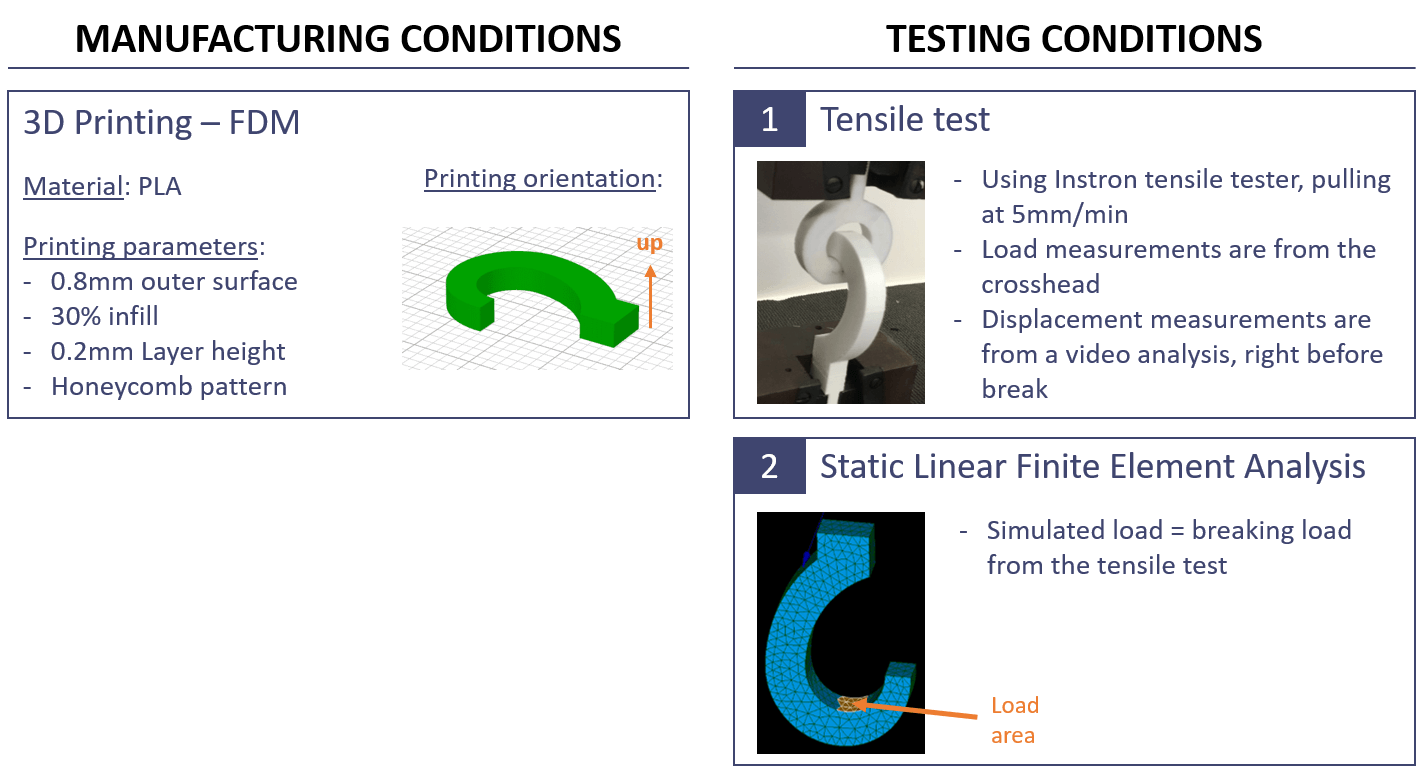
Parameters to test the accuracy of 3D Matter’s FEA.
Their early findings confirm that the data and modeling developed by 3D Matter can be quite useful to industrialists, engineers, and designers looking to optimize the functionality of FDM 3D printing technology. By incorporating this unique FEA process into the information on OptiMatter, the startup has developed one of the most comprehensive FDM part-analysis platforms in the industry. As they’ve shown with their recent research report, there are a lot of critical factors in the functional success of a 3D printed part, from the material used to the geometry of the object. 3D Matter is looking to provide an all-encompassing solution with their OptiMatter platform, offering the 3D printing community streamlined information on how they should print and what materials they should print with.
You can take a more in-depth look at their recent FEA testing process here.

Subscribe to Our Email Newsletter
Stay up-to-date on all the latest news from the 3D printing industry and receive information and offers from third party vendors.
Print Services
Upload your 3D Models and get them printed quickly and efficiently.













You May Also Like
3D Printing News Briefs, May 28, 2026: Continuous Fiber Reinforcement, Bioprinted Trachea, & More
In today’s 3D Printing News Briefs, America Makes announced the winners of its JAQS-SQ Project Call. Axtra3D is partnering with Keystone Industries to expand its dental material ecosystem, while BigRep...
3D Printing News Briefs, March 21, 2026: Resin Safety, 3D Printed Bandages, & More
We’re kicking off this weekend’s 3D Printing News Briefs with some America Makes project call news, and then moving on to resin safety myths. We’ll end with a 3D printed...
New Materials and Curing Unit at Formlabs
Formlabs is showcasing new SLA materials and a new curing solution. The new Tough 1000 Resin, with a tensile modulus of 1000, a Tough 1500, and an improved Tough 2000...
3D Printing News Briefs, October 25, 2025: Strategic Investment, Inner Ear Organoids, & More
In this weekend’s 3D Printing News Briefs, we’ll start off with some business news, as Xact Metal announced continued double digit growth in Q2 and Q3 of 2025, and the...