ORNL Partners With Ingersoll Machine Tools to Develop Colossal 3D Printing System

 When it comes to innovation on the 3D printing front, very few entities have contributed as much groundbreaking research and development as the Tennessee-based Oak Ridge National Laboratory (ORNL) has. Whether it be 3D printing on the nanoscale or large-scale, the government-based national laboratory program is constantly aiming to push this emerging technology to the next level. When they’re not busy creating a simulation guided process for nanoscale 3D printing or licensing their large-scale 3D printing patents to companies like Strangpresse, the ORNL is breaking Guinness World Records for the largest solid 3D printed part.
 Back in 2014, the ORNL worked with manufacturing company Cincinnati Inc. to create the Big Area Additive Manufacturing Machine (BAAM), an unbelievably large 3D printing system with a build envelope of approximately 6 x 12 x 3 feet. Now, the national laboratory is working on a new additive manufacturing system that will make the BAAM look dwarfish in comparison. The ORNL will collaborate with the Rockford, Illinois-based manufacturer Ingersoll Machine Tools Inc. to develop the Wide and High Additive Manufacturing (WHAM), a mammoth-sized additive manufacturing system that will have a build envelop of 23 x 10 x 46 feet, as well as targeted laydown rates of 1,000 lb/hr.
“Our collaboration with Ingersoll on the development of a 3D printer that provides a volume not possible with current printers could open up new markets and applications in defense, energy and other areas of manufacturing. Ingersoll brings years of experience engineering massive equipment in the composites area, and we look forward to a successful partnership,” said Bill Peter, the director of ORNL’s Manufacturing Demonstration Facility.
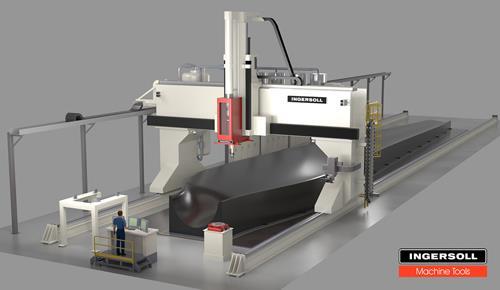
Conceptual design of the WHAM
The project was announced earlier this week by Ingersoll Machine Tools at the Chicago-based International Manufacturing Technology Show (IMTS) 2016. The WHAM system will lead to increased size and speed capabilities over currently existing large-format 3D printing technology, and is projected to be commercially available sometime in the next 18 to 24 months. The WHAM will include high-speed automatic exchange of the printing extruder, as well as a 5-axis milling attachment for conventional subtractive finishing operations. Additionally, the first material that will be used with the large-format 3D printer is already being developed by the Clinton, Tennessee-based plastic material producer Techmer, an ABS with 10% chopped carbon fiber reinforcement.
The partnership is likely to be a fruitful and successful one, as both the ORNL and Ingersoll are among the most innovative in modern manufacturing. According to Ingersoll, they will utilize their experience developing CNC machining systems and automated fiber placement (AFB) machines to create the WHAM system, while the ORNL’s work with the BAAM speaks for itself. The new additive manufacturing system will target the markets of wind energy, aerospace, automotive and defense. The WHAM is an undeniably exciting prospect for the 3D printing industry, which has long been battling to alleviate limitations in build size. Discuss further over in the WHAM 3D Printing System forum at 3DPB.com.
[Source: CompositesWorld]
Subscribe to Our Email Newsletter
Stay up-to-date on all the latest news from the 3D printing industry and receive information and offers from third party vendors.
Print Services
Upload your 3D Models and get them printed quickly and efficiently.













You May Also Like
South Korea’s Lincsolution Lands Hanwha Defense Deal as Hanwha Invests Billions in US
I recently wrote about how the South Korean additive manufacturing (AM) firm Lincsolution is building an aerospace and defense hub, part of the company’s construction of “the largest AM facility in...
Bambu Lab and SUSAN FANG 3D Print for London Fashion Week
At London Fashion Week, some of the more unusual pieces on the runway came from 3D printers. Chinese fashion designer SUSAN FANG presented her Spring/Summer 2027 Air-Illusion collection at the...
Why Cross-Border 3D Printing Is Closing the Speed Gap with Local Manufacturing
The fastest 3D printing supplier in your shortlist may no longer be the one closest to your office. That sounds unlikely to many engineers. For years, overseas 3D printing carried...
Arridex Expands 3D Printing Network to Ghana
Nigeria-based Arridex has deep experience in oil and gas additive manufacturing. Previously known as RusselSmith, the firm has in-house metal and polymer additive technology. The company is making 3D printed...