Russian Institutions Team Up to Produce Drone with 3D Printed Engine


 Russia has been very interested in drone technology lately. Last month, the Russian United Instrument Manufacturing Corporation (UIMC) presented the first-ever 3D printed drone to be manufactured in the country, unveiling it at the annual Innoprom industrial trade fair. Now a new bit of drone-related news has emerged from the country, as two major organizations begin work on an unmanned aerial vehicle (UAV) with a 3D printed engine.
The Russian Foundation for Advanced Research Projects in the Defense Industry (FPI) and the All-Russian Scientific Research Institute of Aviation Materials (VIAM) have teamed up to design a drone that will be powered by VIAM’s 3D printed gas turbine engine. The engine, which was unveiled in June, was assembled entirely from 3D printed parts, according to VIAM Director General Evgeny Kablov.
“The engine is made entirely on the basis of VIAM additive manufacturing using new laser sintering technology and metal powder mixes for heat-resistant and aluminum alloys, which have also been developed by the institute’s experts,” Kablov told Russian publication Izvestia. “We were able to print an engine with unique parameters impossible to achieve with conventional casting by using additive manufacture technology. For example, the thickness of the combustion chamber’s walls is 0.3 millimeters. Such parameters are only possible with 3D printing.”
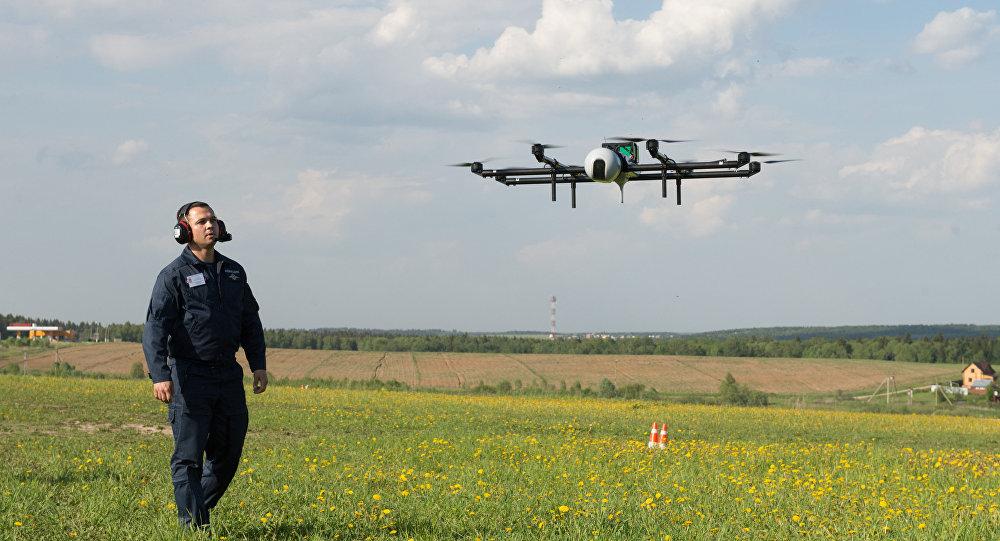
[Image: Sputnik/Iliya Pitalev]
 FPI was founded in 2012 for the purpose of aggressively pursuing advanced technological research for military and defense purposes. At the time, Russia was suffering from technological stagnation, with an increasing gap between it and other Western countries. FPI was formed to close the gap, and a lot of their research, especially lately, has focused on 3D printing. Russia overall has been working intently to develop additive manufacturing technology for the nuclear power, aerospace and defense industries; just last month the country’s nuclear energy corporation, Rosatom, announced that they would begin to produce nuclear components on their industrial metal 3D printer, the first ever to be developed by a Russian corporation.
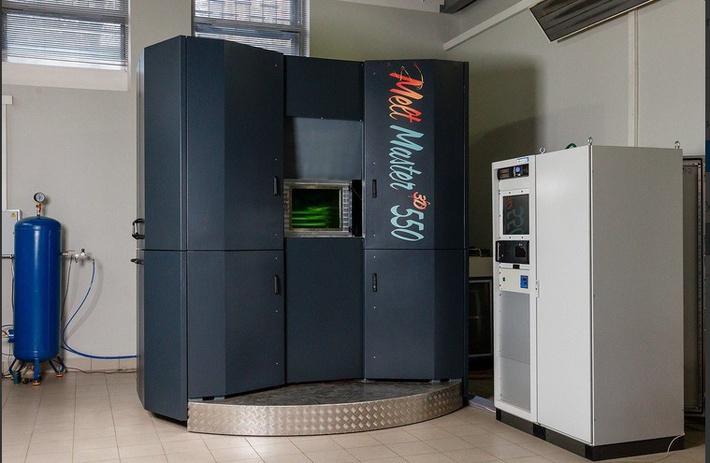
Rosatom’s industrial metal 3D printer
There have been a lot of firsts for Russia in terms of 3D printing lately, and if there’s any way to quickly catch up to other countries in terms of technology, 3D printing research is a good bet. FPI deputy head Alexander Panfilov confirms that this won’t be the last collaboration between FPI and VIAM. The two organizations will continue to work together to experiment with 3D printing and help further the development of a strong additive manufacturing sector in Russia.
“After the experiment, we will begin joint work on developing additive technologies in our country to broaden the range of materials as well as developing our own unique 3D printing stations,” he said.
Discuss further over in the 3D Printed Turbine Engine for Drone forum at 3DPB.com.
[Source: Sputnik International]
Subscribe to Our Email Newsletter
Stay up-to-date on all the latest news from the 3D printing industry and receive information and offers from third party vendors.
Print Services
Upload your 3D Models and get them printed quickly and efficiently.













You May Also Like
The Two Paths to AM Print Services Market Growth
AM Research New market research: AM Research is building its new Additive Manufacturing Services Market 2.0 model. Learn more about the report and preorder here → Things continue to heat...
Additive Manufacturing Has a Major Growth Opportunity; Trust Will Decide Who Captures It
After years of overpromising, the next phase of AM growth will be won by companies that consistently deliver what they say. When I entered additive manufacturing in 2014, after 15...
10 Years of Multi Jet Fusion: Onsite at HP’s Vancouver, Washington Facility
At this year’s RAPID event in Boston, HP Additive Manufacturing Solutions celebrated ten years in the additive manufacturing (AM) market. The company ushered in the milestone with several innovations, including...
ADDMAN to Buy Up to $10.8M in Nickel 718 Powder from 6K Additive Over 30 Months
After years of buildup, we’re finally starting to see what the US metal additive manufacturing (AM) market could look like at scale. To be sure, it’s still not quite there,...