The 3D Printed Orange Screamer is Precisely What it Purports to be

We’re confirming–virtually by the minute–just how far reaching are the possibilities where 3D printing is concerned. No doubt, thanks to 3D printing, lives will be saved, new technological summits reached, and old technologies rendered quaint at best. But there’s an infinitely playful side to it as well, as one 3D-printing innovator has proven.
Instructables maker, “AndyGadget,” has produced the Orange Screamer, a small, 3D printed turbine whistle that could prove lethal in the hands of 12-year-olds and sports fans–imagine them printed in the color of your favorite team!
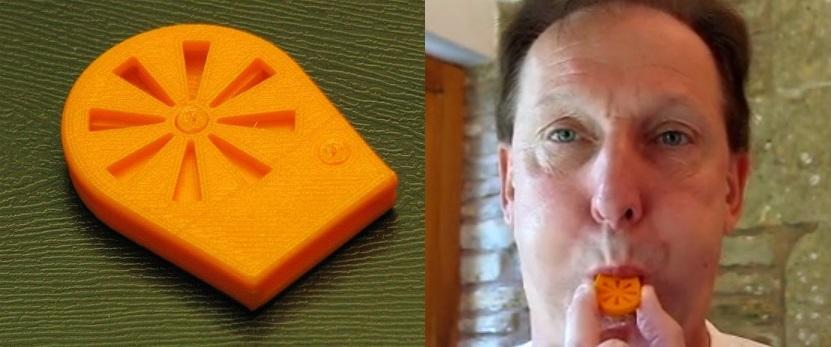
Inspired by a similar device, the Pocket Siren, produced by another Instructables gadget guru, “Kiteman,” the Orange Screamer, approximately 1” x 1.5” fits neatly into a pocket until its bearer is ready to activate it.
AndyGadget demonstrates the Orange Screamer in a short video posted on Vimeo, humorously dubbing it “a wide-area annoyance device” and provides step-by-step instructions for producing your own Orange (or Blue, or Purple, or, perhaps most appropriately, Red) Screamer on his Instructables page.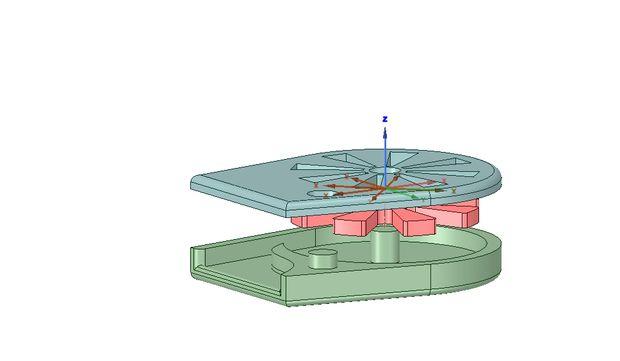
The tools required to produce an Orange Screamer are pretty basic, aside from the 3D printer. AndyGadget used DesignSpark mechanical to produce the original design for the device, which went through, he noted “three iterations.” The first version worked but wasn’t sufficiently loud; it also required considerable lung power to activate, so refinements were in order. “The final version,” he explained, “was a general tidying-up exercise. I slimmed down the top and base thicknesses to 2 mm and changed a couple of dimensions to reduce the need to sand after printing.”
The designer shared a ZIP file on the Instructables site as an alternative to providing “a long list of images.” The available files in RSDOC and STL format, are for the body, the rotor, and the lid. He also included “files in SketchUp (V8) format, a THING file for use directly on a MakerBot and a file with just one rotor blade in case anyone wants to play around with the geometry.”
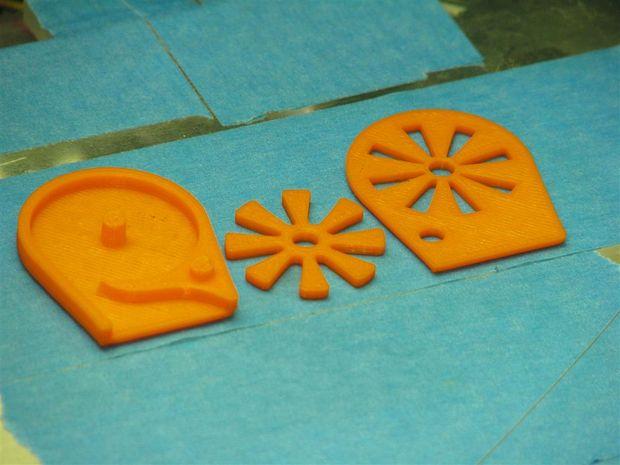 The Orange Screamer was printed in PLA (polylactic acid) on a Wahnao Duplicator 4 (Makerbot clone) 3D printer. “I imagine ABS would work,” said AndyGadget, “but I think the brittleness of PLA is the better choice for this.” He went on to describe his process more specifically: “I used 40% fill and printed with 0.2 mm layers, two shells and rafltess onto blue painter’s tape. I’ve found a plate temperature of 50C stops the warping of small, flat parts like this.” The device, comprised of three parts, took less than 30 minutes to print.
In its final stage of completion, the Orange Screamer was refined with sandpaper and WD40, the parts connected with superglue. AndyGadget warns potential makers of their own Orange Screamers to remove excess glue lest they “end up with it permanently attached to [their] lips,” which might, in a sense, be an act of self-preservation as the completed device is unlikely to endear young (or old) innovators to friends, family members, neighbors, pets…
Have you 3D printed this annoying little device? Let us know how it turned out in the Orange Screamer forum thread on 3DPB.com. Check out the Orange Screamer in use, in the video provided below.
Subscribe to Our Email Newsletter
Stay up-to-date on all the latest news from the 3D printing industry and receive information and offers from third party vendors.
Print Services
Upload your 3D Models and get them printed quickly and efficiently.











You May Also Like
3D Printing Financials: 3D Systems Returns to Growth in Q1 2026
3D Systems (NYSE: DDD) reported one of its strongest quarters in recent years, showing signs that the company may finally be moving past the tough slowdown that has weighed on...
3D People Case Study Details Development of 3D Printed POV Camera Rig
A POV, or Point of View, camera rig, is a wearable support system that helps filmographers capture first-person footage, making the images more immersive. Some good examples of movies shot...
3D Printing News Briefs, May 2, 2026: Soft Robots, Agricultural Waste, & More
In this weekend’s 3D Printing News Briefs, we’ll start off with a multi-laser metal powder bed fusion 3D printer and post-processing news. We’ll end with research into soft robotics and...
Industrial Applications on Display at RAPID 2026: CERATIZIT & 3D Systems
Applications are where it’s at in the additive manufacturing (AM) industry. At the recent RAPID+TCT in Boston, I met with a few companies to learn about some of their very...