3D Printed Smart Eyeglasses May Be Able to Count Your Calories for You


 I just ordered a fitness tracker from Amazon the other day. It’s the first time I’ve tried one, and I’m getting it mostly for its sleep-tracking feature, but the fact that it counts steps and calories burned will undoubtedly be useful, too (or maddening, we’ll see). I’ve always been very curious about devices that measure how many calories you’re burning, but I’ve also wished that they had the capability to detect how many calories you’re taking in. I’m too lazy for traditional calorie-counting; plus, it’s tricky to determine how many calories you’re getting from a scoop of homemade casserole, for instance.
Considering the amazing things that technology can already do, and how quickly it’s advancing, I’ve assumed that eventually someone will come up with some kind of a device that can detect the number of calories a person ingests. As it turns out, someone has. Professor Oliver Amft from the University of Passau has developed a pair of smart eyeglasses that utilize electromyography to determine just what it is you’re eating, and how much of it.

Professor Oliver Amft
Electromyography (EMG) is a technique that measures the electrical activity generated by muscles. It’s commonly used as a diagnostic tool to assess the health of muscles and nerves, but in this case, it’s being used to detect how hard the muscles in your jaw are working when you’re chewing. Dr. Amft developed a series of tiny sensors and embedded them in a 3D printed glasses frame – more specifically, in the arms of the frame, which touch the sides of the wearer’s face. The sensors pick up the electrical activity generated by the muscles of the jaw while the wearer is chewing, and thus can detect how hard those muscles are working – telling the sensors what type of food you’re masticating.
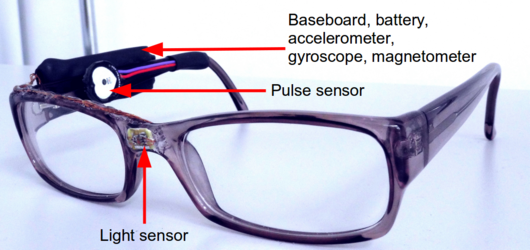
It’s not a perfect science – while the sensors can tell the difference between, say, a banana and celery, they’re less able to distinguish between foods of similar consistencies. The device is still just a prototype, though, part of a larger project called WISEglass. Dr. Amft and his fellow researchers are working to develop regular eyeglasses with embedded sensor technology that can detect different activities the wearer is performing, such as reading or walking. A light sensor can also detect the blue light emitted from screens, which can interfere with the sleep cycle; if the wearer is getting too much screen time late in the evening, the sensor sends a notice to their smartphone telling them they should power down if they want to ensure a restful night’s sleep.
 Eventually, the researchers hope to hide all of this technology inside ordinary eyeglasses. WISEglass has also been tested as a wearable video game controller, so you can play your favorite game simply by moving your head from side to side, while the glasses tell you how that movement affects your heart rate – as well as, likely, how many calories you’re burning (and also ingesting from the bag of potato chips sitting next to you).
The University of Passau’s research was presented earlier this month at the International Conference on Wearable and Implantable Body Sensor Networks, and will soon be published in a paper entitled “Diet eyeglasses: Recognising food chewing using EMG and smart eyeglasses.” Hmmmm…quite an idea! Would you be interested in a pair of these? Tell us over in the 3D Printed Smart Eyeglasses forum at 3DPB.com.
Subscribe to Our Email Newsletter
Stay up-to-date on all the latest news from the 3D printing industry and receive information and offers from third party vendors.
Print Services
Upload your 3D Models and get them printed quickly and efficiently.













You May Also Like
Additive Manufacturing at a Crossroads
Additive manufacturing is at a crossroads. Simultaneously, we find ourselves between certain very different modalities, applications, and industries. Rather than being able to explore them all, companies will now have...
IperionX Raises $50 Million to Expand U.S. Titanium Production
IperionX has raised about $50 million through a public offering to speed up the commercial rollout of its U.S. titanium manufacturing business. The company sold 2.275 million shares at $21.98...
3DPOD 306: Super Polymers for 3D Printing with Mike Zimmerman, Z-Polymers
Mike Zimmerman started in research before starting his own startups. Now his firm makes a fiber with some very exciting properties indeed. The material has been turned into a very...
Why Elegoo Chose Emoji® to Introduce More People to 3D Printing
When Elegoo unveiled the world’s first officially licensed emoji®-themed 3D printer, it wasn’t just launching another version of an existing machine. The company was testing a much bigger idea by...