Makerbot Releases Model for 3D Printed Frog Dissection Kit

It has been pretty clear, over the last year, that one of the most promising areas for the adoption of 3D printers, is within the field of education. The hands on approach of allowing students to print out, and make their own ideas into physical objects, is both exciting and educational for all age groups. Both Makerbot, as well as their leading competitor, 3D Systems have been inching their way into schools worldwide over the last 12-18 months.
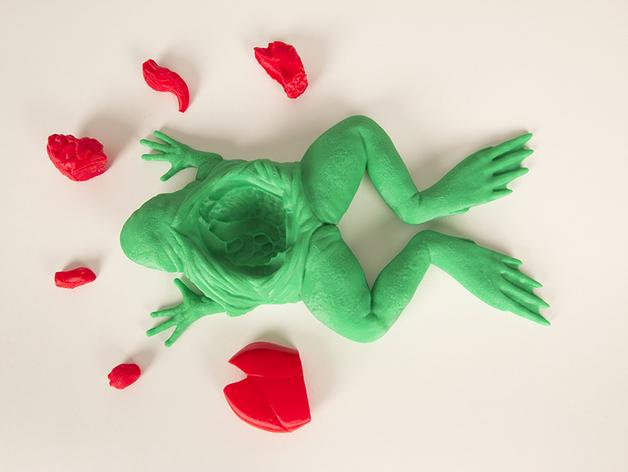 Today, Makerbot Academy has released a model on Thingiverse, which is certainly an interesting route to take for this company. The model is for a seven piece frog dissection kit. The Thingiverse page for this project includes 3D models of all seven pieces of the frog, as well as its anatomy. The 3D printed frog will be the same size as the typical frog which elementary school children have been dissecting for decades. The organs of the model fit together piece by piece like a puzzle. The kit also includes a fairly detailed lesson plan for grades 6-8 teachers who wish to use the model as an alternate way for their students to dissect a frog, of course without the blood, and guts.
Earlier this year, Makerbot announced a program in which they enabled hundreds of teachers across the United States to obtain a Makerbot Replicator 2 3D printer for just  $98. The Makerbot Academy has a mission statement on their site which reads as follows:
“Together, we’re determined to help provide the next generation of American Makers with a relevant STEM (Science, Technology, Engineering and Mathematics) education.”
According to the company, this is just the first of what will be many 3D models they will release in the coming months ahead, in their push to bring about a cooperation between 3D printing and the educational curriculum of schools worldwide. Discuss this model at 3DPrintBoard.
Subscribe to Our Email Newsletter
Stay up-to-date on all the latest news from the 3D printing industry and receive information and offers from third party vendors.
Print Services
Upload your 3D Models and get them printed quickly and efficiently.











You May Also Like
Harvard SEAS Engineers Develop 3D Printing Method for Soft Robotic Components with Programmable Shapes
The world of soft robotics is still largely in its pure research phase, but the R&D landscape has started to produce examples of early-stage commercialization. Researchers have started to refine...
3D Printing News Briefs, February 14, 2026: Project Call, Maritime Construction, Prosthetics, & More
Happy Valentine’s Day! We’re starting this weekend’s News Briefs off with a Project Call award, and then moving on to a business growth program. We’ll end with research in underwater...
CASF: A Green Surface Finishing Technology for AM Hard Metal Alloys and Fatigue Improvement
Sugino Machine Ltd has recently completed development of a highly specialized surface-finishing technology capable of removing partially melted particles, debris, and alpha case left behind by additive-manufactured (AM) laser powder...
Hardware is Dead. Here’s What Actually Wins in Additive Manufacturing.
Hardware is rapidly commoditizing across additive manufacturing. Specifications have converged. Price competition has intensified. Margins have compressed. For companies attempting to scale additive manufacturing beyond prototyping, this shift has profound...