3D Printing Market Evolving Fast as Print-on-Premises Disrupts Early Leaders


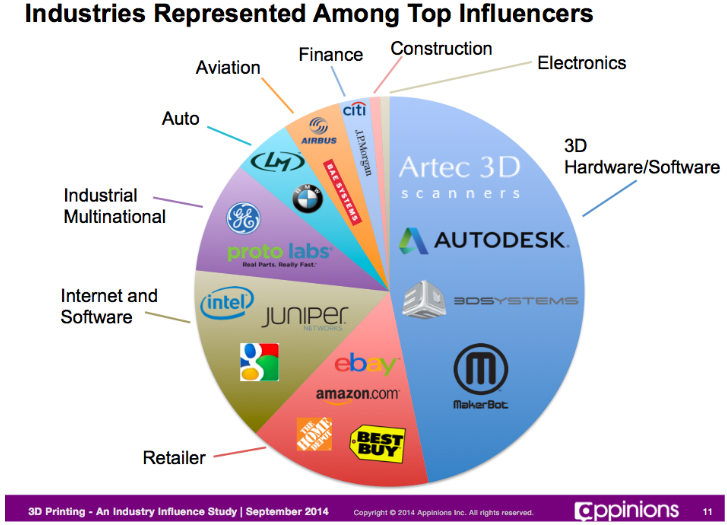
The 3D printing market has never been one to stand still, but a recent Appinions report shows it to be shaking up even faster than imagined. The new study shows that industry stalwart Makerbot is slipping as a few blue-chip behemoths introduce the ability to 3D print on premises, obviating the need for your average consumer to buy their own 3D printer.
Staples and Home Depot Surge Ahead
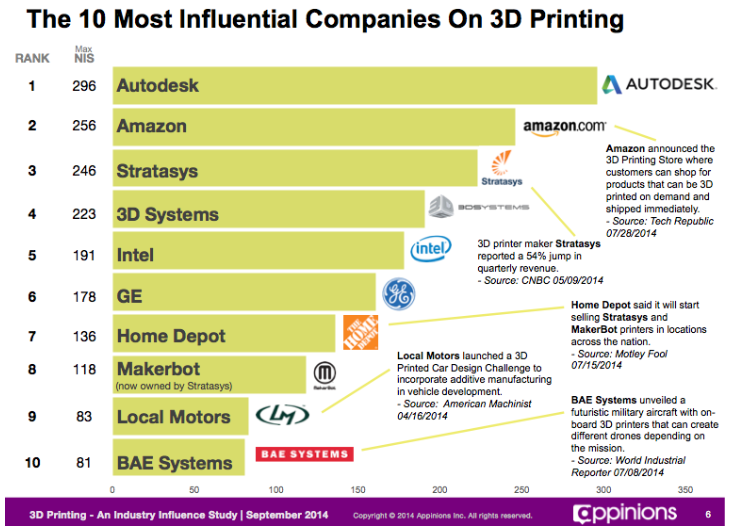
Perhaps no two companies are doing more to bring 3D printing to consumers’ fingertips than Staples and Home Depot. Both recently launched competing print-on-premises plans, which allow anyone to pop into a store with their object on a thumb-drive, and have it quickly printed for them. Home Depot’s partnership with Makerbot for this initiative is paying them both dividends, as they scored a respective seventh and eighth place in overall influence.
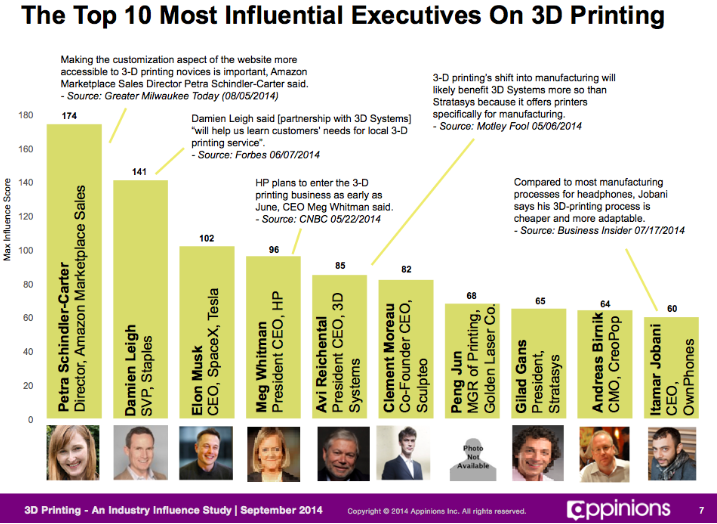
Staples also had its own strong showing, as Appinions’ data shows Senior Vice President Damien Leigh to be the second most influential executive in the industry. While Staples’ partnership with 3D Systems is exciting, their rollout is currently limited to only LA and NYC, which may be limiting enthusiasm among community members.
Amazon – King of the Jungle?
Another strong performer was Amazon, who came in number two overall, while their Director of Marketplace Sales was found to be the most influential executive in the whole industry. This reflects growing excitement over their recent launch of a 3D Printing Store, bringing a new level of visibility to a business model earlier championed by Shapeways and Sculpteo. Only time will tell if this added awareness will help those two early front-runners, or if Amazon will crush them with their ability to set market clearing prices.
What Does It Mean for Makerbot?
Three months ago, if you had asked the average techie to name a 3D printing company they would have shouted out Makerbot. But as this new data shows, they’ve quickly fallen to eighth place, as influencers attention has turned elsewhere. On one hand you have behemoths like Amazon, Home Depot, and Staples attacking them from above (not to mention age old competitor 3D Systems), while below nimble startups like Formlabs and CreoPop are nipping at their heels.
Their partnership with Home Depot is certainly interesting, but will it translate into more business for Makerbot down the line, or will users instead find it a gateway drug to only using printers as a service, and chose to never buy their own hardware.
As always, the 3D printing market shows no slowing down. Between Makerbot’s new challenges, to startups like Farmbot and Sketchfab, there are numerous exciting new developments on the horizon. Read the free Appinions influence study for the rest of their findings.
Let’s hear your thoughts on the way the market is shaping up. Will MakerBot’s early advantage play in their favor as they adapt to cater to a more robust market, or will their brand slowly fall to the wayside as multi-billion dollar corporations enter the market besides them. Discuss with us at 3DPB.com.
Subscribe to Our Email Newsletter
Stay up-to-date on all the latest news from the 3D printing industry and receive information and offers from third party vendors.
Print Services
Upload your 3D Models and get them printed quickly and efficiently.












You May Also Like
ADDiTEC Demonstrates Material Freedom and Mission Readiness at JIFX 2026 with HYBRiD-X
At the Naval Postgraduate School‘s Joint Interagency Field Experimentation (JIFX) in May, ADDiTEC demonstrated how advanced manufacturing can support the future of defense sustainment through its HYBRiD-X expeditionary manufacturing platform....
AM Asia Watch: China’s 3D Printing Boom Is Creating a New Class of Micro-Manufacturers
China’s additive manufacturing (AM) industry has spent years trying to reduce its reliance on foreign technology. In polymer 3D printing, domestic companies have already become major players. In metal AM,...
3DPOD 302: Digital Inventory for AM with Mikhail Gladkikh, Würth Additive Group
Mikhail Gladkikh has worked in oil and gas for many years. With this background, we obviously talk about energy market turbulence and the adoption of AM in oil and gas....
3D Printing News Briefs, June 13, 2026: Management Changes, Project Calls, & Wheelchairs
We’ll kick this weekend’s 3D Printing News Briefs off with some advisory board and management changes, and then move on to project call news. We’ll end with some heartwarming stories...