Fuel3D Announces Their First Custom Enterprise Solution: The CryoScan3D Foot Scanner

 3D scanning technology company Fuel3D has been incredibly busy lately, and they seem to be intent on spreading their technology throughout as many industries as possible. Just last week they were awarded a grant for the development of a new scanning system for customized eyewear, and shortly before that they signed an agreement that will distribute their scanning technology to classrooms in North America and Europe. Now the young company is seeing their technology used in the podiatry and orthotics industry. Cryos Technologies, developer of custom orthotics insoles, has utilized Fuel3D’s tech to develop a 3D foot scanning system that should make designing customized orthotics much faster and easier.
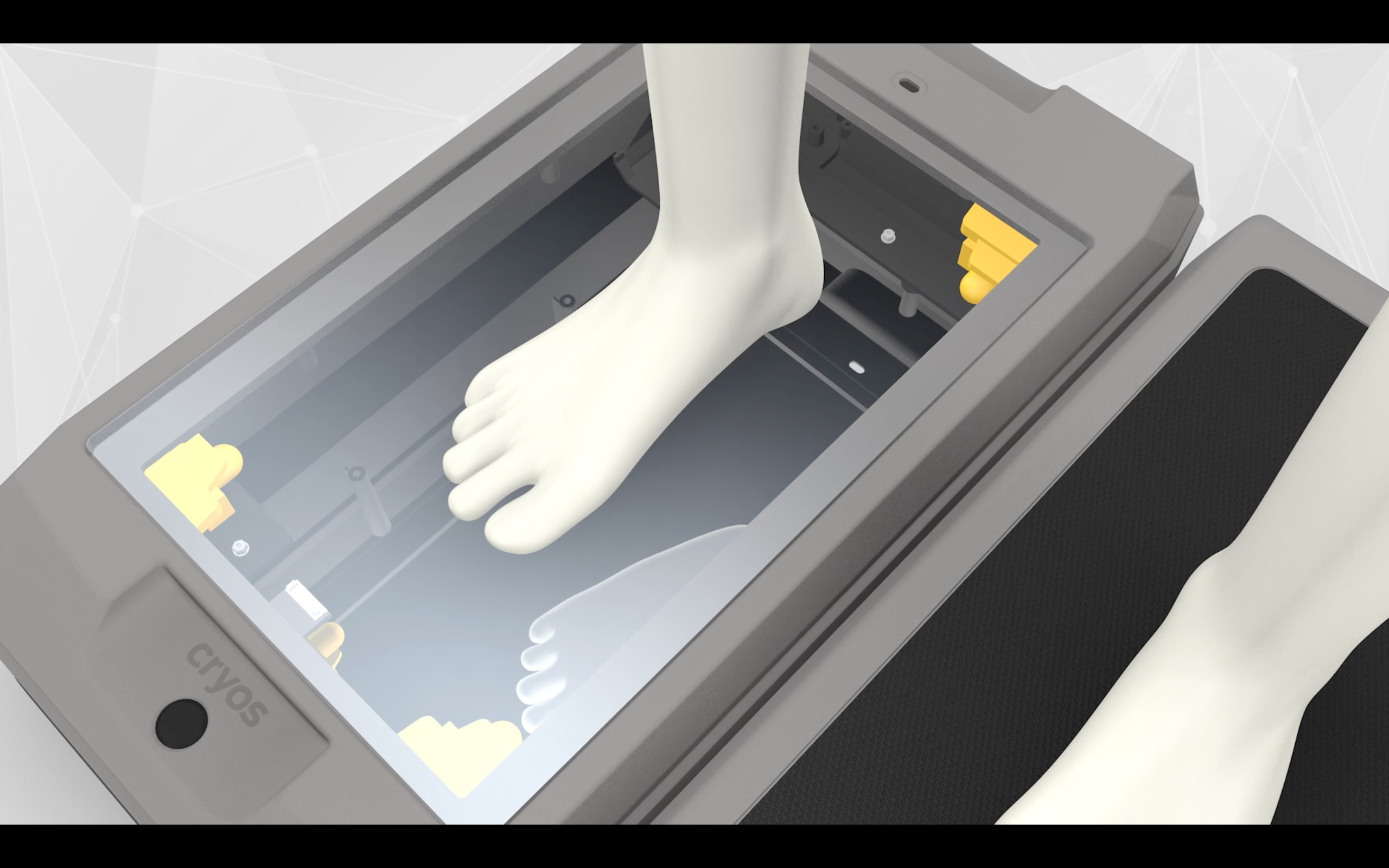
The CryoScan3D is the first custom enterprise solution to be developed with Fuel3D’s technology. The scanner, which made its debut at the FIP World Congress of Podiatry in Montreal last week, is capable of capturing full-color, high-resolution models of the foot in various positions, partially and fully weight-bearing, with just a few clicks:
“Gone are the days of plaster moulds and geographic limitations in our industry – digital imaging allows the podiatry and orthotics business to be scaled up to new levels,” said John Stimpson, President of Cryos Technologies. “We wanted to address some of the key challenges in 3D foot-scanning and Fuel3D’s scanning platform provided us with a high-quality, cost-effective way to do that. We have worked very effectively with the Fuel3D development team to build the CryoScan3D, and are looking forward to transforming the podiatry sector with this great product.”
 Cryos’ dynamic orthotic insoles are made from a strong, flexible polymer that works with the foot while in motion, stabilizing it without affecting mobility. Standard-sized insoles bought at the drugstore may be fine if you’re only looking for a bit of padding and shock absorption, but for more serious or chronic foot, back or posture issues, custom-fitting orthotics are important. 3D printing and 3D scanning have proven to be tremendously useful in the development of custom insoles, with companies like iMcustom and Wiiv Wearables offering their own 3D printed orthotic solutions. The market for orthotic insoles is a fast-growing one; a recent study from market research firm IndustryARC predicted that the global market will reach $3.5 billion by 2020.
In such a booming market, it’s important to stay competitive, and Cryos’ system looks to have a lot of advantages beyond just accurate imaging. One of Fuel3D’s claims to fame is the speed of their scanners, which can capture high resolution 3D images in 0.1 second, so a client can be in and out of the podiatrists’ office in a snap. CryoScan3D is also portable, so it can be easily transported between offices, shoe stores, etc.

“We’re delighted to be working with a technology innovator like Cryos Technologies, which demonstrates the efficiency and competitive advantage that can be achieved at the point of sale to revolutionize traditional techniques,” said Stuart Mead, CEO of Fuel3D. “We are focused on delivering scalable hardware and software solutions by working with technology specialists across a broad range of sectors. This is the first of many enterprise engagements for us, and we are looking forward to sharing the news about our work on other projects in the near future.”
We look forward to hearing about their upcoming projects, as well. Discuss further in the CryoScan 3D Foot Scanner forum over at 3DPB.com.
Subscribe to Our Email Newsletter
Stay up-to-date on all the latest news from the 3D printing industry and receive information and offers from third party vendors.
Print Services
Upload your 3D Models and get them printed quickly and efficiently.











You May Also Like
Flashforge Bets on Meshy AI as Desktop 3D Printing Battle Intensifies
Competition in desktop 3D printing is brutal. Whereas before, firms competed through value engineering, Prusa clones now have an integrated hardware, sensor, and software setup that is making all the...
Asia AM Watch: Advantages to the Chinese Way of Doing Business
Timo Göbel, the Head of Additive Manufacturing at the BMW Group, spoke at the AM Forum in Berlin about industrializing additive. He had wise words to share, including that we...
3DPOD 300: Celebrating 300 Episodes with a Look at the Next Year in 3D Printing
In the 300th episode of the 3DPOD, we take a look at what we think will happen over the next 12 months; for instance, what will happen with Bambu’s dominance,...
3D Printing Financials: 3D Systems Returns to Growth in Q1 2026
3D Systems (NYSE: DDD) reported one of its strongest quarters in recent years, showing signs that the company may finally be moving past the tough slowdown that has weighed on...