Wessex Archaeology 3D Scans and Prints Two Shipwrecks from Underwater Archaeological Sites in UK

 There’s no denying that the value of 3D printing has grown immensely throughout a wide range of industries over time, but one field I personally feel isn’t alluded to enough for its constant use of 3D technology is archaeology. The combination of 3D scanning and 3D printing have enabled archaeologists to restore vital parts of our fragile history, whether it’s a 3D reconstruction of ancient Rome or the world’s oldest ham and peanut. By implementing this emerging technology into the field of archaeology, researchers have been able to preserve extinct animals in the form of 3D printed models, and have even recreated Syria’s Temple of Bel, which was recently destroyed by the heinous terrorist group ISIS.
Now, in a new project headed by UK-based Wessex Archaeology, one research team has surveyed and recreated two historic shipwrecks above ground, becoming one of the first-ever underwater archaeological sites to be replicated with 3D printing. After investigating and scanning the wreck sites themselves, Wessex Archaeology collaborated with 3D printing firms based in Scotland and England. The team used different scanning techniques for each wreckage, and were sure to implement historically accurate colors and features into both of the 3D printed replicas.
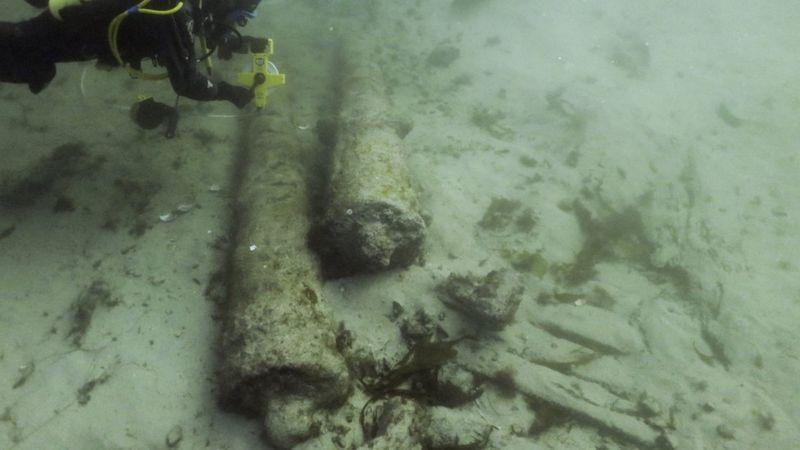
Diver surveys two cannon at the Drumbeg wreck site
The first 3D printed replica was a full-colored model of a shipwreck near Drumbeg, Sutherland, thought to date somewhere around the late 17th or early 18th century. This particular wreck lies about 40 feet beneath the Eddrachillis Bay, and is comprised of three cannons, two anchors, and a partial hull on or below the seabed. Though they have not yet confirmed the identity of this wreck, Wessex Archaeology believes it could be the historic Dutch trading vessel, the Crowned Raven, which was lost around the bay during passage to Portugal sometime during the winter of 1690 or 1691. For this particular wreck, the archaeologists utilized photogrammetry, which allowed them to capture a 3D model of the wreckage with its color and texture still intact.
The other ship being replicated by Wessex Archaeology is the HMHS Anglia, a World War I hospital ship that was lost off Folkestone in Kent in 1915 after striking a mine. For the WWI shipwreck, which measures out to about 100m (328ft) long, Wessex Archaeology used a sonar technique called multibeam to map the HMHS Anglia remains. The multibeam system works by emitting sound waves in a fan shape beneath a ship’s hull; the time it takes for these sound waves to bounce off the seabed and return to a receiver is used to determine depth. In order to properly color the model, researchers used historical information, which included an illustration of the ship in the midst of sinking.
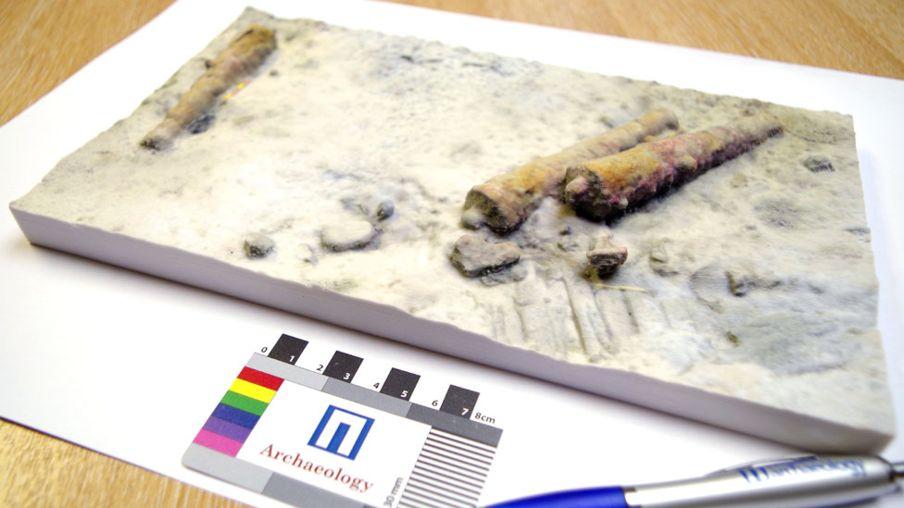
3D model of two cannons at the site of shipwreck in Sutherland
“It’s been a fascinating process to transform the light captured in the photographs and the sound captured by the sonar sensors back into solid objects through the 3D printing process,” said John McCarthy, an archaeologist who undertook the 3D modeling of the wreckage sites. “We are very excited about the potential for this technology to help us to show the wider community what it’s like to visit the site without having to learn to dive or even get your feet wet.”
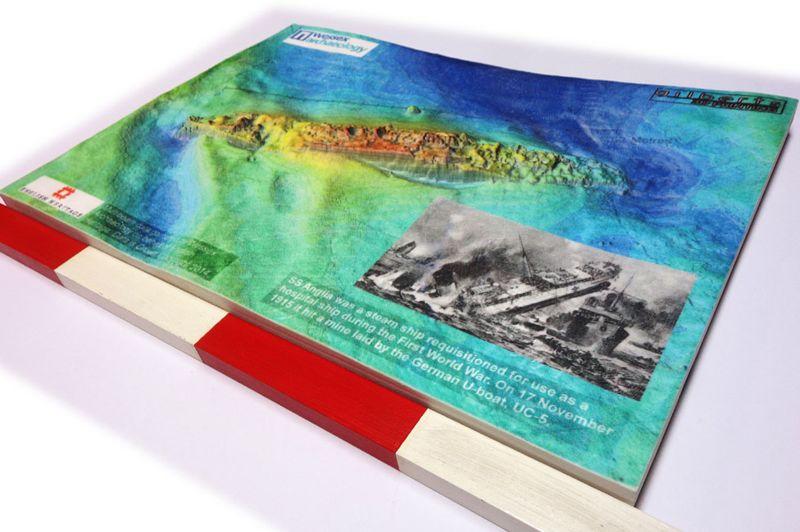
3D print of the HMHS Anglia hospital ship
The Wessex Archaeology team hopes to continue surveying and replicating historical sites like these two shipwrecks, looking to fill local and national museums up with more educational and accurate 3D printed models. Now, those eager to learn about historic shipwrecks have true access to a hands-on experience, allowing them to see a part of history without ever having to dip their toes into the water. Discuss your thoughts on this project in the 3D Printed Shipwreck forum over at 3DPB.com.
[Source: BBC / Images: Wessex Archaeology]Subscribe to Our Email Newsletter
Stay up-to-date on all the latest news from the 3D printing industry and receive information and offers from third party vendors.
Print Services
Upload your 3D Models and get them printed quickly and efficiently.











You May Also Like
American Rheinmetall Orders $300K in 3D Printed Titanium Prototypes for U.S. Army Systems From IperionX
As I’ve noted more than once in recent months, 2025 was the year for critical minerals, and the U.S. additive manufacturing (AM) industry made the most of that. IperionX, the...
EOS Invests $3M In Its Texas Manufacturing & Logistics Facilities to Serve North American Customers
The trajectory of reshoring under President Trump has been largely a mixed bag so far. While tariffs still seem to be doing more harm than good to the U.S. domestic...
Subaru’s Adoption of T25 High Speed Head Reinforces Stratasys’ Dominance in 3D Printed Automotive Tooling
Last September, AM Research published a white paper sponsored by Stratasys on the role of additive manufacturing (AM) in enabling point-of-need tooling production across various industries. The white paper, “3D...
ASTM International Works with UK MoD on America Makes Project
The UK Ministry of Defense (MoD) will work with ASTM International on a $1.1 million project to let it work in closer concert with the US Department of War (DoW)....