3D Printed Knees Implanted Into Humans and Cats, 3-4 Million Estimated Annual Human Implants by 2030


If you’ve ever bought a wedding dress, or know someone who has, you learn quickly that it is difficult to purchase something that fits perfectly right off the rack. Instead, a series of alterations are generally required in order to match body to garment. Now, imagine you were buying new knees and were required to be satisfied with what was available “off the rack.” This is the situation in which people have found themselves in the past. While replacement knees do come in different sizes, just as with the wedding dress, there is a difference between a general size category and a perfect fit.
Over the last decade nearly twice as many Americans are undergoing total knee replacement surgery as in the previous decade. In addition, many people are having knee replacement surgery at a younger age than ever before. This has led to an increasing interest in creating a better alternative. Given the successes of 3D printing in areas such as hip replacement, it did not take long for knees to reap those same benefits.
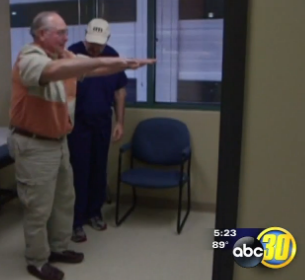
Don Plum had a double 3d printed knee replacement. Image: abc30
The 3D printed knees have many advantages over the traditional replacements. Dr. Buch, an orthopedic surgeon at the Dallas Limb Restoration Center, describes the primary benefit of such customized knees:
“It matches their anatomy and the bone you are taking off is much less than it would have been with the standard knee replacement.”
In addition, 3D printed knee replacements require on average a shorter hospital stay, lead to a quicker recovery time, give the patient less pain, and provide a greater range of movement post surgery. This is a great improvement over the knee replacement options developed by the pioneers of the replacement surgery in the 1950s. 3D printed knee replacements have been available in the United States for several years and are becoming more commonplace, especially as insurance companies expand their coverage to include the 3-D printed joints.
One example is a recent surgery underwent by a retired pipe fitter, named Don Plum, who could barely stand on his own because of two bad knees. Plum had CAT scans done on both knees, before a 3D model of custom fit replacements were fabricated. He then had a double knee replacement surgery. Plum has since made a full recovery and according to him can do “anything he wants.”
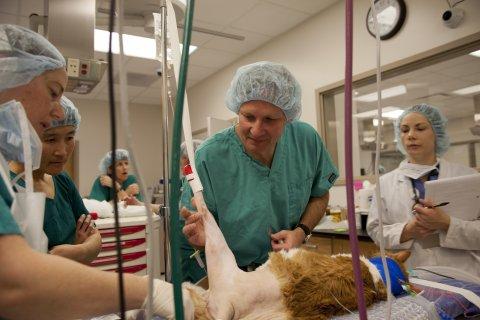
A Feline 3D printed knee replacement. Image: Materialise.com
3D printed joints are being used to replace damaged ones in patients of all sizes, including cats. A kitty named Cyrano was the first cat to receive this high-tech treatment when his left hind leg was saved from amputation because of a 3-D printed knee joint utilized by surgeons at North Carolina State University in conjunction with Materialise’s Mimics Innovation Suite.
It is the absolute customization made easily available through 3-D printing that will make knee replacement surgery equally beneficial to all, no matter whether in man or in mouse. Projections estimate that by the year 2030, there will be 3-4 million 3D printed knee replacement surgeries performed in the United States each year alone.
Subscribe to Our Email Newsletter
Stay up-to-date on all the latest news from the 3D printing industry and receive information and offers from third party vendors.
Print Services
Upload your 3D Models and get them printed quickly and efficiently.













You May Also Like
Stratasys Wins $27.6M in Patent Case Against Bambu Lab; Bambu Challenges Verdict
Update, September 21, 2026: This article has been updated with a statement from Bambu Lab responding to the verdict, along with additional information about the company’s ongoing patent challenges against...
3D Printing News Briefs, September 12, 2026: Rebranding, Cybersecurity, Project Call, & More
We’ve got a lot of business news from ATLIX to start off this weekend’s 3D Printing News Briefs, with a new identify for its additive manufacturing (AM) portfolio and some...
Formnext Asia Shenzhen 2026: China Has Built the AM Stack. What Comes Next?
In Hall 15 at Formnext Asia Shenzhen 2026, consumer 3D printing was everywhere, from toys, figurines, and character models to thousand-machine production farms. Green-laser companies displayed copper cold plates for...
Bambu Lab 3D Printers Bring a 166-Million-Year-Old Dinosaur Back to Life
Fourteen desktop 3D printers spent seven weeks producing the bones of a dinosaur that lived roughly 166 million years ago. The result is now on display at Blenheim Palace in...