3D Printed Microscope Chamber Cuts Cost by 50x

 In the complex world of optical microscopy, the quest is to constantly improve access to samples, because this will yield more information and conclusive scientific results. One way to improve optical access to samples is through the technique of oil immersion, where a sample and the microscope lens are both immersed in transparent oil with a high refractive index. While this technique seems to yield excellent results, there’s one problem: the prohibitive cost of a microscope chamber that holds down the glass coverslip and contains the oil at the same time. To address this cost, the University of New South Wales (UNSW), which uses one of these microscopes in their lab, went ahead and had one 3D printed — cutting costs to a whopping 1/50th the price!
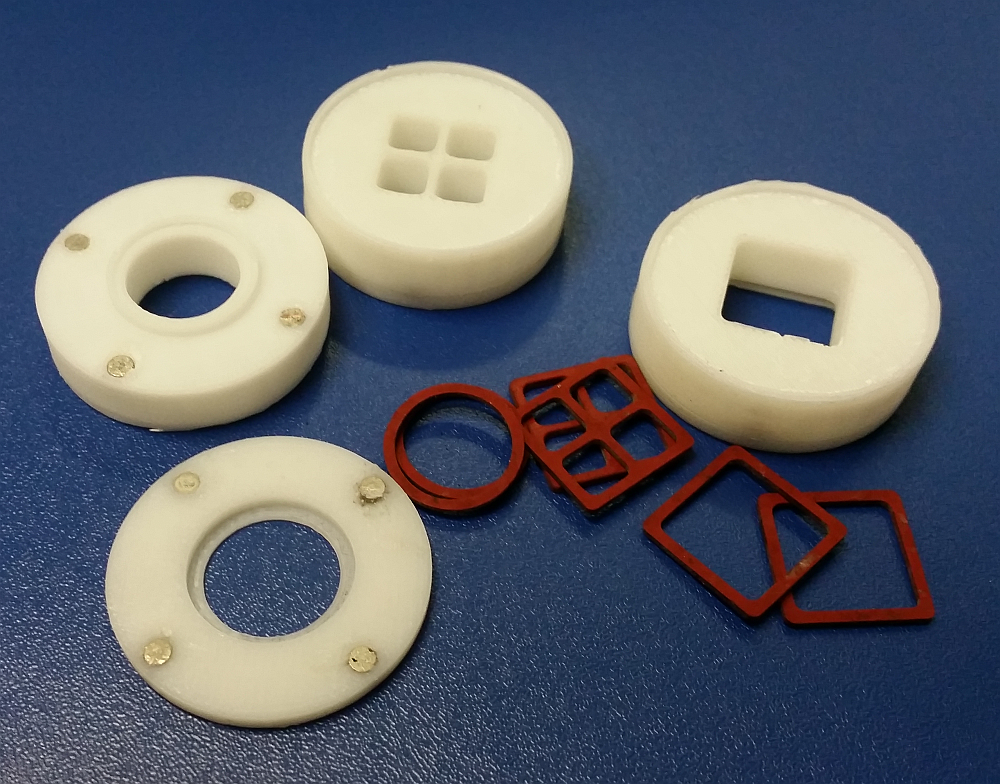
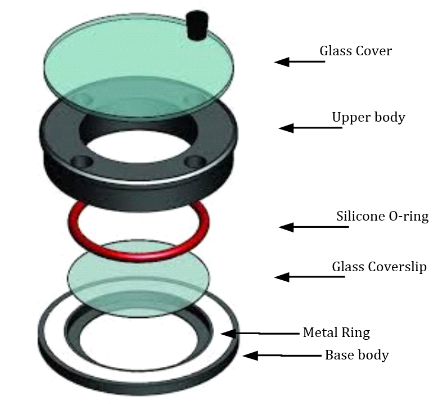 According to the 19th century optical scientist Ernst Abbe, a true miscroscopic image is produced only when a lens is large enough to transmit the object’s entire diffraction pattern. This is generally referred to as “Abbe’s Theory.” Submerging the object and lens in oil is one way to ensure the full refraction of an object, and this is why a coverslip with a thickness of 0.15mm-0.20mm is desirable. But what’s not desirable is the price of the chambers. This is why a 3D printed model, comparable to the LCI Chamlide chamber, which uses a patented magnetic system, was designed by Ben Goodnow of EMBL Australia Node for UNSW’s Single Molecule Science initiative.
A recent Hackaday post tells us more about this project — which uses ABS plastic, a laser cutter producing silicone gaskets, and rare earth magnets to keep the entire ensemble together — and provides access to the files in case you are interested in 3D printing your own microscope chamber. A detailed document titled “Accessible and Low Cost Design and Manufacturing of ‘Chamlide’ Observation Chambers for Molecular Imaging” describes the chamber design and printing process for the first prototype:
“The flexibility of CAD software and 3D printed prototypes allowed for an efficient iterative process. All CAD design was completed in SolidWorks 2014…and the manufacturing of the body used a mid-range UP Plus 2 desktop 3D printer…This printer utilized 1.75mm ABS filament, a high-temperature-resistant and durable plastic, suitable for the range substances the chamber may require, and suitable for use in an autoclave.”
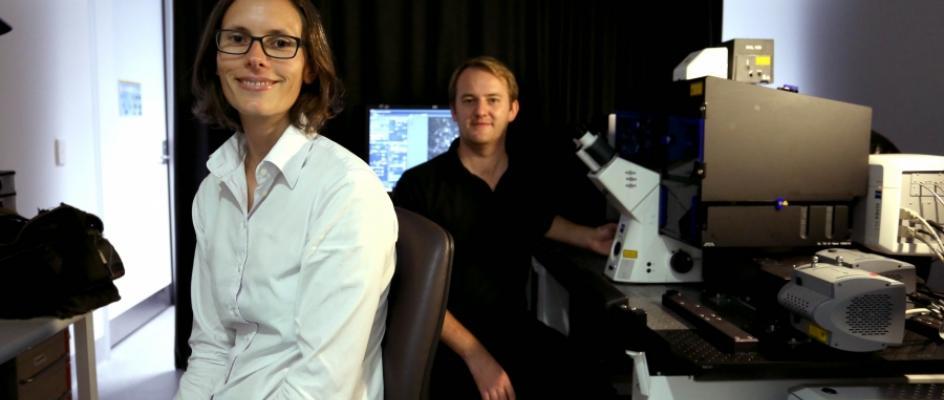
In the second prototype, the one that proved to be the final product, the major design change was the magnets that were used. Goodnow’s paper concludes that 3D printing and laser cutting proved to be “key advantages in the chamber’s design” because lab workers will be able to custom order chambers for their own needs, without the exorbitant expense of both money and time. Goodnow also suggests that the 3D printed chamber “far surpasses the less flexible and high cost Chamlide,” while maintaining imaging quality.
You can check out the below video for a quick crash course on using the oil immersion technique for microscopes. Then consider a custom 3D printed chamber to enhance your imaging quality for all of your scientific research needs. What are your thoughts on this invention? Discuss in the 3D Printed Microscope Chamber forum over at 3DPB.com.
Subscribe to Our Email Newsletter
Stay up-to-date on all the latest news from the 3D printing industry and receive information and offers from third party vendors.
Print Services
Upload your 3D Models and get them printed quickly and efficiently.











You May Also Like
At RAPID + TCT 2026, Executive Keynotes Break Down What’s Next for AM
While AI is expected to be a major focus at RAPID + TCT 2026, the event is also putting the spotlight on something just as important: leadership. This year’s Executive...
3D Printing Moves Deeper Into Production as Parts Near $110B by 2034
A new report takes a closer look at how much 3D printing is actually being used in real production. The numbers point to a market that is already growing at...
3D Printing Financials: Healthcare and Aerospace Drive Growth at 3D Systems
3D Systems (NYSE: DDD) closed out 2025 with stronger performance in the final quarter, helped by growing demand for 3D printing in healthcare, dental, and aerospace applications. The company said...
AM Applications Expected to Reach $110B in 2034, New Report Finds
Additive manufacturing may still be a relatively young industry, but the number of real parts being produced with 3D printing is growing quickly. According to a new report from Additive...