3D Printed Robotic Lawnmower is Like a Roomba for Your Lawn


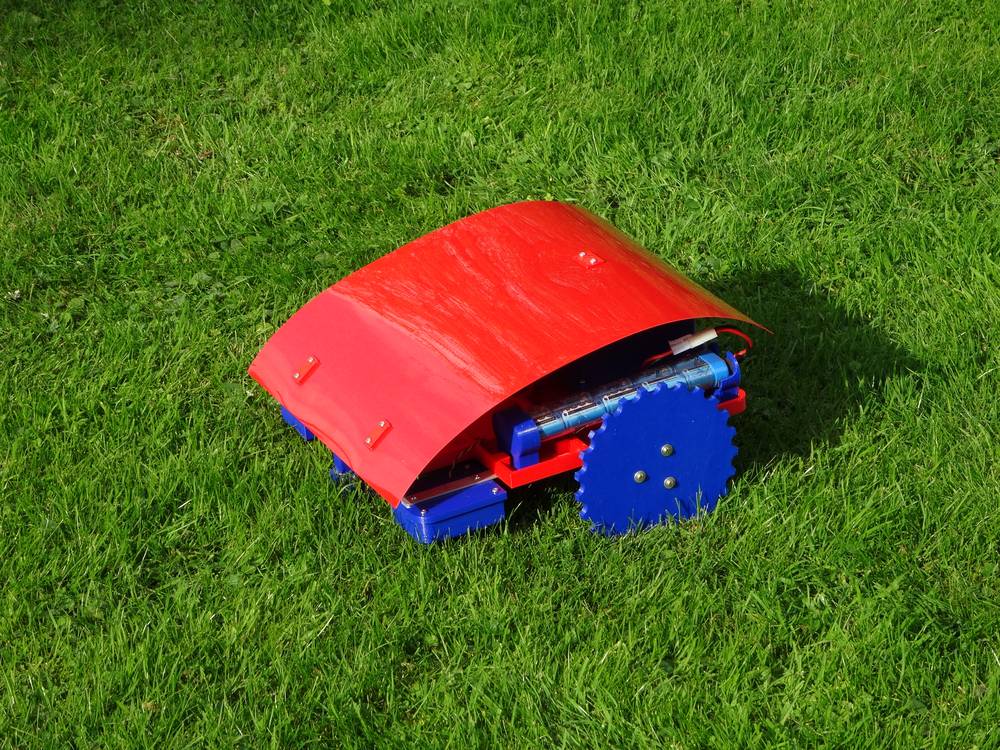 If you’ve ever mowed a lawn, you’re probably familiar with the frustrations that come with lawnmowers. They won’t start, they keep stalling, they somehow get jammed, and when they finally break down altogether, it’s expensive to go out and buy a new one. It’s enough to make you want to give up and just buy a bunch of goats. Or there’s another option: build your own lawnmower. Simple, right? Actually, yes.
Andreas Haeuser has impressed with his 3D printed inventions, which include a wind turbine and solar powered Stirling engine, before. The German engineer’s latest design, the Ardumower, is an automated, robotic lawn mower that zips around the yard and cuts grass by itself, sort of like a Roomba for the lawn. It’s compact, sturdy, and looks to be remarkably effective. All you need to build your own is a 3D printer, some basic electronics, and Haeuser’s detailed instruction manual, which can be downloaded from his website, along with the necessary STL files, for $12.95.
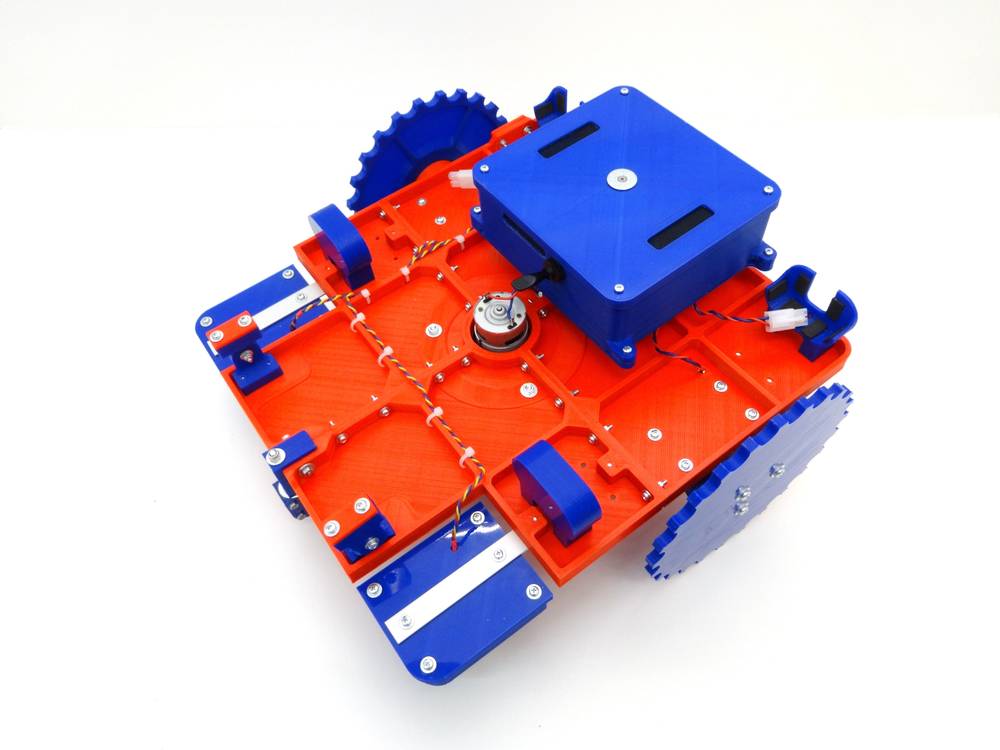 The Ardumower, as its name suggests, is controlled by an Arduino Motorboard and Arduino Uno, which is considered to be one of the easiest microcontroller boards to program and thus ideal for beginners (although it’s well-loved by experienced coders as well). Haeuser emphasizes that he designed the Ardumower to be easy enough for beginners to build, and his construction manual carefully describes and illustrates each step involved in building and programming the electronics.
The mower operates within a boundary wire fence (BWF), which is essentially the same as the invisible fences used to keep dogs in their owners’ yards. It’s driven by two 12V geared motors, which can be powered either by a rechargeable 12V NiMH or 11.1V LiPo battery. It can run for about an hour and a half to two hours before needing to be charged, which, according to Haeuser, should be enough for a typical 500m² lawn. The mower’s height can be adjusted based on the height of the grass, as can the power of the motor.
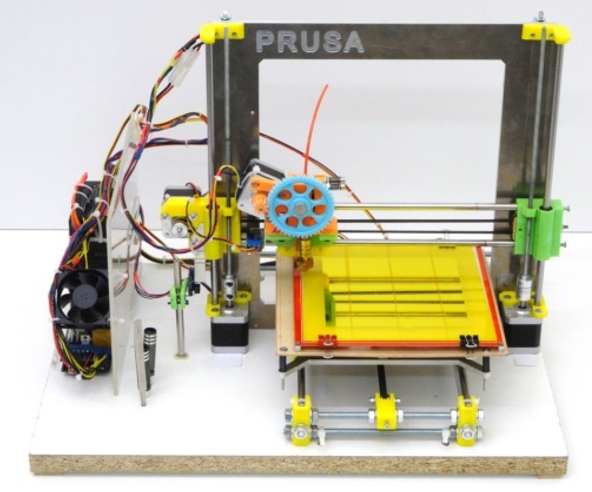 Haueser prints all of his projects on a MendelMax 1.5 and a Prusa i3.
“These are cheap kit-printers of the first generation,” he says. “This ensures that everyone can replicate my projects.”
Of course, any 3D printer will do, as long as it has a build volume of at least 180 x 180 x 60 mm. The Ardumower consists of 46 separate 3D printed parts, which can then be easily assembled with help from the manual. About 1500 grams of PLA and ABS filament are required, or about a typical roll and a half – not a bad amount at all, really, when you consider what you’re building.
Haeuser, an aeronautical engineer with over 25 years of experience working in the German aerospace industry, has devoted his talents in recent years to designing inexpensive, 3D printable machines that would, under other circumstances, be unaffordable for the average person. As he points out, a typical commercial robotic mower will run you about €600 to €800. He clearly has a particular interest in green technology, too, based on his previous inventions – his 3D printed wind turbine is a fully functional piece of equipment for generating electricity, and his Stirling engine has a lot of potential for purely solar-powered equipment operation. As for the Ardumower, it emits no harmful fumes and won’t stink up your yard with that irritating gasoline smell.

On a purely aesthethic level, the Ardumower is kind of ridiculously adorable, as well, especially when printed in bright colors. Watch it chug along below. Would you have a use for this device? Discuss in the 3D Printed Lawn Mower forum over at 3DPB.com.
Subscribe to Our Email Newsletter
Stay up-to-date on all the latest news from the 3D printing industry and receive information and offers from third party vendors.
Print Services
Upload your 3D Models and get them printed quickly and efficiently.













You May Also Like
3D Printing News Briefs, June 6, 2026: Expansions, New 3D Printers, & More
We’re starting with business in this weekend’s 3D Printing News Briefs. Axtra3D just opened its expanded facility in Italy, and Austal USA expanded its leadership team. Then we’ll move on...
3Dnatives to Present ADDITIV Metals 2026: Resolving Key Barriers to Scaling Metal Additive Manufacturing
As the metal additive manufacturing sector prepares for a massive leap—with market valuations expected to climb from $6.02 billion to $7.02 billion this year—the industry is shifting its focus from...
3D Printing News Briefs, May 28, 2026: Continuous Fiber Reinforcement, Bioprinted Trachea, & More
In today’s 3D Printing News Briefs, America Makes announced the winners of its JAQS-SQ Project Call. Axtra3D is partnering with Keystone Industries to expand its dental material ecosystem, while BigRep...
DoW Accelerates Drone Readiness with AMTrain Phase 2 Launch at Camp Lejeune
Equipping today’s warfighter with the most advanced technology is paramount, driving increased prioritization and investment in drone development and advanced manufacturing training within the Department of War (DoW). In this...