
Verbatim Enters 3D Printer Filament Market

It’s often a sign that a market is expanding rapidly when you begin finding large companies, known for products outside a space, bringing to market brand new products within that space. We saw it happen when Apple  entered the smartphone market, when Microsoft entered the video game console market, and when more recently, Autodesk announced that they will be producing a new SLA based 3D printer, called Spark, along with a 3D printing platform known by the same name.
As we probably mention almost on a daily basis, the materials market within the 3D printing industry is beginning to expand in a dramatic way, with billions of dollars to be made over the next several years. One company, traditionally known for their data storage devices such as hard drives, Blu-rays, USB drives, and other forms of computer memory, Verbatim, has announced this week that they will enter the 3D printer filament market.
The company which was founded 45 years ago, and was influential in the development of optical media recording and the CD/DVD family of products, will begin offering a variety of filament products beginning next month in Europe.
“The 3D printing industry is currently undergoing a massive transformation and enjoying unprecedented growth that is estimated to reach a value of $669 million (EUR500 million) in 2014, according to Gartner,” stated the company. “Now, new and more technologically advanced 3D printers are increasingly being introduced that target use in homes, schools and universities, and key business and industrial applications.”
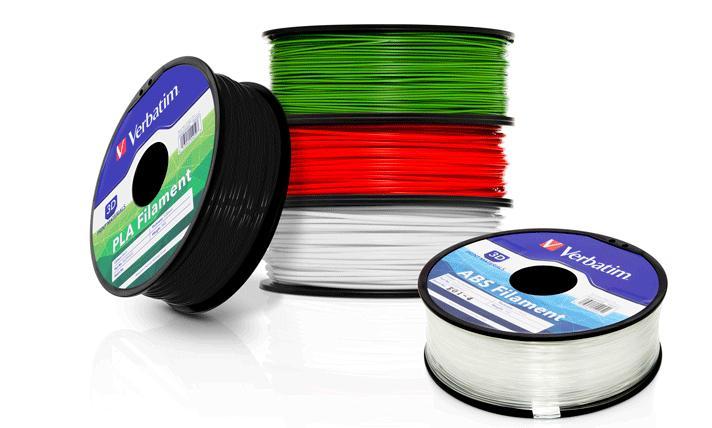
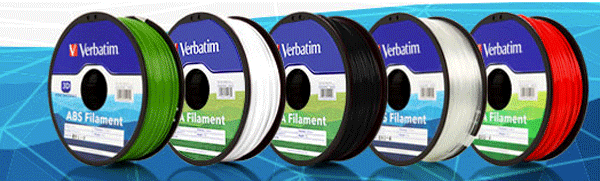
The Verbatim branded filament will include both ABS and PLA thermoplastics, both of which will come in 1.75mm and 3mm sizes. Multiple colors will be available, and the filament will come in 1kg spools. According to the company, the filament is produced with the highest quality materials, and will be distributed in bags which have been vacuum sealed.
 It is interesting to note, that Verbatim’s parent company, Mitsubishi Chemical, announced last month that they are working on specialized 3D printer filaments which combine the best attributes of both PLA and ABS plastics. The filament, which they call Durabio is a bio-based plastic resin which can be used within 3D printers as well as other manufacturing applications.
Although Verbatin hasn’t commented on who their Japanese manufacturing partner is for this project, it could be guessed with relatively high confidence, that Mitsubishi Chemical are the ones manufacturing these new filaments.
Let’s hear your thoughts on the news of Verbatim entering the material side of the 3D printing market, in the Verbatim filament forum thread on 3DPB.com.
Subscribe to Our Email Newsletter
Stay up-to-date on all the latest news from the 3D printing industry and receive information and offers from third party vendors.
Print Services
Upload your 3D Models and get them printed quickly and efficiently.













You May Also Like
AMAsia Pulse: AM Investment Picks Up Across Asia-Pacific
The first half of September brought fresh investment and expansion activity across Asia-Pacific’s additive manufacturing sector. China’s Xinjinghe secured funding for an aerospace AM hub, South Korea’s Lincsolution outlined plans...
3D Printing News Briefs, August 26, 2026: Meshy 7, 4D Printed Implants, & More
We’re kicking things off today with software news, as the new Meshy 7 is now live. Then we’ll move on to business, with ExOne and voxeljet now operating as a...
AMPulse Asia: India’s Orbital Launch Headlines a Busy Second Half of July
The second half of July brought major developments across Asia’s additive manufacturing sector. Highlights included India’s first private orbital launch powered by 3D printed engines, a billion-yuan ownership change at...
3D Printing News Briefs, July 9, 2026: RIMPAC 2026, Software, Housing, & More
In today’s 3D Printing News Briefs, Massivit continues its focus on aerospace and defense manufacturing, and Meltio is collaborating with Phillips Corporation for RIMPAC 2026. Moving on to software, AMIS...
























































