Lenovo ThinkPad X1 at CES 2016: Modular Design Allows for 3D Scanning

 Just as numerous manufacturers are quickly lending the all-in-one convenience to 3D printers, allowing users to bring design concepts to fruition with that highly desired one click of a button, other companies are integrating 3D concepts into other hardware as an attractive and additional twist. And while CES 2016 Las Vegas surely will blow our minds with a long list of electronic goodies this week, things are heating up from the start as companies like Lenovo begin to preview traditional devices–but with some surprises.
Preparing to delight users with new features and functions that allow for greater productivity as well as fun and innovation, Lenovo will be releasing the ThinkPad X1, powered by Intel’s latest Core m7 chipset. While many will be excited straightaway about minor features that offer enormous help such as the kickstand (and keyboard), propping up the 12-inch tablet fairly easily, the real news here is that the small ThinkPad X1 offers a modular design allowing for big functionality.
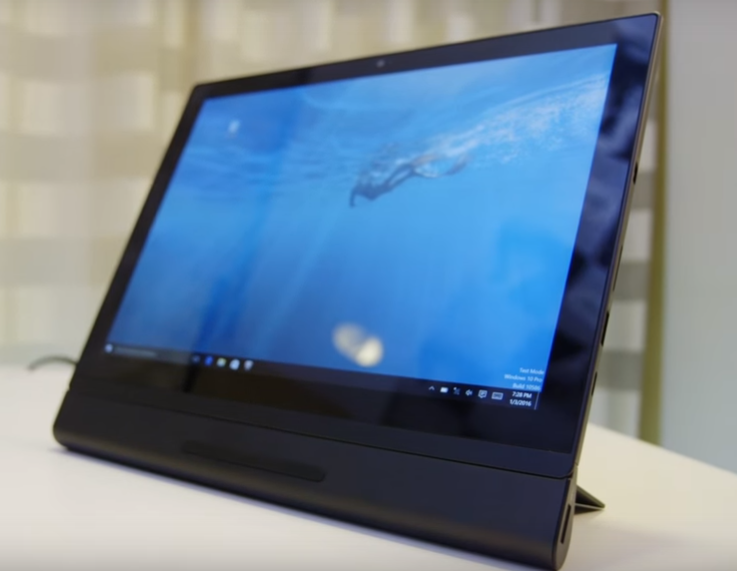 Depending on your project needs, you can basically make the ThinkPad X1 into a laptop, projector, or most exciting, of course–a 3D camera. In the form of long, slim, packs, each module can be attached firmly to the tablet, transforming its use substantially. The modules are not said to be exactly easy to put on and take off, but they do seem to snap in firmly, offering stability once attached. (They may require enough effort that a user does not find themselves wanting to switch modules often.) The modules themselves actually add a bit more form to the shape of the tablet as well, making it easier to hold the device weighing in at two to two and a half pounds, depending on whether or not you are using the keyboard.
The productivity module alone adds on five extra hours to the standard ten hours of battery power running this compact tablet, only 8.4mm thick.
The presenter module allows for the projection of a 60-inch display, which is quite an impressive feat and should be extremely useful for work projects as well as recreational in allowing users to screen movies on the wall or a surface.
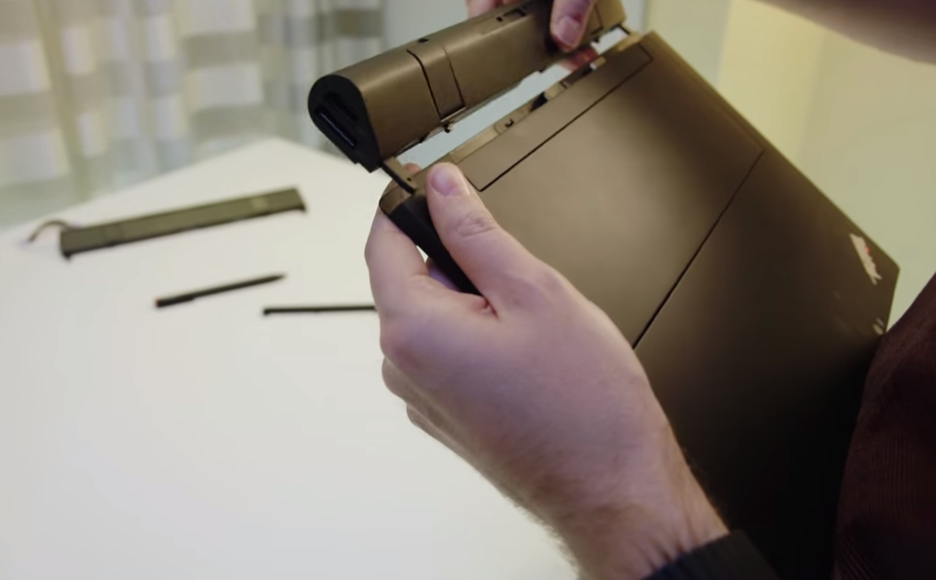 Using Intel’s RealSense technology, the last module allows for a 3D camera module to be attached for capturing, editing, and 3D printing files. While we’ve followed numerous companies allowing for this technology on more traditional hardware like PCs, the tablet arena is uncharted territory for the most part. The module attaches to the bottom of this device, rather than the top, and while not allowing it to double as a webcam, it should allow for incredible versatility in one slim hybrid machine to be sold for $899.
The modules will be available and priced separately. The 3D camera module, as well as the additional battery and ports, will retail at $149, while the projector commands a heftier pricetag of $279. The ThinkPad X1 should be available in February along with the Productivity Module. The Projector Module and 3D Imaging Module will be available in May. Will you be attending CES? Let us know in the ThinkPad X1 3D Scanning forum thread on 3DPB.com.
[Source: The Verge]Subscribe to Our Email Newsletter
Stay up-to-date on all the latest news from the 3D printing industry and receive information and offers from third party vendors.
Print Services
Upload your 3D Models and get them printed quickly and efficiently.











You May Also Like
Printing Money Episode 36: Recent 3DP/AM Deals and More with John Barnes (TBGA & MPW)
Welcome to Printing Money Episode 36! For this episode Danny is joined by a new guest, John Barnes (Founder and President, The Barnes Global Advisors, Founder and CEO, Metal Powder...
Friendshoring and Additive Manufacturing: Turning Australia’s Research Strength into Commercial Impact
Global supply chains are being re-written. After decades of globalisation driven primarily by cost efficiency, geopolitical tensions, trade disputes and pandemic-era disruptions have exposed the risks of concentrating manufacturing and...
Velo3D’s $32.6M Defense Contract Highlights Why U.S.-Made 3D Printing Is Suddenly Critical
When the U.S. government talks about supply chain security, it’s no longer theoretical. It’s now written directly into law and into defense contracts. That detail matters for Velo3D, which this...
Northrop Grumman & Titomic Achieve Successful Hot Fire Test with 3D Printed Thrust Chamber
Back in April, leading Australian cold spray additive manufacturing (CSAM) original equipment manufacturer (OEM) Titomic announced that the company was partnering with defense giant Northrop Grumman to test the use...