Man 3D Prints a Working DC Motor

 The question used to be, “What can you print with a 3D printer?”. The open source initiative in the 3D printing space has brought forth literally hundreds of thousands of unique and innovative designs. Websites such as Shapeways, Thingiverse, and Threeding, have contributed to a vast collection of 3D printable designs. These sites allow designers to take a design, improve upon it, and then make it available for the next person to come along and do the same thing. This is how the open source revolution that we have seen with 3D printing has led to the development of so many truly amazing design ideas.
The question now being asked is one of, “What can’t you print with a 3D printer?”. We have seen guns, prosthetic arms, and elaborate mechanical clocks. Now, a working DC motor can be added to that list. Thanks to a man on Instructables, anyone can now print out a working motor. While, the motor is 3D printed, as you can see in the video below, it does include several non-3D-printed parts, which are inserted mid-print into the design.
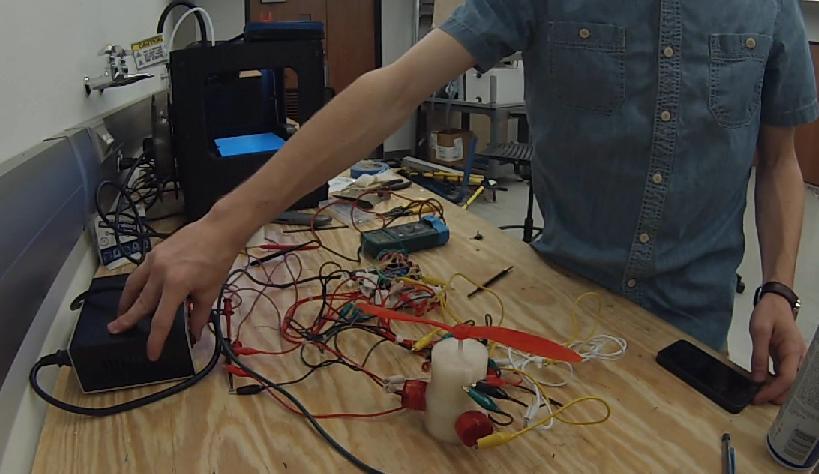
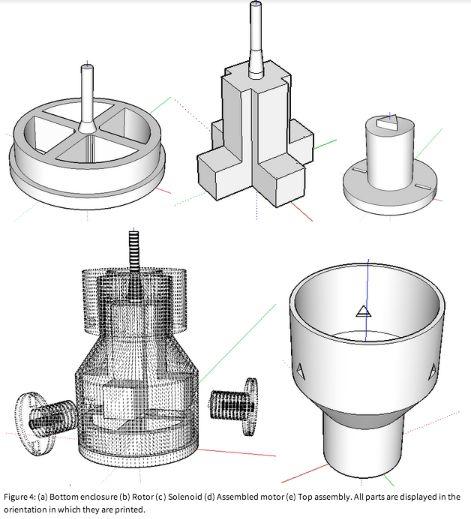
“I designed and 3D printed a Brushless Direct Current (BLDC) motor, and used an Arduino to control the motor,” explained Instructables user, Pitrack. “All parts of the motor, excluding magnets, solenoid wrapping wire, and hall effect sensors, were printed with a Makerbot Replicator 2.”
“The magnets and hall effect sensors were inserted into assembly by designing a correctly sized internal void in the appropriate place, printing to just below the top of the void, pausing the print and inserting the device, and then continuing the print,” explained Pitrack.
Once done printing, the pieces should fit together nicely. The complete instructions on creating this motor can be found on Instructables, and the program written for Arduino, which is used to control the computation sequence can be found on github.
This goes to show that almost anything is possible to print on a 3D printer if you put your mind to it, and take the time to think over the process. Off course some design ability and general engineering experience is helpful. What do you think? Have you tried to 3D print this yourself? Let us know how it turned out in the 3D Printed DC Motor forum thread on 3DPB.com.
Subscribe to Our Email Newsletter
Stay up-to-date on all the latest news from the 3D printing industry and receive information and offers from third party vendors.
Print Services
Upload your 3D Models and get them printed quickly and efficiently.











You May Also Like
3D Printing News Briefs, April 11, 2026: Energy Targets, DoW Contracts, Nike Air Max, & More
We’re starting with 3D printing for energy applications in this weekend’s 3D Printing News Briefs, and then moving on to military and defense 3D printing. Finally, Nike Sportswear is focusing...
BLT & Tianqiong Partners Flex on West with Consortium-Enabled, 3D Printed Upgrade for OPPO Find N6 Hinge
Due to a combination of historical, ideological, and economic reasons, companies originating in East and Southeast Asian nations have proven far more adept than their Western counterparts at leveraging organization...
Divergent & GA-ASI: How Connecting at AMUG Led to an Important Industry Partnership
As I mentioned in my AMUG 2026 overview, I had a lot of delays traveling to Reno, Nevada to attend the conference. So unfortunately, I missed “From Hypercars to Defense...
3D Printing News Briefs, April 2, 2026: Reseller, Submarine Parts, & More
We’re starting off today’s 3D Printing News Briefs with business from Materialise and RapidFit, and Axtra3D and MULTISTATION. Then we’ll move on to a contract for submarine components, and end...