Western Australia: Researchers Use 3D Printing to Make Headway with Cranial Reconstruction

 While the excitement of all we can do with the 3D printer from the desktop is enough to make a hobbyist giddy, with the sky seeming to be the limit for incredible creation and innovation in everything from jewelry to hobby cars–imagine how thankful thousands of patients are today as the technology offers them a new lease on life with everything from revolutionary new devices to implants–to eventually one day–body parts for seamless organ transplants.
Today, a team in Australia is working to perform a complex new procedure which will benefit patients with very serious conditions concerning the skull. Not just looking at assisting patients with a helpful device or outfitting them with an optional accessory, the team must figure out how to do more cranial reconstruction surgeries–and how to do them better.
With 3D printing, a selected team at Royal Perth Hospital–comprised of a surgeon, two engineers, a neurosurgeon and chief scientist–thinks it is entirely possible that patients will be able to reap all the enormous benefits of the technology. First, they will be able to use digital scans to make complete replicas of bone taken from patient’s skulls, as most of these surgeries are necessary due to either damage to the cranium or a partial removal during other surgeries.
 One of the immediate benefits in using 3D printing is that they will be able to create patient-specific implants in the form of bioceramic scaffolds that are less than 0.1 mm the size of the patient’s original bone. The team will be injecting these scaffolds with millions of stem cells and once implanted, they should help to regrow the bone, as well as disintegrating easily afterward.
Actual trials will be performed next year, with a 3D printing service from Vienna being responsible for the actual fabrication of the scaffolds. Researchers hope to see that in their use of 3D printing they will be able to eliminate complications like infection, shave minutes and hours off of time spent in the operating room, and also shave dollars and cents off the bottom line for creating such scaffolds, which is important as it leads to greater opportunity for experimentation and innovation and in the end, accessibility for patients.
For the Australian researchers, this is a very important project, marking the first time stem cells will be used for the regrowth of bone. This should be a vast improvement over previous, traditional methods, using pieces of the patients’ bones that had been frozen (and caused risk of infection later) or inserting titanium, which can cause issue when breaking down in the patient’s body later.
“What we’re trying to do is take it one step further and have the ceramic resorb and then be only left with the patient’s bone, which would be exactly the same as having the skull back,” said Neurosurgeon Marc Coughlan.
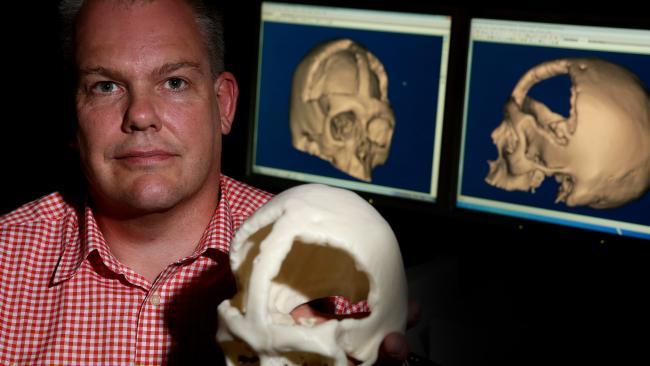
Royal Perth Hospital biomedical engineer Dr. Alan Kop holding skull with damage
As part of a funding grant split between nine different health and medical entities in Australia, health officials are receiving A$2m (approximately $1.5 million USD) for research on this project and to work on cutting costs as well as increasing quality and efficiency in Australia’s health system. Many eyes will be monitoring the success of the project, as it offers so much potential not just for future cranial reconstructions, but obviously many other procedures in the surgical arena as well.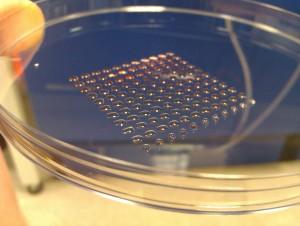
“This project highlights some of the innovative and groundbreaking research that is under way in WA’s public health system, and the commitment of the government to supporting this crucial work,” said health minister Kim Hames.
We’ve reported on numerous cases of 3D printed implants, and even one that is similar to this particular case in Zambia, where a seven-year-old girl received a forehead implant after hers was partially removed due to an infection. With a 3D printed lattice framework, surgeons successfully reshaped her forehead, helping her to look better but also to help regrow the bone, with the 3D printed lattice eventually degrading safely.
As the Australian researchers take this process further and are (hopefully) able to help many others, the use of 3D printing will hopefully be able to propel numerous other medical processes along as well, transforming surgeries–and the quality of life for many people. Let’s hear your thoughts on this research in the 3D Printed Cranium forum thread on 3DPB.com.
[Source: International Business Times]
Subscribe to Our Email Newsletter
Stay up-to-date on all the latest news from the 3D printing industry and receive information and offers from third party vendors.
Print Services
Upload your 3D Models and get them printed quickly and efficiently.











You May Also Like
Roboze Opens U.S. Aerospace & Defense Headquarters in El Segundo
The manufacturing sector is made up of clusters: “geographic concentrations of interconnected companies” that both cooperate and compete with each other. Of course, this is true about any sector in...
EOS Invests $3M In Its Texas Manufacturing & Logistics Facilities to Serve North American Customers
The trajectory of reshoring under President Trump has been largely a mixed bag so far. While tariffs still seem to be doing more harm than good to the U.S. domestic...
At AIAA SciTech 2026, 3D Printing Was Part of the Workflow — Part I
The AIAA SciTech Forum 2026 brought much of the aerospace community together in one place. With roughly 6,000 attendees, 115 exhibitors, 21 sponsors, and nearly 3,000 technical paper presentations, the...
€73 Million Investment Round into SWISSto12
SWISSto12 is on the move. I think that the firm owns one of the most promising and profitable applications for 3D printing, RF components, and it is showing real growth...