Nostalgia for ’80s Vectrex Game Console Prompts Maker to Create a Mini 3D Printed Version

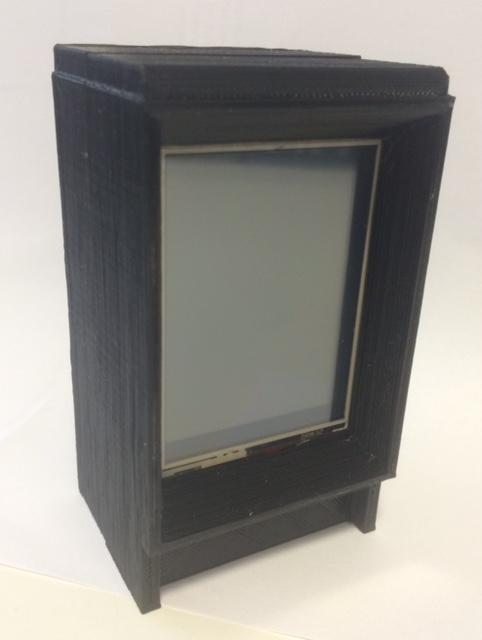
3D printing has been a real boon for the nostalgic branch of the maker movement. Suddenly you can use 3D printing to recreate your favorite, um, thing–you name it and you can probably make it if you have the wherewithal, the skills (or a willingness to acquire them) and, of course, a 3D printer. That’s definitely the case with maker Jason Wright, who posted a recent project on Hackaday and Thingiverse. Wright’s 3D printed Mini Vectrex is a tribute to old school video gaming and the explosion in the accessibility and affordability of DIY electronics.
So, what’s a Vectrex? A Vectrex is a vector (a quantity that has direction and magnitude) display-based, home video game console. The Vectrex was developed by Western Technologies/Smith Engineering and released by the Milton Bradley Company for retail sale in 1982. Back then, it cost $199 and, like lots of technology, gets cheaper over time.
It’s different than other video game consoles that aren’t portable as they connected to TVs and rendered raster graphics. Instead, the Vectrex has its own integrated vector monitor and displays vector graphics. You could play games like Armor Attack and Space Wars on the Vectrex as well as the built-in game that came with it–MineStorm.
Wright says he looked everywhere and didn’t see anyone making their own Vectrex.
“There are many ‘mini’ computers and consoles that have already been 3D modelled,” he explained. “However, I didn’t find a Vectrex anywhere. I had already been doing work on a Vectrex Emulator and decided to model my own and make it work.”
And that’s the maker spirit in a nutshell.
The so-called “heart” of Wright’s system is the VoCore. VoCore is open hardware that runs OpenWrt. It has WiFi, USB, UART, and 20+ GPIOs yet it’s only a square inch in size. Wright has been testing the VoCore to get a sense of its benefits and limitations. Along with the VoCore, he used a “cheap 2.2 inch SPI LCD” screen, which he purchased on eBay. It was originally a phone screen but he’s adapted it for use with the Mini Vectrex.
 Wright used Google SketchUp to design the Vectrex case. Afterwards, he exported the 3D model and loaded the mesh into MeshLab, where he scaled it and did some cleanup work. The .stl files are available for downloading on his Thing page. Wright used his M3D (Micro 3D) printer and PLA filament for printing the Mini Vectrex case. Apparently it took multiple tries before he was satisfied with the results. The printing wasn’t the problem, however. He realized he’d skipped some important steps in the design process: he hadn’t included mounting posts for the LCD and hadn’t considered how the front and back of the Vectrex case would be connected.
Once Wright had solved the design problems, he was pretty happy with the results. He concluded his blog post by saying, “This makes it totally self contained and portable, along with WiFi it makes it a nice little unit.” Watch the video to get a sense of how the Mini Vectrex works. Like most video games, note how it draws you in and holds you hostage for hours and hours and hours and hours…
Is this the sort of project that would light up your nostalgia? Let us know if you’ll create your own in the 3D Printed Mini Vectrex forum thread over at 3DPB.com.
Subscribe to Our Email Newsletter
Stay up-to-date on all the latest news from the 3D printing industry and receive information and offers from third party vendors.
Print Services
Upload your 3D Models and get them printed quickly and efficiently.











You May Also Like
Asia AM Watch: China’s 5 Million-Printer Export Year Signals Desktop AM at Scale
For years, a lot of the discussion around China and additive manufacturing has focused on industrial competition. Can Chinese companies move into higher-end markets? Can they challenge Western machine makers...
Creality Launches Filament Maker M1 & Shredder R1, Letting Makers Reuse Waste, Cut Costs, and Create Their Own Filament
From Printing Objects to Shaping Materials Desktop 3D printing has made on-demand creation more accessible than ever. Yet one critical part of the process remains fixed: the material itself. Most...
Bambu Lab 3D Prints Miniature Playground City for Kids in China
Bambu Lab has partnered with meland to open what they describe as China’s first 3D printing creativity center for children. The new space, officially named “meland x Bambu Lab,” launched...
Bambu Lab Says 2025 Was a Breakout Year: 10 Million Monthly Users and Real Business Growth
Chinese 3D printer maker Bambu Lab reported strong results for 2025, showing that the company’s push into community and small-business 3D printing is working. The numbers suggest consumer 3D printing...