Museum Victoria 3D Scans Rare 20-Foot Long Basking Shark – 3D Printed Replica Coming Next

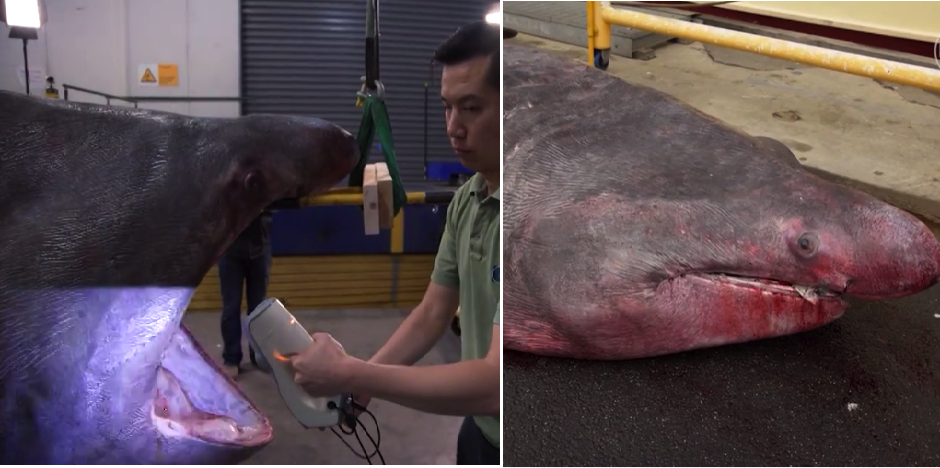
The combination of 3D scanning and printing is changing the way we preserve our past. Two dimensional photographs used to be the best way to chronicle past discoveries, events and research, but over the last several years the emergence of highly accurate 3D scanning equipment and the subsequent ability to 3D print the data obtained from those scanners has presented a way to replicate the past. Whether it’s a bust of President Obama while in office, or an artifact destroyed by terror groups around the world, these technologies are changing the way that those in the future can tap into our current time.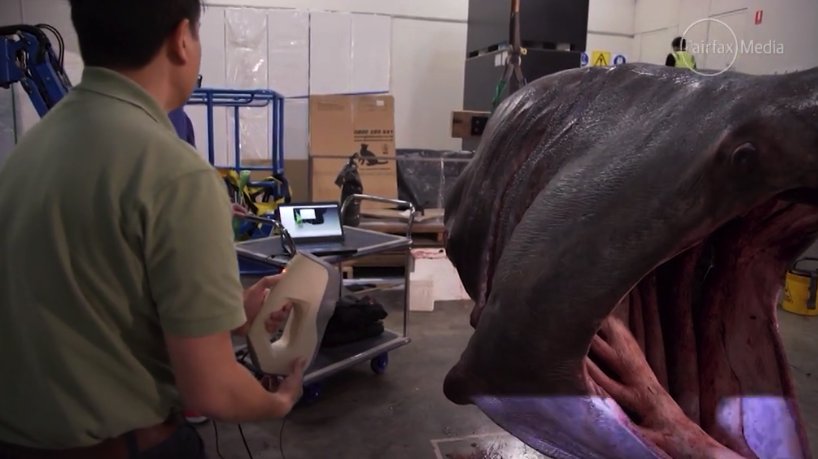
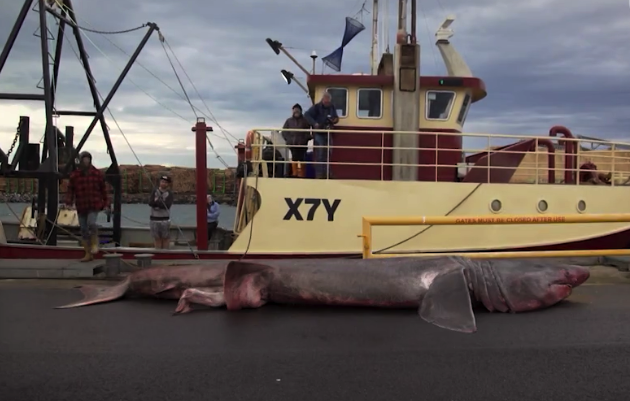
Recently these technologies came into play after researchers in Australia unexpectedly came upon the specimen of a rare basking shark. It was just a couple of weeks ago when a fishing trawler accidentally caught the shark in the Bass Strait off of the coast of Portland, Victoria, in Southeast Australia. Unfortunately the fish got caught up in their nets and did not survive.
Basking sharks are often sought after for their fins, used in shark fin soup. Those who caught the giant fish, however, didn’t want this rare 20-foot long, 7,716 pound specimen to goto waste. They decided to donate the shark to the Museum Victoria for research.
Upon receiving the giant fish, which happens to be the second largest living species of fish after the whale shark, Museum Victoria decided to preserve it for centuries to come via highly advance 3D scanning and printing technology.
“This is the first time we have done 3D scanning at the museum, certainly at this scale,” said Martin Gomon, the museum’s senior curator of ichthyology. “We can compare their morphology with fish from other areas to see if they are a different species or how they are related to other species. The internal structures can also be X-rayed or CAT-scanned, so they are very valuable.”
 Because of the fish’s sheer size, researchers decided to remove most it its dorsal, anal, pectoral and pelvic fins, as well as some of its vertebrae. This left them with the head and gills, which they meticulously began scanning with a handheld 3D scanner. The scanner, operated by 3D scanning engineer Ben Tam, from the scanning company Qubic, could cover about a meter every 4 seconds and was able to capture 10-15 frames a second. Once the entire head, inside of the mouth and inside of the gills are scanned to the best of Tam’s ability, the museum will be 3D printing a replica of the head for public display.
How rare is the basking shark in this area of the world? Incredibly rare. In fact, it’s the first basking shark caught in the region since the 1930’s and only third ever caught since 1855. Despite its rarity within the region, these advancing technologies will soon allow museum goers to get an up close and personal view of the giant shark, and who knows, maybe even 3D print a replica themselves at home.
Let us know your thoughts on this preservation technique and what these technologies will ultimately mean for researchers moving forward. Discuss in the 3D Printed Basking Shark forum thread on 3DPB.com.
Subscribe to Our Email Newsletter
Stay up-to-date on all the latest news from the 3D printing industry and receive information and offers from third party vendors.
Print Services
Upload your 3D Models and get them printed quickly and efficiently.











You May Also Like
University of Glasgow Researchers Develop 3D Printed Compostable Electronics
Recycling is one of those things that people support, but, for the most part, don’t actually do. If it sounds like I’m being judgmental, let me be the first to...
3D Printing News Briefs, January 21, 2026: Scanning Inspection, Manufacturing Upskilling, & More
In 3D Printing News Briefs, we’ll start with 3D scanning news from Artec 3D. Then, Nanoscribe opened a demolab in Shanghai, and The Ohio State University Center for Design and...
3D Printing News Briefs, January 17, 2026: Titanium Scrap, Autopsy Analysis, & More
In this weekend’s 3D Printing News Briefs, we’ll start with government funding news from IperionX. Then, a German contract manufacturer has acquired its 6th and 7th Lithoz ceramic 3D printers....
ASTM International Works with UK MoD on America Makes Project
The UK Ministry of Defense (MoD) will work with ASTM International on a $1.1 million project to let it work in closer concert with the US Department of War (DoW)....