3D Printed Tactile Books For Blind Children, Created By University of Colorado Assistant Professor

There are many important learning tools for a child’s development, as they make their way through the world. For me at least, one of the more memorable tools for learning, even though I didn’t see it that way at the time,  were picture books. They allow children to entertain themselves while also teaching them a tremendous amount about the world around them. Children, at a very early age are able to begin to develop a story sense, differentiating between beginning, middle and end, while the images in picture books provide an understanding of the words which are being read to them by a parent or teacher.
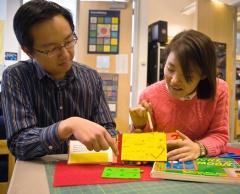
Tom Yeh with his 3D printed book, ‘Goodnight Moon’
What if a child is visually impaired though? This tremendous learning tool is now not an option. Sure there are other ways to provide these unfortunate children with alternate material, however, they are still missing out on a key developmental tool. A University of Colorado assistant professor, Tom Yeh and his team are trying to change this with the help of 3D printing. Yeh is 3D printing children’s picture books, so that those who are visually impaired have the same access to the material as those without an impairment. The project he is working on is called, ‘the Tactile Picture Book Project‘, and he certainly has a strong ambition to succeed.
“I really enjoy reading stories with my son,” says Yeh, who’s son is not visually impaired, “and I thought I might be able to contribute to making books for visually impaired children more tactile.”
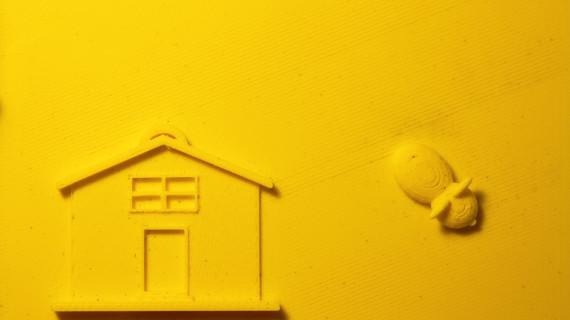
The very first book he has printed is a 3D version of one of his son’s favorites, ‘Goodnight Moon’. By using a 3D printer he was able to create a very thick paged copy of the book, where the words were in braille, and the pictures were all three dimensional.
“Three-dimensional printing holds the key to simplifying the making of tactile picture books,” says Yeh. “As 3D printers become cheaper and more powerful, soon people will own a 3D printer at home, just like now they own color printers at home.”
Yeh’s ultimate goal is to develop a software which would allow parents to take pictures of any page, on any book, and be able to turn that photo into a 3D model which they can then print on a 3D printer. Such an option would be invaluable to parents of children with visual impairments.

3D Printed ‘Goodnight Moon’
Currently there are a number of tactile picture books on the market, however, these are all mostly hand made, which leads to a limited supply and extremely high prices, when compared with traditional picture books. Yeh’s hope is to allow parents to purchase a normal book, and via his software and a 3D printer, create a tactile version of it. Yeh and his team are working hard to develop the software capable of doing such. It’s not as easy as it may seem though. He still hopes that within five years such software will be available so that parents with very little knowledge of 3D modeling, or printing can quickly and easily manage to make their own tactile picture books.
How big of an impact could 3D printing have for the visually impaired? Let us know your opinion in the 3D printed book forum thread at 3DPB.com
Subscribe to Our Email Newsletter
Stay up-to-date on all the latest news from the 3D printing industry and receive information and offers from third party vendors.
Print Services
Upload your 3D Models and get them printed quickly and efficiently.











You May Also Like
3D Printing News Briefs, February 21, 2026: Vapor Smoothing, Brain Models, & More
In this weekend’s 3D Printing News Briefs, we’re starting with material and post-processing news from Quickparts, and some more post-processing news from AM Solutions. We’ll end with researchers at the...
3D Printing News Briefs: February 19, 2026: Market Data, Africa, Metal Parts for Defense, & More
We’re starting with some business news for you in today’s 3D Printing News Briefs! The Wohlers Report 2026 is now available, Carbon announced its new Chief Technology Officer, and Farsoon...
From “Magic” to Metal: How Intrepid Automation Wants to Make 3D Printing Matter at Scale
Ben Wynne still talks about 3D printing the way people do when they’ve felt that “wow” moment up close. Back in the early 2000s, he was working at HP’s advanced...
Takeaways From MILAM 2026: Defense’s Growing Role in Driving 3D Printing – Part II
At the recent Military Additive Manufacturing Summit & Technology Showcase (MILAM 2026), additive manufacturing wasn’t just being discussed as a production strategy; it was being packaged for deployment. A big...