Keep Your Filament Dry with This Easy-to-Make Airtight Filament Delivery System

People often assume that because PLA filament is made of plastic storage isn’t something that they need to be concerned about. Unfortunately proper storage is actually extremely important, because PLA left exposed to open air can absorb water or pull dust and particulates into your printer. You may be asking why plastic would need to be protected from water, but PLA is a bioplastic that is made from plant materials like corn or rice. That means that it is especially susceptible to absorbing water from the atmosphere.
PLA that has absorbed too much water will cause all sorts of problems with a typical 3D printer. Any moisture that has been absorbed into filament will eventually turn to steam once it is sent through the printer hot end. This sudden escape of water vapor can cause any printed objects to be weaker, or even cause them to fail. Additionally, the pockets and air bubbles caused by water evaporating can result in the flow of plastic being imprecise and cause flaws in the final object. In extreme cases, the PLA can absorb so much water that it will swell thick enough to become jammed in the hot end, and may even damage it enough that it will need to be replaced.
 Because protecting filament from moisture is so important, there are several home-made solutions to keep it dry. 3D printing enthusiast and Thingiverse user Stephen Hall has developed one of the more clever storage solutions that I’ve seen, and as an added bonus it looks pretty easy to put together.
All you need is an inexpensive air tight plastic box, some teflon tubing that can feed the filament to the printer, and the 3D printable parts that Hall has uploaded to Thingiverse. Hall initially designed all of the parts in SketchUp and since he has multiple varieties of filament, each with their own spool size, he also designed adjustable reel rollers.
“At first I just sat the reels in and poured in desiccant beads and it did work but I was concerned how much force was needed to pull out the filament, so I designed the Adjustable Reel Roller to ease the spin, I have all sorts of different filament makes and the reels are all different sizes,” Hall told us via email.
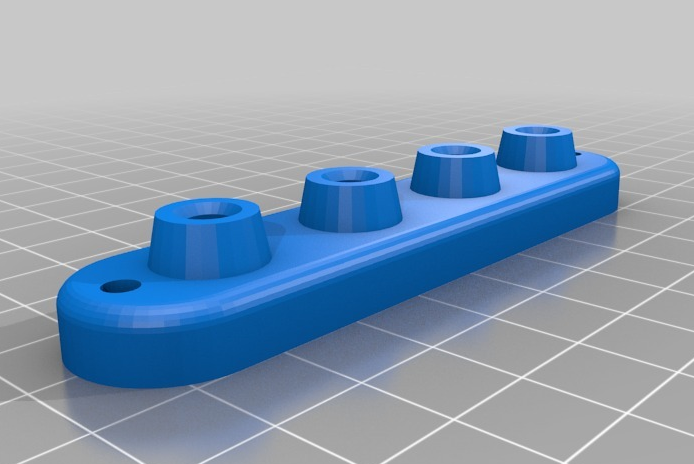
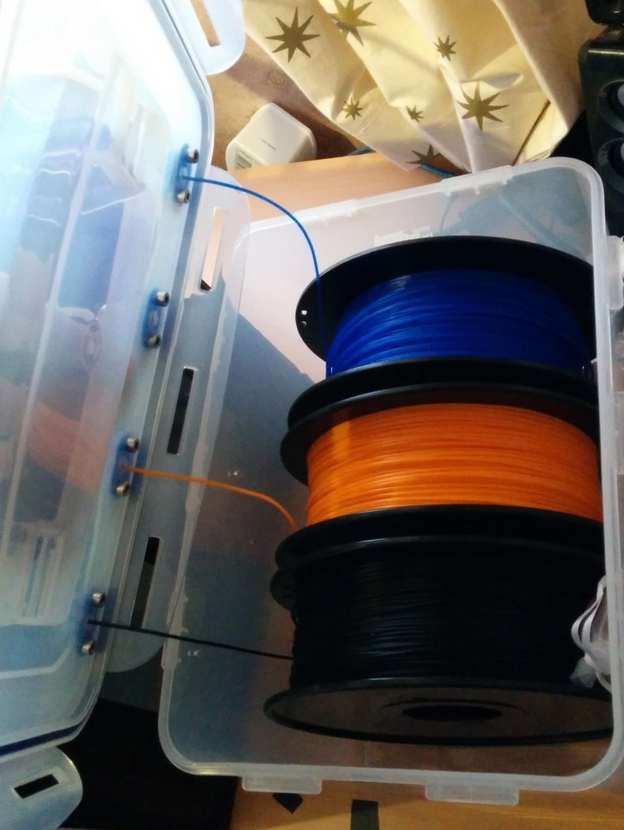 Once he had all of his parts, Hall drilled holes in the box lid for the mountings. Once they were in place he sealed each hole with silicone, which makes the box virtually airtight and reduces the risk of exposing the filament to moisture.
The box and all of the parts are designed to hold up to four spools of filament (depending on spool size) so any unused slots would need to have the hole plugged up to keep the box airtight.
“I have printed a few items from the box even before the rollers with no problems and I think it should be hard work for moisture to travel along half a meter of 2mm tube with a 1.75mm filament running through it. The desiccant I removed after 2 weeks had only slightly started to turn green, way better than the old round holders,” Hall said.
Honestly, considering how damaging moisture is to PLA it is a little odd that none of the major 3D printing manufacturers have really addressed the issue. But since 3D printing is both an industry and hobby full of makers, there are always DIY solutions to problems that manufacturers don’t want to admit exist. Have you developed a similar solution to storing your filament? Tell us about it on our Filament Delivery System forum thread at 3DPB.com.
Subscribe to Our Email Newsletter
Stay up-to-date on all the latest news from the 3D printing industry and receive information and offers from third party vendors.
Print Services
Upload your 3D Models and get them printed quickly and efficiently.











You May Also Like
Cisco Report Finds Cybersecurity and Networks Determine AI Growth in Manufacturing
Additive manufacturing (AM) is a market in-itself. Still, more broadly, it can be viewed as one component of a shift in the productive economy towards interconnection by the Industrial Internet...
AMR Webinar to Reveal 2025 3D Printing Market Data and What 2026 Will Really Look Like
On March 24, 2026, Additive Manufacturing Research (AM Research) will host a free webinar that many in the industry won’t want to miss. Titled “3DP/AM Market Insights: 2025 Review and...
The Tribal Knowledge Crisis in AM Cannot be Solved Without an AI Intervention
Additive manufacturing (AM) has long relied on a deep well of expertise that is notoriously hard to document. That expertise can be found in the nuances involved in setting up...
Generative AI Is Moving From Design to Factory Floors: TCT Asia 2026 Shows the Full Workflow
Generative AI is rapidly moving beyond digital experimentation and into real manufacturing environments — but the key challenge remains: can AI-generated 3D models move seamlessly from creation to production? At...