Basic Hack Helps You Keep Small Debris Out of Your 3D Printer

If you’ve been under the misguided impression that all DIY projects are complicated, Instructables contributor “DeStulp” has provided strong evidence to the contrary. This mysterious maker clearly agrees that the simplest and most straightforward answer usually is the right one, as her (or his) simple, 3D printer Filament Cleaner suggests.
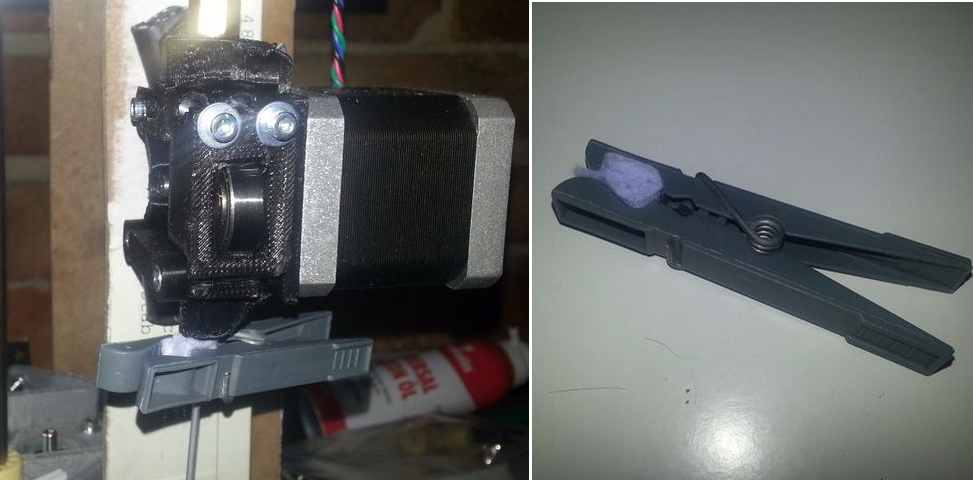
Why would you need to clean filament? With fused filament fabrication (FFF), filament fed through your machine can introduce dust, dirt, and other stuff that can cause major problems, like a clogged nozzle. Many people get filament shipped to them and find some of it broken in transit and coated with light powder from the material breaking down. Whatever the case, debris on the filament translates to a dirty print at best and possibly a malfunctioning 3D printer.
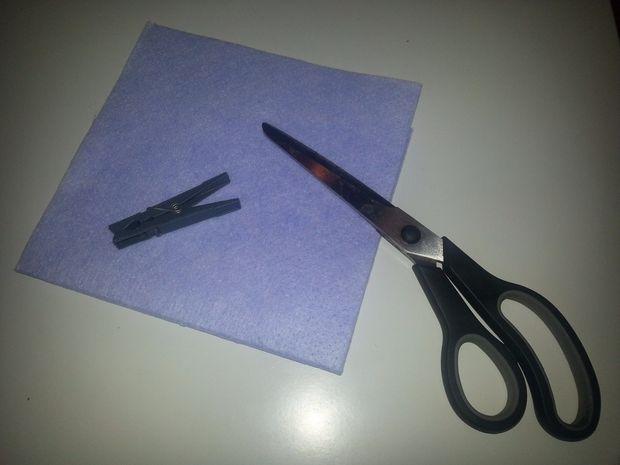
DeStulp’s Filament Cleaner is even more basic than a 3D printed one we reported on last fall and it doesn’t actually use 3D printed parts. You’ll need a clothespin (go with a plastic one) and a small chunk of a “kitchen wipe,” by which DeStulp must mean thin, compressed sponge sheet (see the photo). You won’t need a well-stocked tool box for this project or “hack” either as the only tool you’ll be using is a pair of scissors (or a sharp knife).
Here’s how it works: You cut out a rectangular piece of the wipe, making it a little wider than and at least as long as the clothespin. Next, you fold the piece of sponge over a few times, creating a kind of a roll, which you clip between each arm of the clothespin. And… that’s it! That’s your homemade Filament Cleaner.

The Filament Cleaner needs to be installed anywhere between the spool and the extruder so that the material passing into the extruder first goes through the cleaning process. DeStullp recommends placing it just in front of the feeder.
The filament filter/cleaner that we told you about back in October suggested using a slight amount (less than a drop) of mineral oil each time you run filament through it for an average-length print job as lubricating the filament seems to help keep the machine itself clean and slightly lubricated but you should read the maintenance information about your individual 3D printer before doing so. Also, there’s the possibility of the oil making the print bed even slightly slippery, which could prevent the printed material from sticking.
Again, the best advice seems to be to keep it simple. Isn’t that the beauty of DeStulp’s approach anyway?
Have you tried a filament cleaner for your 3D printer? Will DeStulp’s setup work for you? Let us know in the Easy Filament Cleaner forum thread over at 3DPB.com.
Subscribe to Our Email Newsletter
Stay up-to-date on all the latest news from the 3D printing industry and receive information and offers from third party vendors.
Print Services
Upload your 3D Models and get them printed quickly and efficiently.











You May Also Like
Reshoring Requires Rules of Engagement
Reshoring manufacturing in the U.S. is a stated national priority. Policymakers, industry leaders, and defense planners agree that domestic production capacity is essential for economic resilience, national security, and long-term...
When a Factory Stops Being a Building and Starts Being a Machine
Metal manufacturing still carries the layout and logic of an older industrial age. Most factories run as a collection of isolated disciplines, each with its own equipment, staff, and data....
Bridging the Gap: 2D to 3D AI in Manufacturing
For decades, the early stages of manufacturing have been defined by a simple, frustrating trade-off: you can have it precise, or you can have it fast. AI just broke that...
Hardware is Dead. Here’s What Actually Wins in Additive Manufacturing.
Hardware is rapidly commoditizing across additive manufacturing. Specifications have converged. Price competition has intensified. Margins have compressed. For companies attempting to scale additive manufacturing beyond prototyping, this shift has profound...