
3D Print Your Own Portable Counterfeit Currency Detector

For those of you who are still paying with cash or, more importantly, taking cash payments, an Instructables contributor, Carmelito Andrade, shared instructions and STL files for 3D printing your own portable counterfeit money detector. Andrade, from Stamford, Connecticut — an electronics tinkerer, 3D designer and printer, and also a farmer — created this device, which is smaller than the size of the bill you’re checking. It fits into your wallet and, because it’s battery operated, needs only to be switched on to run a quick scan on a bill.
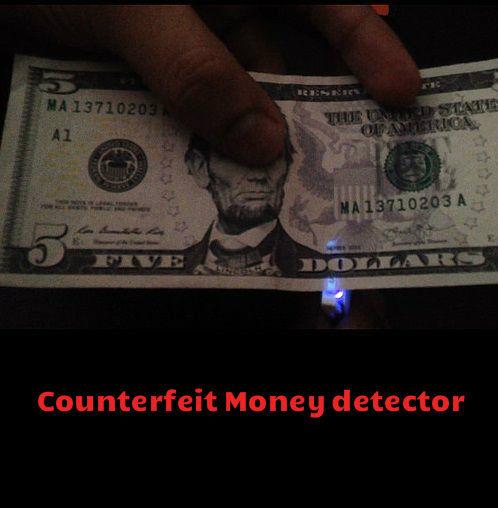
Andrade’s device, which also functions as a small flashlight, works on the same principle as any other ultra violet (UV) light-based detector: When you illuminate the bill with a UV light source, a thin, vertical strip to the left of the President’s head will appear. The strip is printed on the bill in fluorescent ink that is not visible to the naked eye. The strip is a specific color based on the denomination of the bill. $100s are red, $50s are yellow, $20s are green, $10s are orange, $5s are blue.
That the ink can fade over time, however, so the UV test is probably not the only form of scrutiny you should give incoming currency if you want to be certain it’s the real thing. The portable UV detector seems to be a good place to start for the financially fretful DIYer. According to the Federal Reserve, there is a substantial amount of counterfeit money floating around out there. The estimate is that about 0.086% to 0.090% of the currency circulating during a given year is counterfeit. For some perspective, that would be about $261 million in counterfeit dollars out of around $303 billion dollars. In light of those numbers, it does seem better to be safe rather than sorry, doesn’t it?
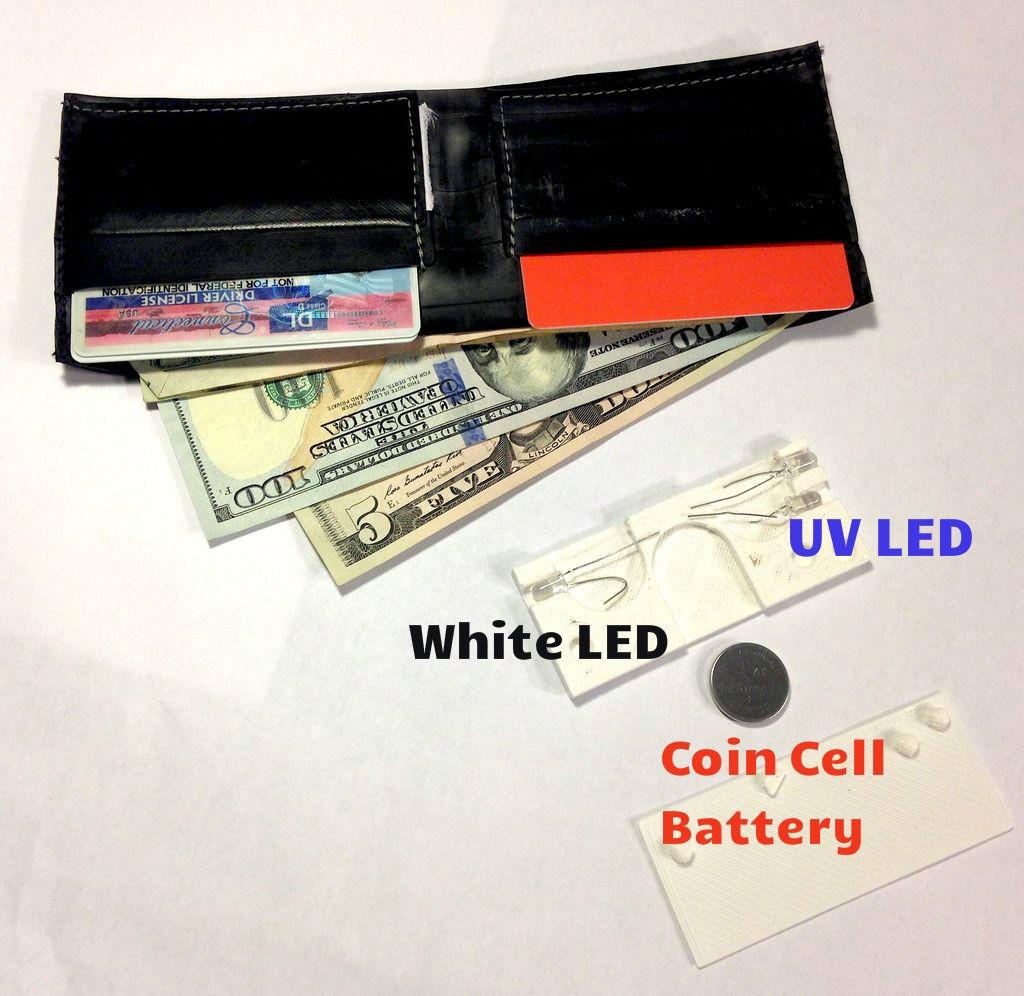
 For this project, you will need a few electronics components in addition to the 3D printed parts. You should be able to purchase the electronic parts at any hardware store:
– Two UV LEDs
– One white LED
– A coin cell battery (CR2302)
– Super glue
Andrade’s STL files are available via the Instructables page. It took him about an hour to print all of the non-electronic parts, which is easily assembled using his instructions and some super glue. His video (below) demonstrates how the device is used both for counterfeit detection and as a flashlight.
Note that you should avoid looking directly at the UV light for long and should never shine it toward your eyes. That’s probably a no-brainer for our tech-savvy readers, but just in case you’re tempted to conduct a quick retina scan, don’t.
Do you have a small business that would benefit from a quick, compact counterfeit bill detector? Would you think about making one of these devices? Let us know over at the 3D Printed Counterfeit Currency Detector forum thread at 3DPB.com.
Subscribe to Our Email Newsletter
Stay up-to-date on all the latest news from the 3D printing industry and receive information and offers from third party vendors.
Print Services
Upload your 3D Models and get them printed quickly and efficiently.













You May Also Like
Metal 3D Printers for the Desktop Are Finally Starting to Feel Like Desktop Products
FDM 3D printing is becoming increasingly accessible, yet metal 3D printers designed for everyday desktop use remain rare on an ordinary workbench. The real challenge is not making a metal...
3D Printing Financials: 6K Additive Sales Rise as Aerospace and Defense Demand Grows
6K Additive (ASX: 6KA) grew rapidly in the first half of 2026 as demand for its metal powders increased, particularly from aerospace and defense customers. The newly public company also...
When Data Becomes the Differentiator: Qualified Material Data is Changing the Future of Structural Additive Manufacturing
For years, additive manufacturing has promised engineers greater design freedom. The challenge wasn’t printing the part—it was proving the part belonged on an aircraft. Designing a lightweight bracket or consolidating...
Amaero Builds U.S. Metal Powder Capacity for Additive Manufacturing
For metal additive manufacturing (AM) to grow in the United States, companies need more than printers. They also need a reliable supply of the powders that go into those machines....























































