4WEB Medical Announces Major Milestone: Over 3,000 of their 3D printed spine truss implants in use


Back in September, we talked about 4WEB Medical, an implant device manufacturer based in Texas. The company was founded in 2008 and was the first FDA-cleared company to make spine implants via additive manufacturing. The company’s topological dimension theory research led  them to develop the 4WEB, a breakthrough high-strength, lightweight web structure that they combined with 3D printing technology to create their implants.
Already established as the 3D printed implant technology leader in the medical field, today 4WEB Medical had a big announcement to make. At the North American Spine Society Annual Meeting, held this week (November 12-15) in San Francisco, California, 4WEB Medical announced that over 3,000 orthopedic truss implants have been implanted into patients.
“Crossing the 3,000 implant milestone is a significant accomplishment for our company,” said Jessee Hunt, President of 4WEB Medical. “It is a testament to our surgeons’ positive clinical experience with truss implant technology and the role it may play in achieving better outcomes for their patients.”
The structure of the ALIF spine truss system is demonstrated in this short video:
4WEB Medical currently offers Cervical and ALIF interbody devices in their spine portfolio; more spine truss designs are on the table for the first half of 2015. Having reached the milestone of 3,000 implants in use, 4WEB Medical seems on track to raise their profile as a go-to technology in implants.
Besides being simply the first on the market, 3D printed spine truss implants from 4WEB Medical are high quality and have an innovative design that enhances their popularity of use.
“The 4WEB Medical Spine Truss Systems are differentiated from other fusion implants currently on the market because the structural mechanics of the truss implants are designed to distribute loads across the entire endplate and throughout the device,” said Dr. Cameron Carmody, an orthopedic spine surgeon based in Plano, Texas. “This is significant because these implants may reduce stress risers and subsidence-related complications and potentially stimulate a cellular response through a mechanical transduction of strain.”
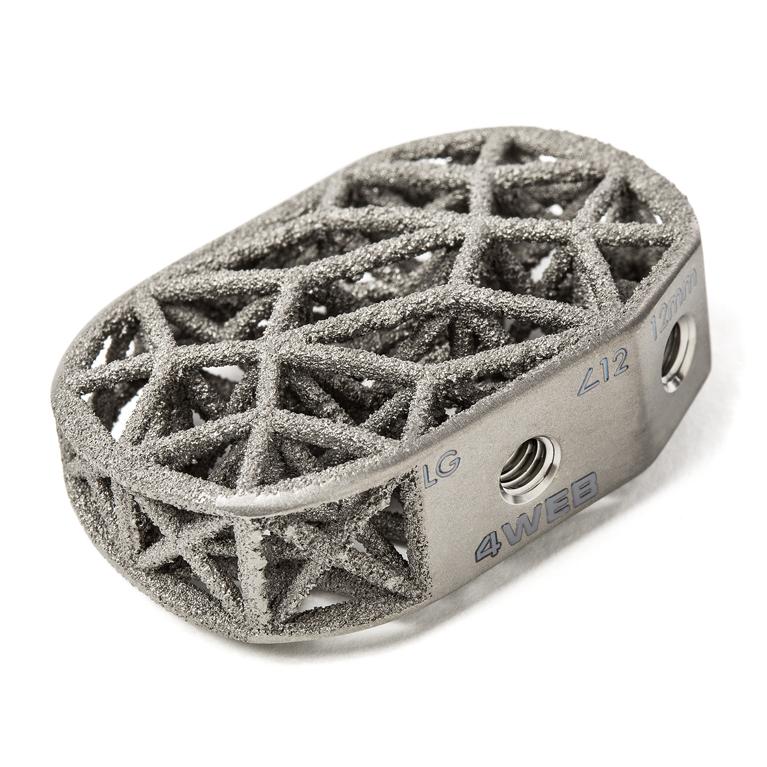
The use of additive manufacturing allows for the use of structural mechanics, load transfer, and adjacent material reaction — principles from engineering disciplines — in the production of the implants. The company’s implants don’t just sit inside a spine; they actively stimulate the healing process from within.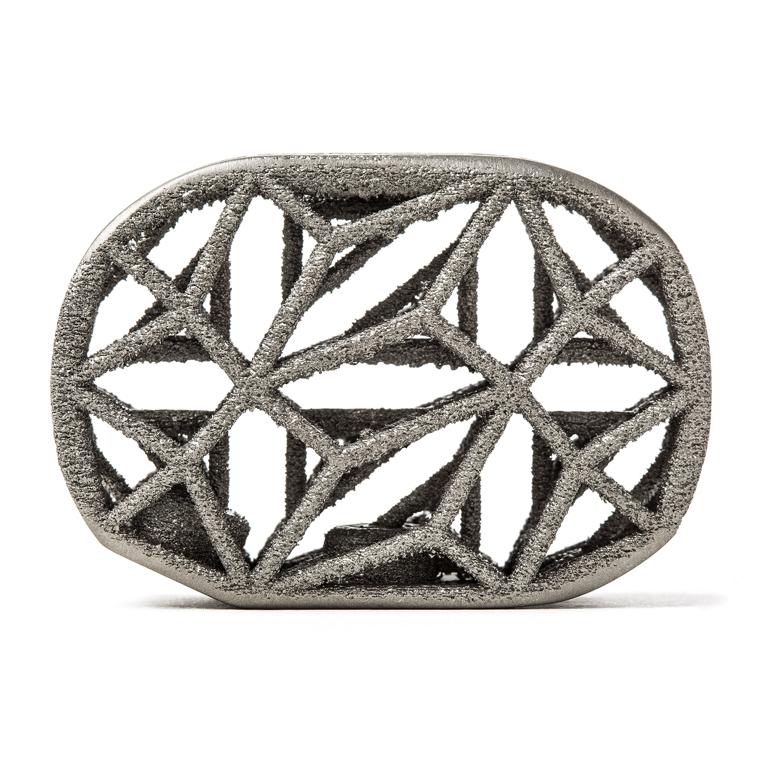
The unique design of the truss includes three-quarters of the implant to be filled with graft material. The texture of the piece — note the finish in the photos — also keeps the implant in place, lessening the opportunities for it to migrate from its point of initial fixation. Altogether, the architecture of 4WEB Medical’s implants allow for the devices to truly incorporate themselves into the body; the bi-convex surface brings the entire endplate closer to the adjacent bone, enhancing bone incorporation into the graft material. Most similar spine trusses, on the other hand, allow this only around the outside edge.
4WEB Medical also offers other trusses, including implants designated for use across the entire orthopedic arena such as for feet and ankles.
What do you think of their implants? How long until they hit the next big milestone? Let us know your thoughts at the 4WEB Medical Hits Milestone forum thread over at 3DPB.com.
Subscribe to Our Email Newsletter
Stay up-to-date on all the latest news from the 3D printing industry and receive information and offers from third party vendors.
Print Services
Upload your 3D Models and get them printed quickly and efficiently.













You May Also Like
ADDiTEC Demonstrates Material Freedom and Mission Readiness at JIFX 2026 with HYBRiD-X
At the Naval Postgraduate School‘s Joint Interagency Field Experimentation (JIFX) in May, ADDiTEC demonstrated how advanced manufacturing can support the future of defense sustainment through its HYBRiD-X expeditionary manufacturing platform....
AM Asia Watch: China’s 3D Printing Boom Is Creating a New Class of Micro-Manufacturers
China’s additive manufacturing (AM) industry has spent years trying to reduce its reliance on foreign technology. In polymer 3D printing, domestic companies have already become major players. In metal AM,...
3DPOD 302: Digital Inventory for AM with Mikhail Gladkikh, Würth Additive Group
Mikhail Gladkikh has worked in oil and gas for many years. With this background, we obviously talk about energy market turbulence and the adoption of AM in oil and gas....
3D Printing News Briefs, June 13, 2026: Management Changes, Project Calls, & Wheelchairs
We’ll kick this weekend’s 3D Printing News Briefs off with some advisory board and management changes, and then move on to project call news. We’ll end with some heartwarming stories...