Research Scientist Siblings Create 3D Printed Lamp Demonstrating Fruit Fly Brain Activity Data

 I have a thing for lamps, but until now I’d never considered adding one to my collection that in its illumination is a 3D printed map relaying scientific data from a fruit fly brain. While delighted at the thought of trying to explain this to someone admiring it in my living room, I am not so sure about pulling it off as a DIY project. That, however, was a ‘no-brainer’ for Nicolas Aimon, who wanted to make a tangible display of the research his sister was interested in, as well as get his hands on the new FormLabs 3D printer in his MIT research lab.

Nicolas Aiman
Nicolas Aimon, post-doctoral associate at MIT, found the research his sister Sophie was doing on fruit fly brains to be illuminating — so much so that he wanted to put her scientific data in lights, literally. While not at work in MIT’s Department of Materials Science and Engineering where they research new materials, device architectures and bottom-up fabrication methods for memory, logic, and photonic devices, Aimon set his sights on taking his sister’s scientific data from the computer screen to a 3D model.

Sophie Aimon
Sophie Aimon, post-doctoral associate studying at Kavli Institute for Brain and Mind at UC San Diego at the research laboratory of Professor Ralph Greenspan, was studying networks in the brains of fruit flies to figure out how interactions in the brain, in general, are coordinated and bound together ‘to produce coherent percepts and action.’ They chose to test their ideas on the brains of fruit flies because they are small and established enough for using genetically encoded calcium sensors which offer wide, efficient samples of data where they can figure out what is going on in the brain all at once.
And how would a fruit fly brain even remotely correlate with the human brain? According to Professor Greenspan’s study, you would be quite surprised. In the study, the researchers point out that drosophila melanogaster and other invertebrates are similar to vertebrate embryos in early nervous system gene expression, continuing later, and also including the structure of the cortex.
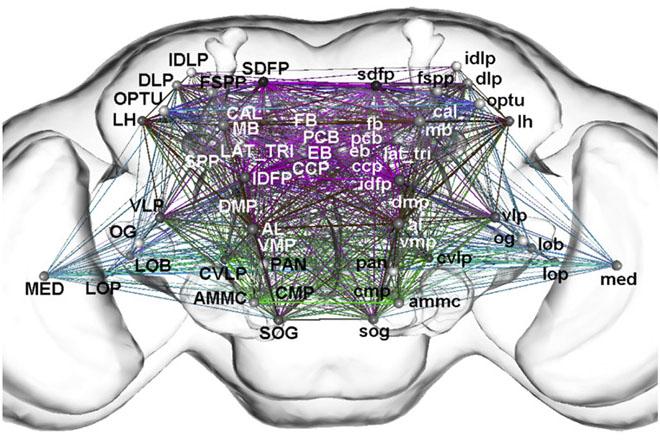
Map showing wiring connections among local processing units of the Drosophila brain. (Chiang et al., 2011)
It just so happened that MIT had a new Formlabs 3D printer which, Mr. Aimon explains, has “great print resolution and allows to make models in a transparent resin.” He began working on a design to make a 3D printed model that would illustrate his sister’s data, which uses microscopy techniques to examine the fruit fly data.
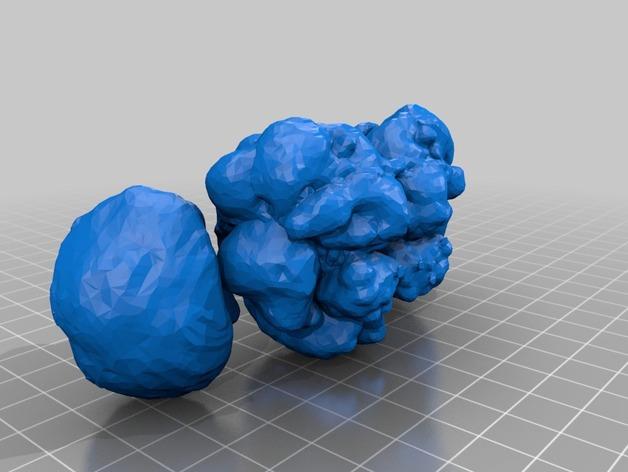
Preview at Thingiverse
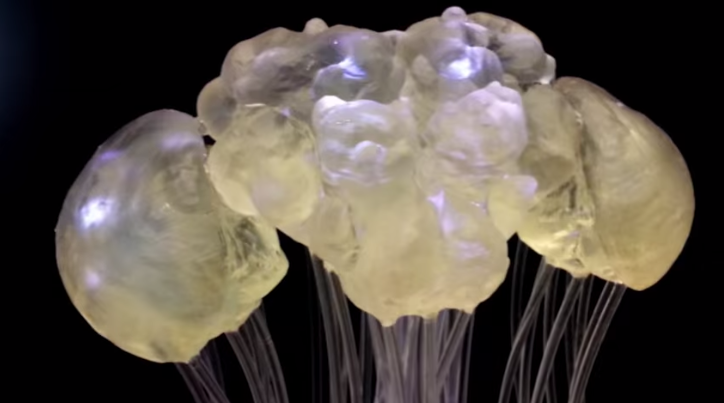
Mr. Aimon knew it would be much more helpful — and exciting — to view this data in a tangible 3D model. He downloaded a model of the fruit fly brain, and after refining the file a bit, uploaded it to Thingiverse. His next challenge was in configuring the illumination for the model, which he did by:
- Creating a grid with 53 spheres to insert fibers for model illumination.
- Created guides for inserting the fibers.
- Gluing the fibers with epoxy glue.
- Using a string of LEDs — Adafruit NeoPixels — to light up display and control color.
- Modifying a hardboard box with holes for the fibers and to house the Arduino board, with an access to the USB port.
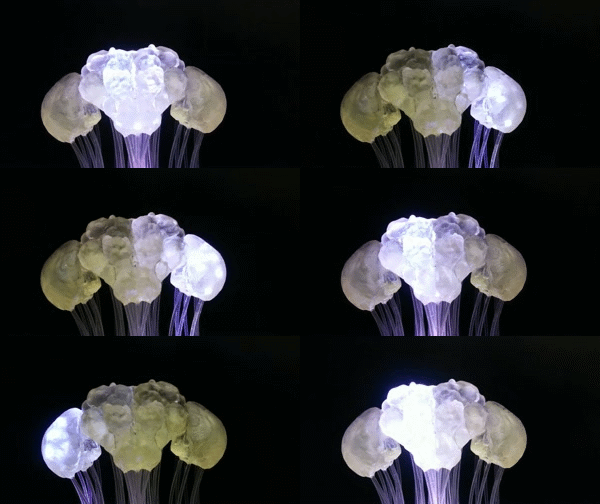
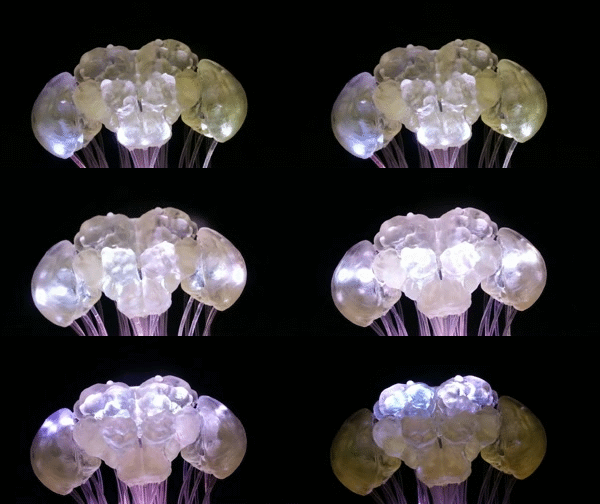 Mr. Aimon’s final challenge was to display the data, converting the information to the positions of the fibers, according to the coordinates fo
r the spheres, allowing him to assign light intensities, which he was able to test against the data for accuracy. The end product was a 3D printed model using optical fibers to demonstrate the fruit fly’s brain activity.
Does this inspire you to design and 3D print something similar? What are your thoughts on Aimon’s project? Tell us about it in the 3D printed Fruit Fly Brain forum thread at 3DPB.com.
Check out these videos with placements for the project:
Subscribe to Our Email Newsletter
Stay up-to-date on all the latest news from the 3D printing industry and receive information and offers from third party vendors.
Print Services
Upload your 3D Models and get them printed quickly and efficiently.













You May Also Like
The Money Behind AM: What to Watch at AM Investment Strategies 2026
For years, simply being a 3D printing company could attract attention from investors. New machines, new materials, faster speeds, and the promise of mass production were often enough to get...
3D Printed Football Helmets Are Amazing Business. They’re Also So Much More
NFL football is by far the most popular sport in the US, followed by college football (a state-of-affairs oddly similar to the fact that the world’s largest air force is...
Continuous Composites Wins Navy SBIR for 3D Printed UAVs
In a diversification effort, Continuous Composites has decided to seek work outside of the courtroom. The company that has been successful in defending its patent portfolio in composite 3D printing...
When Data Becomes the Differentiator: Qualified Material Data is Changing the Future of Structural Additive Manufacturing
For years, additive manufacturing has promised engineers greater design freedom. The challenge wasn’t printing the part—it was proving the part belonged on an aircraft. Designing a lightweight bracket or consolidating...