Thermal Video Shows Heat Map of 3D Printing in Action

 When I am approached by people who are not familiar with 3D printers, the first thing they usually ask is, “How do these printers work?” I usually take a moment to pause and then try and figure out which type of 3D printers they are referring do. Is this person a corporate business executive, someone who would be more interested in the industrial level 3D printers like those manufactured by 3D systems and Stratasys? Or, perhaps they appear to be a tech-geek, potentially interested in 3D printing stuff for themselves at home. This is a determining factor in helping me decide, which 3D printing technology I should explain to them.
The thing I love about the technology behind 3D printing is that when it comes down to it, it really is quite easy to understand, grasp and explain. That’s one reason I love talking to people about additive manufacturing. The most common 3D printing technology among hobbyist and the average Joe is Fused Filament Fabrication (FFF), also known as Fused Deposition Modeling – FDM (although this term is trademarked by Stratasys).
FFF/FDM works quite simply by extruding molten plastic out of a small nozzle, in a similar fashion to how a glue gun extrudes hot glue. Whereas a glue gun is controlled by an individuals hand movements, an FFF 3D printer is controlled by sophisticated computer software, thus is much more accurate, and can print with much higher resolutions. Upon the extrusion of either PLA or ABS plastic, the material is placed onto a build platform. In many cases, especially with ABS printing, the build plate is heated to aid in adhesion, improve print quality and prevent warping.
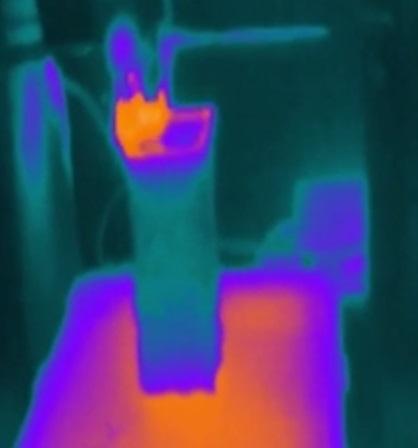
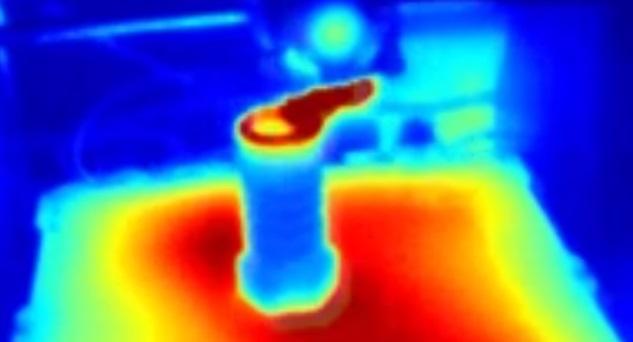
Sometimes it is difficult for newcomers to 3D printing to understand the heat aspects of the technology, but thanks to a man named Frank Kinnaman, this is no longer an issue. Kinnaman decided to take his smartphone, equip it with a Seek Thermal Camera Attachment, and record his 3D printer in action. As seen in the video below, the results are quite interesting, as well as entertaining to watch. Most importantly though, they provide for an easy way for those new to the technology to understand how the heat elements of a 3D printer work.
The video depicts Kinnaman using his FFF-based 3D printer to print out some vases. As you can see, the extruder (upper portion of the video) shows the greatest amount of heat. This is where the molten plastic is melted and extruded from. Also the upper layers of the print, which were just laid down onto the object, remain pretty hot according to the thermal images. Below the vase you will also see that the build plate is giving off a lot of heat. In this case, Kinnaman is using a heated build plate.
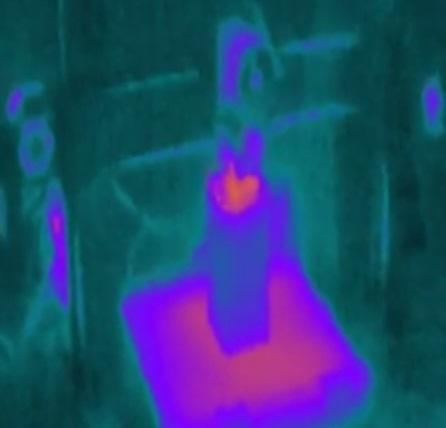 This shows exactly how heat is involved in the entire FFF printing process. Thanks to modern technology Kinnaman was able to capture this very interesting video. The thermal camera attachment he used cost him only $200, and can be found here.
What do you think about this video made by Kinnaman? Discuss in the 3D printing thermal video forum thread on 3DPB.com.
Subscribe to Our Email Newsletter
Stay up-to-date on all the latest news from the 3D printing industry and receive information and offers from third party vendors.
Print Services
Upload your 3D Models and get them printed quickly and efficiently.











You May Also Like
Roboze Opens U.S. Aerospace & Defense Headquarters in El Segundo
The manufacturing sector is made up of clusters: “geographic concentrations of interconnected companies” that both cooperate and compete with each other. Of course, this is true about any sector in...
EOS Invests $3M In Its Texas Manufacturing & Logistics Facilities to Serve North American Customers
The trajectory of reshoring under President Trump has been largely a mixed bag so far. While tariffs still seem to be doing more harm than good to the U.S. domestic...
At AIAA SciTech 2026, 3D Printing Was Part of the Workflow — Part I
The AIAA SciTech Forum 2026 brought much of the aerospace community together in one place. With roughly 6,000 attendees, 115 exhibitors, 21 sponsors, and nearly 3,000 technical paper presentations, the...
€73 Million Investment Round into SWISSto12
SWISSto12 is on the move. I think that the firm owns one of the most promising and profitable applications for 3D printing, RF components, and it is showing real growth...