New FACTUM High Speed Sintering 3D Printer, Prints Objects In Under a Second

The biggest obstacle to widespread adoption of 3D printers as a manufacturing tool, as well as a tool for the home, has been the speeds at which objects gradually materialize. No company will directly print out a product  when it takes them hours to do so, and hobbyists often shy away from the technology, claiming that they don’t have the patience.
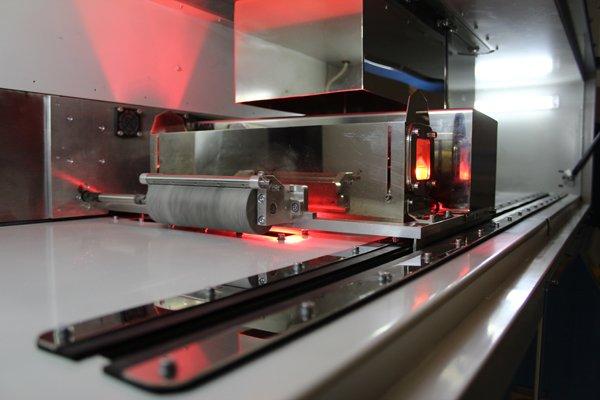
In what is being described as a major 3D printing breakthrough, researchers at the Universities of Sheffield and Loughborough created the FACTUM 3D printer. The printer uses what they are calling high speed sintering technology (HSS). Currently the FACTUM printer is using plastic polymer materials in the form of powder, but eventually could broaden its scope of material options. Instead of using an extruder like many polymer based 3d printers do to slowly melt the plastic into a layer that is placed methodically in a given pattern, or using a laser to sinter metals as they are deposited, FACTUM uses a sweeping heat lamp to sinter larger areas of the material at a lower temperature. The ironic part is that the lamp applies heat to the material 10,000 times longer than a laser does, yet the print process is exponentially faster.
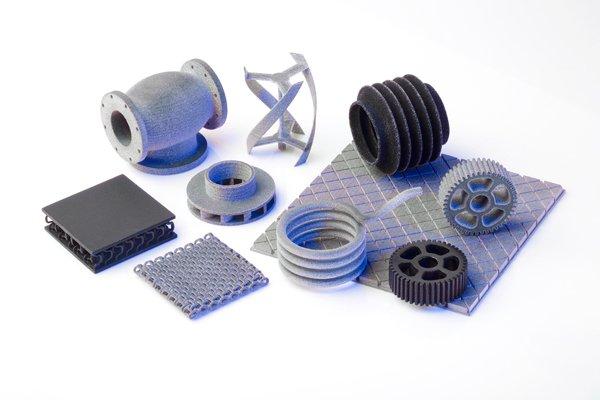
These Items can all be printed in about one second flat
In a test, the printer could print out entire finger sized polymer objects in under a second. A typical fused deposition modeling printer like a Makerbot Replicator would easily take 30 minutes to an hour to do the same job.
British printing company Xaar teamed with the researchers to developed special inkjet technology for the FACTUM 3D printer, and it is one of the key technologies that allows this printer to work at such amazing speeds. In addition, both Unilever and BAE Systems have teamed up to explore possible applications for the technology.
“The fact that it has attracted the interest of the likes of Unilever and BAE Systems underscores this potential,” said David Chapman, the developer of Xaar’s inkjet system. “Inkjet is at the heart of this technology and by working with our supply chain partners, Xaar is committed to bring this technology to market.”
This technology is sure to drive more companies towards 3D printing, and if commercialized for hobbyists, it could really push the technology quickly into the mainstream.
“We can imagine lots of applications where products are currently made in CNC machining out of aluminium because the part is made in small quantities and moulding it is cost prohibitive, so the choice is to machine it and this dictates that the material should be metal. If you are going to use HSS and you don’t have to consider the cost of tooling, you don’t have to consider machining – therefore the part doesn’t have to be metal. So we see a lot of opportunities particularly in low production up to a few thousand where we think these technologies will displace the CNC machining market,” said University of Sheffield’s Professor Neil Hopkinson, of the Department of Mechanical Engineering, who was on the research team that invented HSS.
Specific details are still limited on this new printer, but they are certain to emerge over the coming weeks and months ahead. Head over to the FACTUM forum thread to discuss this technology and share new information as it becomes available to the public. [Source – tctMagazine]
Subscribe to Our Email Newsletter
Stay up-to-date on all the latest news from the 3D printing industry and receive information and offers from third party vendors.
Print Services
Upload your 3D Models and get them printed quickly and efficiently.











You May Also Like
AM Demand Signals: Global Grid Resilience
We’re one year and a few days removed from the DeepSeek meltdown that rocked U.S. equity markets, not to mention the de facto U.S. AI brain trust, with fears that...
Critical Alloy Powder Manufacturing: CAPP Prioritizes AM Feedstocks and Advances U.S. Materials Leadership
Scaling additive manufacturing (AM) supply chains, particularly for metal powder-based processes, depends on the economic viability of products. The development of critical high-temperature metal alloys in powder form requires customer...
3DPOD 290: 3D Printing Since 1993 with Rajeev Kulkarni, Axtra3D
Rajeev Kulkarni was an early 3D Systems employee. He would spend 29 years at 3D Systems and was their VP of Corporate Strategy, CPO Printer Products, Manager of their Desktop...
The AM Adoption Problem No One Models
Through its short history, Additive Manufacturing has been presented to the investment community as a classic high growth technology story. Manufacturing is a multi-trillion-dollar market. Even a small percentage looks...