3D Printed Musical Notation Makes Reading Music Easier for Visually Impaired


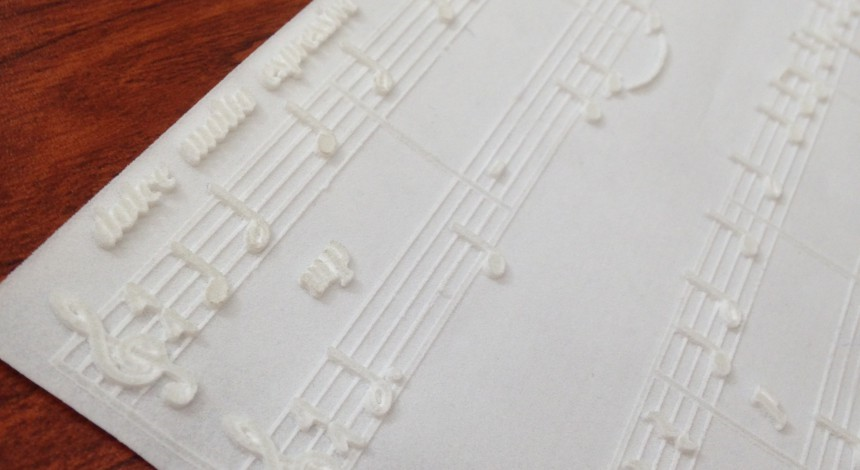
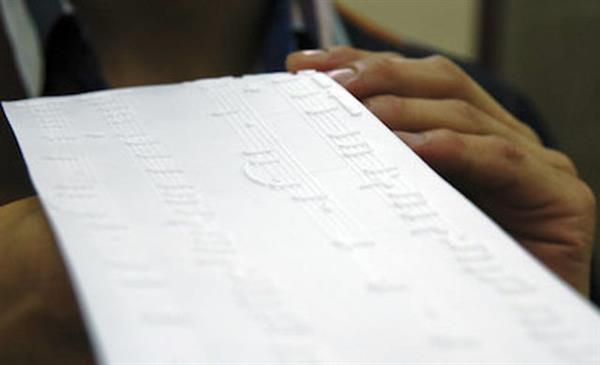
 Whenever I hear a story about how 3D printing is being used to help people who have limiting physical conditions of some kind, I always think that this one is my favorite story. Take for example, the idea of reading music while blind– the subject of this story. Traditionally, braille is used for musical notation, but apparently that has proven rather “complex and daunting” for music students. Then, as part of her doctoral dissertation work at the University of Wisconsin, Yeaji Kim developed a 3D printed universal notation system called Tactile Stave Notation, as we briefly covered back in January. This was done out of Kim’s own desire to have a more accessible musical notation system that corresponds with the standard notation system.
The only real way for this system to work is for notes to be raised on sheets. Students can learn notes through touch, and they are touching the same notes the music teacher is using too. Wow: just think about how much better communication is improved. Better communication equals better and faster learning.
University of Wisconsin Professor of Piano and Pedagogy Jessia Johnson emphasizes how much this new system helps people make music:
“This system is incredibly innovative. The potential impact on the way music is studied [and] learned as well as the way that it will allow more people access to diverse types of music is very exciting.”
Also exciting is the role that 3D printing plays in bridging this previous gap between teacher and student. For this project, a Selective Laser Sintering (SLS) 3D printer is used. This kind of machine layers powder onto a printing bed and a laser will selectively melt certain portions of the powder, “sintering” two layers. The layers are partly attached to each other, allowing for two different layers to depict the musical score.
“The main advantage of this process is the resolution you can get,” explained William Aquite, a research associate in the department of mechanical engineering. “The resolution you can achieve is one-four-thousandth of an inch so it is very high accuracy.”
 Again, wow. I still can’t get over how revolutionary this change is in musical notation. The inventor of this system, Kim, is back in South Korea but receives prototypes regularly for her to test out. It’s important for her to test the prototypes for accuracy so that she doesn’t cut herself on residual powder. The resolution is a constant process that engineers and Kim work on — to get it just right.
On a final note (pun intended) there is no software or programming to translate sheet music into 3D printable musical notation, so engineers are working to adjust levels and corner sharpness for the “most readable notation.”
I wonder if that kind of software is upcoming. This all now seems so essential, so fundamental for the expansion of musical access to all people, that I wouldn’t be surprised if someone was currently working on this.
In the meantime, we can marvel at what an incredible development this is for music education, music composition, and 3D printing. Discuss this story in the 3D Printed Musical Notation forum thread on 3DPB.com.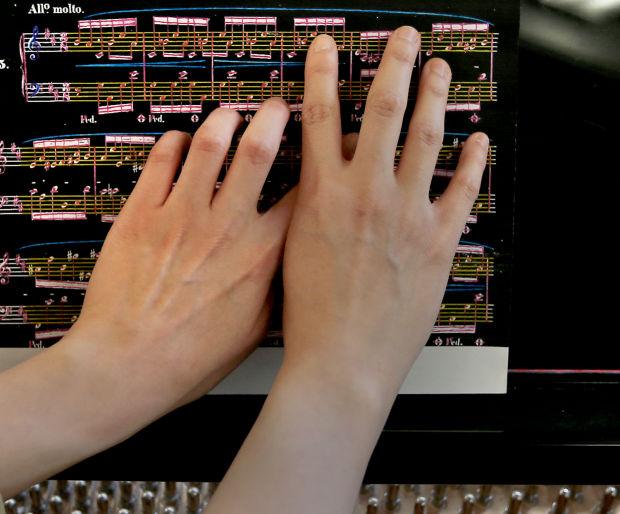
Subscribe to Our Email Newsletter
Stay up-to-date on all the latest news from the 3D printing industry and receive information and offers from third party vendors.
Print Services
Upload your 3D Models and get them printed quickly and efficiently.













You May Also Like
AM Investment Strategies 2026 Sets the Stage for AMS 2027
AM Investment Strategies 2026 Nov. 5 · 12 p.m. ET · Free online event RESERVE YOUR SPOT ↗ A one-hour online discussion featuring some of the biggest names in 3D...
With Its Latest $200M Round, ICON May Be Running Away With the 3D Printed Construction Market
I used to view ICON, the Austin-based additive construction (AC) firm, as one of a handful of companies that could realistically consider itself the leader of the 3D printed construction...
How Should Businesses Build New Business? Dirk Simon Weighs In — Part 1
Dirk Simon had deep experience in materials and chemistry before joining the 3D printing industry. Instrumental in BASF and Farsoon’s market introduction, Dirk has spent a lot of time thinking...
3D Printing Services Near $2.5B as AM Market Shifts Beyond Hardware
The additive manufacturing market may be growing again, but one of the more interesting numbers behind that recovery has little to do with selling 3D printers. AM services generated nearly...