India: 3D Printed Heart Model from Sahas Softech Takes Risk out of Complex Pediatric Surgery


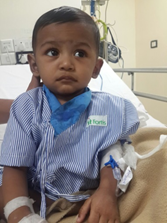
Baby Lavesh
While it’s incredibly terrifying to have a family member–and especially your tiny baby–diagnosed with a heart condition that requires a complex surgery, it’s also incredibly inspiring to see what a new technology can do not only to save a life but to restore it to a much better quality as well.
In the case of 11-month-old Lavesh Navedkar, everyone involved was thanking their lucky stars to have an intricate 3D model available, outlining the condition. Thanks to Sahas Softech LLP, this was made available in an exact replica of the tiny heart.
Not only are 3D models a great educational tool for the patients and their very concerned families, but they also serve a much higher and even more important purpose in guiding surgeons from the beginning, in making a much more educated diagnosis, through training and rehearsing, and very importantly–right into the operating room.
Taking it upon themselves as a challenge, free of cost to the patient and hospital, to see that this baby was given every opportunity for the best possible outcome, the team at Sahas had an exact 3D printed replica made within two days of receiving the MRI scan. They spliced it in cross sections for two separate views as requested, and delivered the 3D models to the hospital with all fees waived.
This was a crucial part of making a decision in what to do for the baby as in discovering that Lavesh had a complex congenital heart defect, beginning to choose a plan of action was fraught with great conflict on the part of the medical team. Performing heart surgery on anyone is 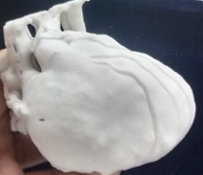 obviously a serious procedure, but with a baby, it’s even more complex.
Lavesh was not gaining weight properly, and after doctors ran tests, they found him to be suffering from a complex cyanotic congenital heart defect called DORV (Double Outlet Right Ventricle) with a large remote VSD (Ventricular Septal Defect), and 2 adequate sized ventricles. With heart surgery looming, and the specific condition at hand, medical professionals were handed two choices: the ideal plan which was too risky–or the ‘not ideal’ plan which was conservative and safe.
The ideal, but risky, plan would involve making a heart tunnel linking the defect to the aorta and allowing a way for proper drainage. Complex and requiring a great deal of planning ahead of time, surgeons knew this had the best outcome but they could not be sure that the baby would be able to survive the surgery.
Wrestling with the pros and cons, the doctors decided to look for an alternative to help with the decision–and the surgery. The following doctors were involved in seeking out assistance in 3D printing technology to help minimize risk:
- Dr. Alpa Bharati – Pediatric cardiac radiologist at NM Medical Center Bandra, Mumbai
- Dr. Swati Garekar – Pediatric cardiologist at Fortis hospital, Mulund, Mumbai
- Dr. Sulaiman Merchant – Dean at Sion Hospital, Mumbai
“3D heart models showed fine details of the structures within the heart and helped the surgeons and physicians assess the possibility of surgery and if there were any chance of likely complications as a result of surgery,” said Dr. Alpa Bharati.
In a stunning demonstration of what 3D printing can indeed do to assist in medical procedures, the doctors were able to proceed with the ideal surgery that they initially thought was too risky. Using the 3D heart model, the baby headed into surgery performed–very successfully–by Dr. Vijay Agarwal, a pediatric cardiac surgeon at Fortis Hospital, Mulund, on May 29th.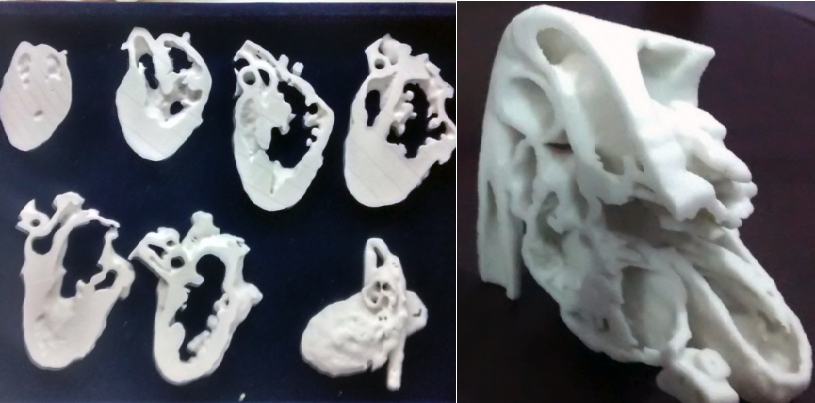
“In the absence of the heart model, it would have been difficult to confidently opt for complete repair of the heart using an intra-cardiac tunnel or baffle,” said Dr. Vijay Agarwal.
When you think about it, the assistance offered by the 3D printed model is substantial in that it allowed the doctors foresight. Without it, they may have gone into the procedure only to discover that they could not go forward as planned and would have had to move on to the lesser surgery.
“We are confident that such heart models will help not only DORV patients but possibly patients with other complex heart defects as well,” said Dr. Swati Garekar.
Due to the success of this case, now Sahas Softech is working on five other cases, providing 3D models (again, cost free) for surgeries involving children with DORV.
“We believe that by making the technology available to the masses, it will benefit a large number of patients like Lavesh, a goal that is not impossible to achieve and would have far reaching beneficial medical and socio-economic outcome,” states the Sahas team.
With each surgery, they not only gain more experience but are able to also improve techniques to the maximum degree–all around. The innovative team also focuses on using 3D printing technology for creating bones, surgical guides, low-cost prosthetic limbs, patient-specific implants, and more.
Discuss your thoughts on how 3D printing can make an ongoing impact in surgical procedures in the 3D Printed Heart Model forum over at 3DPB.com.
Subscribe to Our Email Newsletter
Stay up-to-date on all the latest news from the 3D printing industry and receive information and offers from third party vendors.
Print Services
Upload your 3D Models and get them printed quickly and efficiently.













You May Also Like
Advanced Manufacturing at IMTS 2026: 3D Printing and AI and Drones, Oh My!
Last week’s International Manufacturing Technology Snow (IMTS) in Chicago welcomed over 90,000 attendees to the jungle that is McCormick Place. With over 1.17 million square feet of exhibit space, and...
Caracol to Build Large-Format 3D Printing Hub in Milan With Designtech & LAMÁQUINA
In the 1990 classic in economic strategy, The Competitive Advantage of Nations, business theorist Michael Porter wrote, “Most commentators on the Italian economy have persistently underestimated Italy, because they have...
ETH Students 3D Print Experimental Rocket Engine
Students at the Swiss University ETH have built a Rotating Detonation Rocket Engine (RDRE). An RDRE burns propellant in a ring-shaped combustion chamber where a continuous supersonic wave detonation is...
Printing Money Episode 35: Notable VC and M&A Deals, with Arno Held and Alex Kingsbury
Welcome to Printing Money Episode 35 and let us be the last to wish you a happy new year. For this episode Danny is joined by Arno Held (Managing Partner,...