Notbroken: 3D Printed Arm Brace Soon to Get Biker Back on Track–and Biking on Mountainous Terrain


 Many of us are somewhat envious of the mountain biker’s spirit, whether they are riding in spectacular groups, circling up inclines showing off muscular strength many of us will never possess, or barreling down rocky paths. Aside from the treacherous paths winding in rocky overpasses and over rough terrain, they just exude adventure–and cause others to hold their breath viewing cliffs, drop-offs, and very, very narrow paths. What we aren’t envious of, and what most of us shy away from–whether it’s considered to be from common sense or sheer cowardice–is injury. The thought of breaking an arm or bashing one’s head on a boulder is often enough to keep many out of the mountains and home on the exercycle instead, watching re-runs of Grey’s Anatomy while we whir away on a slight incline.
While the mountains are home to a wide range of dangers, from predatory wildlife such as the mountain lion, bobcat, or bear, to unpredictable weather issues and commonplace rock slides, the world of mountain biking is a place full of unique injuries. 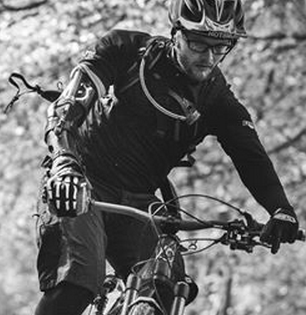 For most who are doing it right, mountain biking can remain relatively safe. There is however, most commonly, the risk of injury like broken collarbones and sprained wrists. We won’t go into the dangers of cycling right over the side of a mountain, as that’s pretty self-explanatory in terms of consequence and leaves me weak-kneed just typing about it.
The one thing most mountain bikers do have in common in terms of injuries is that they realize there is only one person to point at after a crash, and that’s themselves–not the ineptitude of emergency help, biking coordinators, the person who got in their way, or anyone else. And in the same vein, while there might be trauma–you are the only one who can see to it that you get yourself back in the saddle.
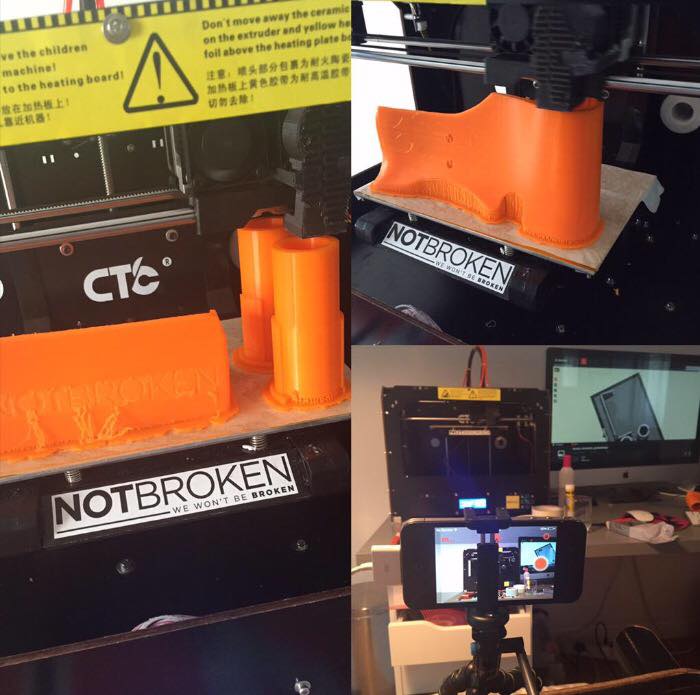
Tom Wheeler has been able to take that to another level, after a severe injury to his Brachial Plexus. Since then he has been working on a design for a 3D printed riding brace which allows cycling enthusiasts to get back out in the fresh air again. Over the last year, the brace has been evolving, with the motto “Design, print, test, repeat.” While it may be a process to achieve the desired results for the best dynamics in biking, the technologies of digital design and 3D printing together allow for affordable prototyping and re-designing until the brace fits and functions optimally.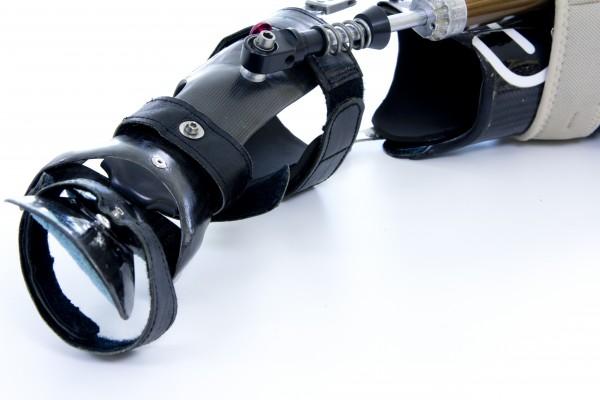
Wheeler is the founder and head of design and innovation at Notbroken, and his degree in Wearable Technology is coming in handy, along with a passion for innovation coupled with a stubborn spirit. Involved in mountain bike racing since the age of three, giving up on the sport was simply not an option for Wheeler. Thus, Notbroken was born, and the team continues to strive toward completion of the device.
Currently being fitted for Wheeler’s use in cycling, the team hopes that soon they can make the brace for others. The prototype which they’ve achieved at this point shows off a carbon fiber wrist support, along with: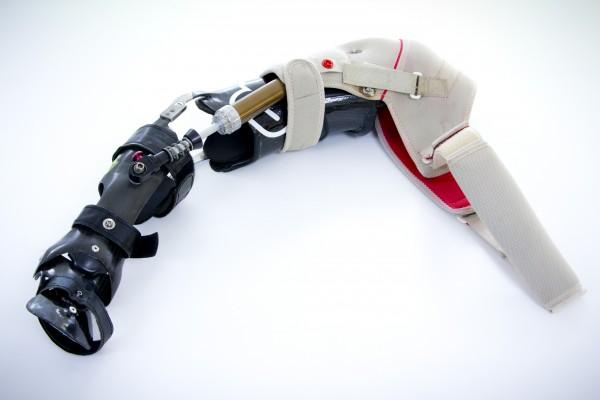
- Ottobock shoulder support
- Sas-tec foam shoulder padding
- Titanium bolts
- Custom Fox damper
The team has also been working further on development of the hand-to-bar attachment and release mechanism for riders with either limited or no hand control.
Notbroken has also been collaborating with Poppy Farrugia, PDR (International Centre for Design Research) in making a 3D printed mountain biking prosthesis that is highly functioning, although still in prototype form. The latest iteration functions with springs in each side of the hinges. He will be presenting it at TCT Live later this year, according to industry buzz.
Subscribe to Our Email Newsletter
Stay up-to-date on all the latest news from the 3D printing industry and receive information and offers from third party vendors.
Print Services
Upload your 3D Models and get them printed quickly and efficiently.













You May Also Like
Russia’s 3D Printed Missiles & Can NATO Get Its Act Together?
For most of US history, however much the two major parties differed on domestic policy (in some cases a lot, overall less than you’d think), there was always essentially a...
3D Printing News Briefs, October 21, 2026: Digital Twins, AI CAD Service, AR Smart Glasses, & More
In today’s 3D Printing News Briefs, America Makes announced the winners of its MIAMI Project Call, and AM Europe released a new report. Artec 3D launched its new Artec Twins...
3D Printing News Briefs, October 10, 2026: Drones, WAAM, Ceramics, & More
We have a packed 3D Printing News Briefs for you this weekend! First, America Makes celebrated the recent National Manufacturing Day with 3D printed drones, and then it’s on to...
The Manufacturing Race Behind the Drone Revolution
We are in the middle of a major manufacturing shift focused on the production speed and payload capacity of uncrewed aerial systems (UAS), or drones. A recent Manufacturing Dive article...