UC Davis Students Build Robotic “Project Naughty Ball”

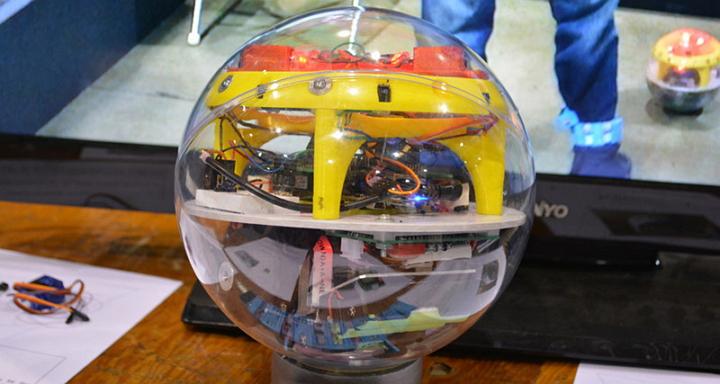 Hengjiu Kang, Yi Lu, and Yunan Song are students at the University of California Davis, juniors and seniors with a mighty impressive list of career-starting projects and internships. Kang is a member of the Formula SAE team, Lu has completed a pair of summer internships at Honeywell and MobiTV as a software engineer, and Song interned at BMW headquarters in Munich.
Two of the trio are electrical engineers and one a mechanical engineer, and their latest project is a robotic ball which rolls about in search of anyone wearing an infrared-powered ankle strap.
They call it Project Naughty Ball.
The team say they wanted to create an intelligent, robotic ball which didn’t need a handheld controller to function. They say they didn’t like the idea of a handheld controller as it restrains a user’s movement.
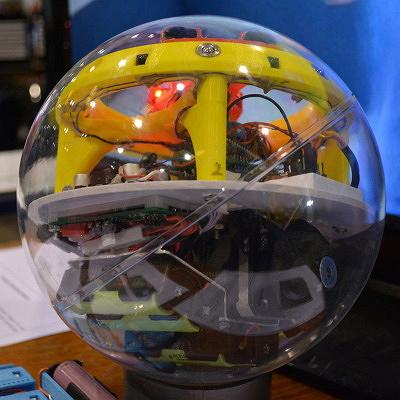 So in place of the handheld control, they used IR Track technology and indoor positioning technology to make their robotic ball be aware of the user and its environment. A mechanical module encased within the ball controls the direction of motion by shifting its center of gravity to move closer to or further away from the user.
They began with two potential solutions to the problem of how the Naughty Ball would handle positioning tasks. The first solution was to use a few IR sensors from inside a Wii controller, or Wiimote, to detect the infrared emitter on a user’s wrist or ankle.
The second solution involved using a Bluetooth module installed in the robot and utilizing an indoor localization feature.
The Naughty Ball moves and changes direction with the help of an internal gyroscope and requires no external force to move.
They add that each different ball will have a different “personality.” While some iterations of the ball will try to avoid a user, some versions of the ball will “enjoy human hugs.”
“Some of the balls will smoothly rub your legs – like your pet dog – yet some will just run off to other areas if you even come close,” they said in their proposal for the project.
The team also added features to the Naughty Ball which respond to human contact by changing color and emitting sounds which reflect the sphere’s current “mood.”
The total costs for the project involved $40 for tools, $50 for the controller hardware, $40 for the 3D printed mechanical hardware and structure, and $60 for motors and sensors.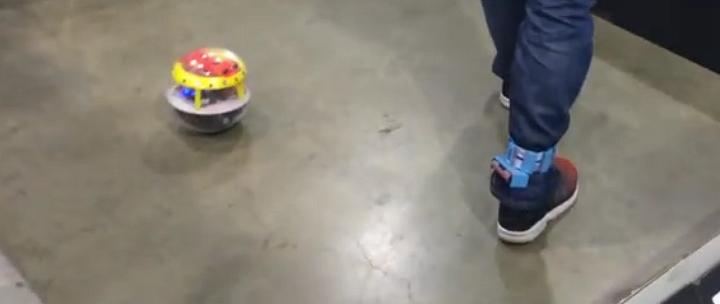
What Kang, Lu, and Song came up with is ingenious indeed; a two-wheeled, balancing bot design inside a clear plastic sphere. Batteries work to provide ballast, stepper motors, and 3D printed plastic wheels balance and steer the Naughty Ball and the upper section of the structure houses most of the necessary electronics.
Ultimately, the team settled on a BeagleBone Black board outfitted with a WiFi adapter for connection, a few motor drivers, and a novel 3D printed mount which moves the robot’s “eyes.” Infrared cameras spin around inside the ball, and they’re used to track whoever may be wearing the infrared-transmitter equipped ankle bracelet.
Kang, Lu and Song debuted their Naughty Ball at the Bay Area Maker Faire.
What possible applications can you see for the Naughty Ball? Do you think you could build your own version of this device? Let us know in the Project Naughty Ball forum thread on 3DPB.com. Check out the students’ project video introduction below.
[Source: Hackaday]
Subscribe to Our Email Newsletter
Stay up-to-date on all the latest news from the 3D printing industry and receive information and offers from third party vendors.
Print Services
Upload your 3D Models and get them printed quickly and efficiently.











You May Also Like
3DPrint.com & AM Research Present: UAS Additive Strategies, Sponsored by EOS
When your work involves a technological field, like additive manufacturing (AM), which still flies under the radar for most people, it can often feel like what you do every day...
ARC & ORNL Form Partnership to Accelerate AI-Enabled Manufacturing for Defense
Last year, Autonomous Resource Corporation (ARC) became the surprising owner of Desktop Metal’s (DM’s) assets following the bankruptcy of the one-time additive manufacturing (AM) unicorn, an acquisition that cost ARC...
HP Stock Jumps on 3D Printing Buzz
HP (NYSE: HPQ) had its best day in over a year this week, with shares jumping more than 7% on Tuesday. Interestingly, the move was quickly tied to 3D printing,...
RAPID 2026 in Pictures: The Coolest & Craziest Things on the Show Floor
Last week, North America’s premier 3D printing trade show, RAPID+TCT 2026, came to Boston. I spent two days trekking the show floor, trying to see as much as I could,...