3D Systems Working with Navy to Evaluate & Fulfill Strategic 3D Printing Initiatives

 While the general public is getting the point that 3D printing is a valid technology progressing on an almost daily basis, we all still tend to sit up and take note of what the military is using it for–as well as those of other countries–as it usually tends to be very for interesting purposes. And it makes sense that the US military, with all its might, would endeavor to make the best use of one of the most stunning new technologies that’s responsible for breaking so many barriers today.
 The latest announcement regarding 3D printing and the military arrives via a cooperative R&D agreement between 3D Systems and Naval Sea Systems Command’s (NAVSEA) Naval Surface Warfare Center Carderock Division (NSWCCD), for plans on a broader scale. The partnership between the two will allow 3DS to “fulfill a number of strategic initiatives” regarding military use of 3D printing.
“The US Navy is at the forefront of a concerted military effort to integrate 3D printing into their operations,” said Neal Orringer, 3DS’ Vice President of Alliances and Partnerships. “Through their Print-the-Fleet initiative, the Navy is educating sailors on the latest in digital manufacturing and accelerating adoption of 3D printing. We’re proud that our technology—our direct metal printing and our advanced polymer materials—are going to play an integral part in the Navy of the future.”
This agreement will initiate evaluation of 3D printing technology and materials for the Navy. With the use of this technology also comes new education and skillsets for soldiers and officers who will be able to use and learn to maintain the machines, as well as being part of incredible new innovations supporting military ventures.
”Additive manufacturing has the potential to be a truly disruptive technology and shows great promise for supporting Naval Sea Systems components,” said Jennifer Wolk, NSWCCD’s Additive Manufacturing Lead. “However, a great deal more needs to be done to ensure this technology can be qualified for repeatable, safe, and effective use. This cooperative research and development agreement is an important step toward broader utilization of this technology.”

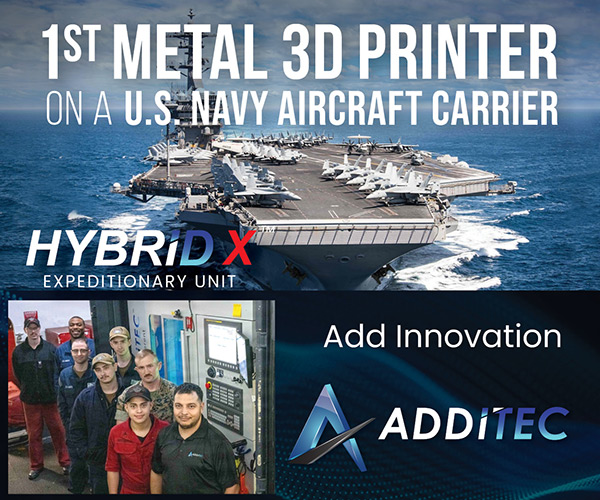
USS Essex, home to the very first 3D printer on a naval ship
One of the most valuable aspects of 3D printing, aside from the transformations it offers to manufacturing in terms of innovation and affordability, is that of self-sustaining power. Because military operations often require ships–as well as soldiers–to be in remote regions where products are not easily accessible–to have the power of 3D printing in terms of simply making tools and more gives a real boon to forces out in the field, as well as offering overall advantages for life at sea or even on the battlegrounds.
While 3D printing has proved itself to be of enormous benefit in many sectors, we’ve also reported on the many ways it’s beginning to serve our country, as well as others, in myriad ways. We’ve reported on everything from 3D printed body armor to warheads and food. Putting 3D printers on naval ships has been a topic over the past couple of years as well, with the first 3D printer installed on a naval ship, the USS Essex, last year. Considering the exciting innovations the military has entertained so far, no doubt we will all be interested to see what follows from this latest deal between 3DS and the Navy.
How ingrained do you think 3D printing will become in the military? Discuss in the 3D Systems Inks Deal with Navy to Evaluate 3D Printing forum thread over at 3DPB.com.
Subscribe to Our Email Newsletter
Stay up-to-date on all the latest news from the 3D printing industry and receive information and offers from third party vendors.
Print Services
Upload your 3D Models and get them printed quickly and efficiently.












You May Also Like
The Manufacturing Race Behind the Drone Revolution
We are in the middle of a major manufacturing shift focused on the production speed and payload capacity of uncrewed aerial systems (UAS), or drones. A recent Manufacturing Dive article...
ADDMAN to Buy Up to $10.8M in Nickel 718 Powder from 6K Additive Over 30 Months
After years of buildup, we’re finally starting to see what the US metal additive manufacturing (AM) market could look like at scale. To be sure, it’s still not quite there,...
Metal AM in a Multipolar World, Part 2: How PBF and DED Could Change by 2035
The first decades of PBF development were heavily shaped by machine capability: more power, more lasers, larger build volumes, better recoating, and improved process monitoring. These developments will continue, but...
Advanced Manufacturing at IMTS 2026: 3D Printing and AI and Drones, Oh My!
Last week’s International Manufacturing Technology Snow (IMTS) in Chicago welcomed over 90,000 attendees to the jungle that is McCormick Place. With over 1.17 million square feet of exhibit space, and...