ATSmake Announces Six New 3D Printers, Including the Jupiter 2

 China is becoming quite the 3D printing superpower. Although there are the usual pop-up companies, which simply copy ideas of established European and American products, there are other companies like ATSmake that are innovating, creating their own unique printers for this expanding market.
Shenzhen-based ATSmake (Artisan Make) was launched back in September of 2011, and has slowly been expanding their 3D printing product offerings. In September of last year they unveiled their ‘Make’ SLA printer, followed by the release of their ‘Mars’ FFF machine in December. Here we are four months later and the company has just announced a laundry list of new 3D printers they will soon be making available.
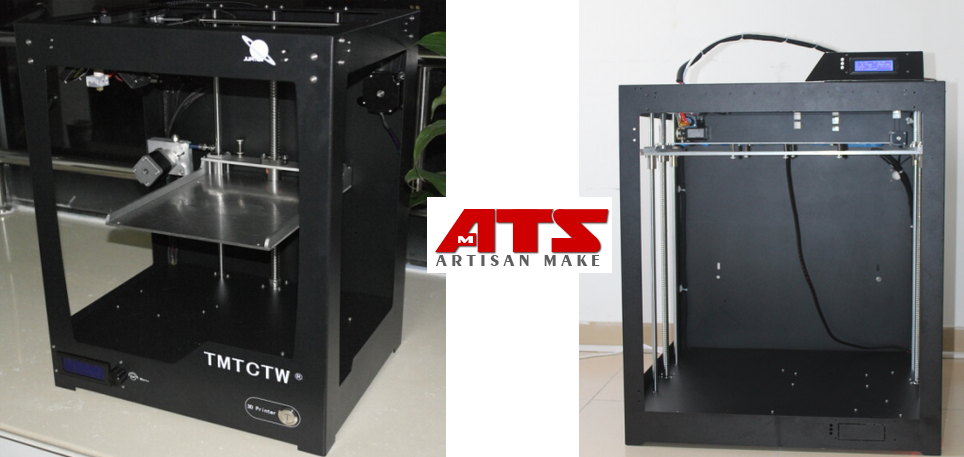
Ranging in all sizes and price ranges, this announcement certainly puts ATSmake, at, or close to, the top of the Chinese desktop 3D printing space. Below you will find each machine along with their general specifications:
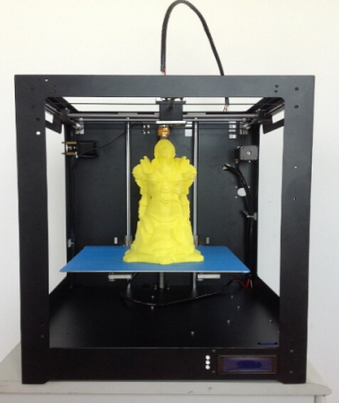
ATSmake Jupiter 2
This machine has an above-average build envelope, relatively fast print speeds, and prints objects with high resolution. It will be priced at $1070 with one-year warranty, and the following specs:
- Build Envelope: 300 x 200 x 360 mm
- Printing Accuracy: 0.1mm – Positional Accuracy: X/Y (6 microns), Z (1.5 microns)
- Printer Weight: 25kg
- Printer Size: 450 x 360 x 560 mm
- Layer Thickness: 0.1mm
- Nozzle Diameter: 0.4mm
- Max Print Speed: 250mm/sec
- Filament Size and Compatibility: ABS and PLA at 3mm
- Connectivity: USB2.0 or SD Card
- Languages Supported: Chinese & English
The company has also just announced a range of five different machines, all with varying build volumes. In order from small to large, these include the ATSmake 250, ATSmake 300, ATSmake 450, ATSmake 500, and ATSmake 600. Below you will find the shared specifications that these five machines include:
- Layer Thickness: 0.1mm
- Nozzle Diameter: 0.4mm
- Connectivity: USB2.0 or SD Card
- Languages Supported: Chinese & English
Below are the specs which are specific to each of these new printers:
- ATSmake 250: Build envelope of 250 x 250 x 250 mm, print speed of 40-300mm/s
- ATSmake 300: Build envelope of 300 x 300 x 350 mm, print speed of 40-300mm/s
- ATSmake 450: Build envelope of 450 x 450 x 600 mm, print speed of up to 200mm/s
- ATSmake 500: Build envelope of 500 x 200 x 1000 mm, print speed of up to 200mm/s
- ATSmake 600: Build envelope of 600 x 600 x 1000 mm, print speed of up to 200mm/s
All six new machines should be available shortly, with further pricing details forthcoming. Let us know if you have used any of these new 3D printers and what your thoughts have been. Discuss in the ATSmake forum thread on 3DPB.com.
Subscribe to Our Email Newsletter
Stay up-to-date on all the latest news from the 3D printing industry and receive information and offers from third party vendors.
Print Services
Upload your 3D Models and get them printed quickly and efficiently.













You May Also Like
The Manufacturing Race Behind the Drone Revolution
We are in the middle of a major manufacturing shift focused on the production speed and payload capacity of uncrewed aerial systems (UAS), or drones. A recent Manufacturing Dive article...
ADDMAN to Buy Up to $10.8M in Nickel 718 Powder from 6K Additive Over 30 Months
After years of buildup, we’re finally starting to see what the US metal additive manufacturing (AM) market could look like at scale. To be sure, it’s still not quite there,...
Metal AM in a Multipolar World, Part 2: How PBF and DED Could Change by 2035
The first decades of PBF development were heavily shaped by machine capability: more power, more lasers, larger build volumes, better recoating, and improved process monitoring. These developments will continue, but...
Advanced Manufacturing at IMTS 2026: 3D Printing and AI and Drones, Oh My!
Last week’s International Manufacturing Technology Snow (IMTS) in Chicago welcomed over 90,000 attendees to the jungle that is McCormick Place. With over 1.17 million square feet of exhibit space, and...