Eurostar E3000 Satellite Project Features First Space-Qualified 3D Printed Aluminum Part

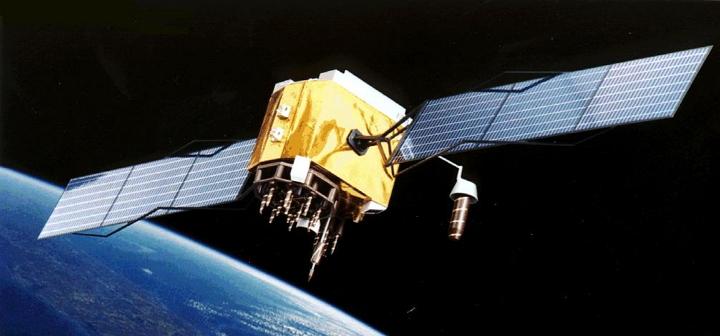 The Eurostar E3000 is a generic satellite model often used for commercial and military communications. Manufactured by Astrium, the system uses a bi-propellant chemical propulsion system and an optional plasma propulsion system (PPS) which captures the Newtonian effect from the ionization of xenon gas and hall-effect plasma thrusters. The E3000 was also the first commercial satellite system to make use of lithium-ion batteries to keep it powered up during eclipses.
The system is not small. It weighs in at between 9,900 and 13,200 pounds, and includes solar arrays of between 115 and 148 feet wide which can make up to 16 kilowatts of power.
Airbus Defence and Space say more than 50 Eurostar satellites have been built and delivered since the launch of the first iteration, the Inmarsat-2 F1, which was in service for more than 20 years. The latest version, Eurostar E3000, can be loaded with 100 transponders, a number of antennas, and payload power ranging from 4 kW and up to 14 kW.
Now Airbus Defence and Space in the UK says they’re producing their first space-qualified 3D printed components from aluminum. The parts are the result of a two-year-long research and development program undertaken by the UK National Space Technology Programme via Innovate UK and the UK Space Agency.
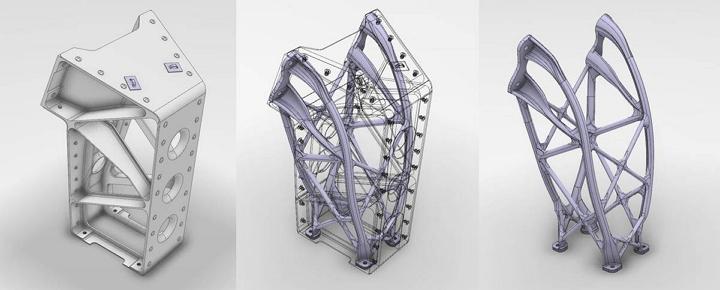
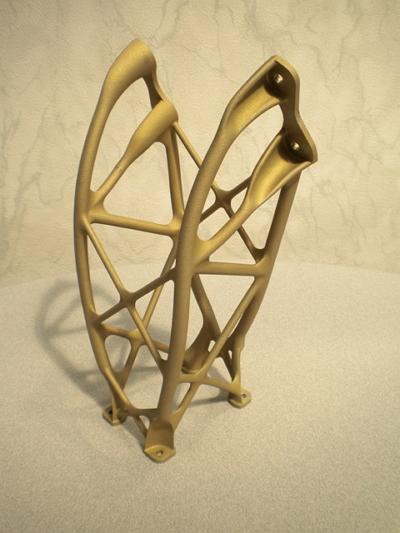
Eurostar E3000 bracket (photo copyright Airbus Defence and Space Ltd 2015)
The UK team say these new 3D printed components cannot be manufactured using conventional manufacturing methods, and they include a structural bracket built using aerospace-grade aluminum alloy. The Airbus Group has started using ALM (additive layering manufacturing) for tooling and prototyping parts for test flights and for parts that will fly on commercial aircraft. The company says components produced with ALM are beginning to appear on the A350 XWB the jetliners in the A300 and A310 line.
 The first flight-qualified ALM part — a titanium alloy bracket from Airbus Defence and Space — is already flying aboard the Atlantic Bird 7 telecom satellite, and the Unmanned Aerial Vehicle “Atlante” features a 3D printed air intake.
The space-qualified part in question, made as a single piece via laser melting, weighs 35% less than the previous bracket. The part it replaces was made up of four separate pieces and included 44 rivets. In comparison, the additively-manufactured piece which replaces it is now 40% stiffer and no waste results from the process as would be were it created by conventional machining.
This bracket is made to mount the telemetry and telecommand antennas to the E3000 and the fact that it has successfully completed flight qualification testing means it’s ready to be flown immediately as part of an upcoming satellite mission.
“Producing the first flight qualified ALM component is a major milestone and the result of two years of great teamwork funded by Innovate UK in partnership with our suppliers,” says Amy Glover, Senior Spacecraft Structures Engineer on the project. “Through developing and proving the design and manufacturing process, which significantly reduces the testing required, we can now look at what other opportunities there are for ALM components that will be lighter and quicker to manufacture.”
The bracket was manufactured for Airbus Defence and Space by 3T RPD Ltd, an additive manufacturing company based in Newbury, UK.
There are also plans to build parts with similar AM construction techniques such as waveguides, heat exchangers, propulsion components, secondary structures, and fuel tanks.
Airbus Defence and Space is a division of Airbus Group, and it was formed by integrating the business activities of Cassidian, Astrium, and Airbus Military. It’s Europe’s number one defense and space enterprise, and the second largest space business worldwide. The company employs more than 38,000 people and generates revenues of approximately $13.8 billion per year.
Do you work with aerospace additive manufacturing processes? Have you heard of projects which use 3D printing in aerospace or spaceflight applications? Let us know in the First Space-Qualified 3D Printed Aluminum Part forum thread on 3DPB.com.

Subscribe to Our Email Newsletter
Stay up-to-date on all the latest news from the 3D printing industry and receive information and offers from third party vendors.
Print Services
Upload your 3D Models and get them printed quickly and efficiently.













You May Also Like
HG Laser & The Overlooked Sources of China’s Advanced Manufacturing Strength
Chinese state-owned enterprise (SOE) HGTech (Huagong Tech) just reported that it achieved record revenue in H1 2026, amounting to just over $1 billion. The company credited the results to success...
3D Printing Financials: $28M in China, U.S. Deals and a Metal AM Comeback
Money continues to go into additive manufacturing (AM). From a $30 million raise for a Chinese metal 3D printing company to new funding for naval AM and a European company...
AMAsia Pulse: AM Investment Picks Up Across Asia-Pacific
The first half of September brought fresh investment and expansion activity across Asia-Pacific’s additive manufacturing sector. China’s Xinjinghe secured funding for an aerospace AM hub, South Korea’s Lincsolution outlined plans...
3D Printing Market Hits $4.48B After Six Straight Quarters of Growth
The additive manufacturing market continued to grow in the second quarter of 2026, adding another quarter to what is becoming a much more consistent expansion for the industry. Worldwide revenue...