Clinton Freeman Offers Advice and Info on 3D Printing Filament and Moisture Damage

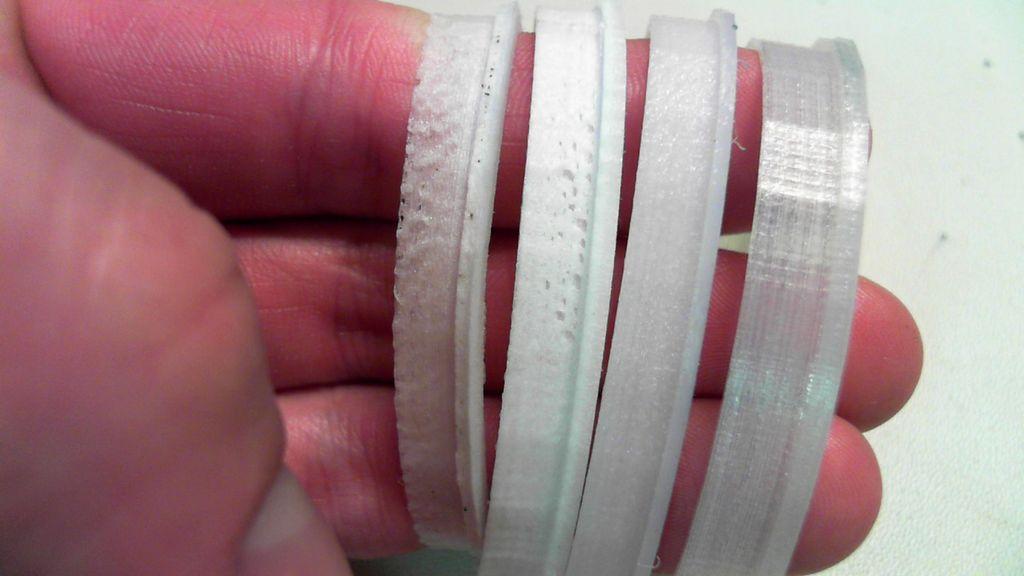
The effect of varying levels of moisture in objects printed with nylon filament.
Clinton Freeman of RepRage has some excellent advice for storing 3D printer PLA filament to avoid moisture problems.
Freeman is a Senior Software Engineer at NICTA in Brisbane Area, Australia, and he also worked for the State Library of Queensland and is a graduate of the University of Sydney.
He’s also a 3D printing aficionado, and he recently became interested in making a study of all the different ways people store PLA (polylactic acid) filament.
While there is no lack of available material being explored for 3D printing, by far the most common plastic materials are ABS and PLA. Both are thermoplastics, are excellent for formation into raw 3D printer feedstock, process well during 3D printing operations, and offer useful levels of strength, durability, and gloss.

Clinton Freeman
Both ABS and PLA work most efficiently if they are sealed off from suffering the absorption of moisture from the surrounding environment. ABS can be dried using a source of hot, dry air, and though PLA can be dried, it may undergo alteration of the material’s crystallinity ratio and lead to unwanted changes in extrusion temperature characteristics.
In his investigation, he says he’s found a wide range of solutions that range from very simple to very elaborate PLA humidors.
“It was enough to spook me, and change the way I stored my stock of PLA filament,” Freeman says. “But I was still skeptical. I had more questions than answers. The first came up often: Absorb water? That doesn’t make sense. Isn’t PLA a plastic and waterproof?”
According to Freeman, experiments that examined how moisture and starch content affect PLA plastic were done by submerging PLA in stainless steel tubs filled with water for 30 days.
Before and after comparisons of the filaments following 30 days in water showed that they increased in weight by some 1-6% as the liquid was absorbed.
 Freeman says moisture damaged PLA can cause a variety of problems, two of them critical, in the process of 3D printing: it can damage the printer itself as swollen PLA filament can jam up the printer’s hot end and even require it to be replaced; and second, the moisture trapped inside the filament can turn to steam when a rapidly heated hot end creates unwanted pockets and bubbles within the finished object.
The scientists also tested the strength of the prints which resulted from filament exposed to various levels of moisture and found that the more water absorbed by PLA, the weaker the objects became as a result. In fact, the filament stored for 30 days in water showed a reduction in the tensile strength of output objects by 6%, but once it was re-dried, the tensile strength of PLA fell 33%.
In his excellent article, Freeman offers a number of useful tips to make sure your PLA filament performs at peak efficiency.
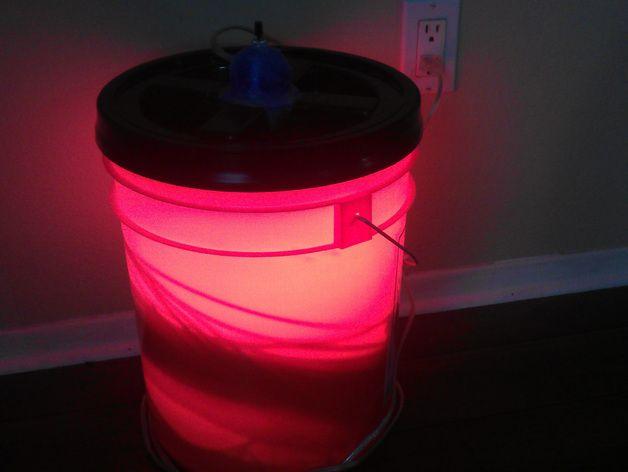
Nylon filament can be adversely affected by moisture as well, and you can find a design for a filament dryer over at Instructables.
Have you got any advice for us on the proper ways to store and prevent moisture damage to 3D printing filament? Let us know in the 3D Printing Filament and Moisture Damage forum thread at 3DPB.com.
Subscribe to Our Email Newsletter
Stay up-to-date on all the latest news from the 3D printing industry and receive information and offers from third party vendors.
Print Services
Upload your 3D Models and get them printed quickly and efficiently.











You May Also Like
Subaru’s Adoption of T25 High Speed Head Reinforces Stratasys’ Dominance in 3D Printed Automotive Tooling
Last September, AM Research published a white paper sponsored by Stratasys on the role of additive manufacturing (AM) in enabling point-of-need tooling production across various industries. The white paper, “3D...
Why Superior, Affordable Chinese AM Machines Are a Great Chance for the Industry
Additive Manufacturing is entering a decisive phase. Consolidation is no longer a future scenario; it is happening now. Across polymers and metals, companies are under intense pressure to become profitable,...
UK Government Partnership to Develop 3D Printed Metal Alloys for Nuclear Fusion
The UK Atomic Energy Authority (UKAEA), a government-funded research organization, has demonstrated a persistent interest in developing metal additive manufacturing (AM) materials for nuclear fusion applications, including multiple phases of...
Friction Stir Additive Used to Make Shape Memory Metal Ceramic Composites
Associate Professor Hang Yu, along with researchers Donnie Erb and Nikhil Gotawala, has used Additive Friction Stir Deposition (AFSD) to make shape-memory ceramics. Published in Materials Science and Engineering R:...