Bq Unveils Ciclop, the Open Source 3D Printable 3D Scanner at 2015 CES

 As I walked around CES this week there was one theme this year that stood out in the 3D printing section of the show: 3D scanning. It seemed like every fifth or sixth booth had some sort of scanner being showcased. Most impressive thus far has been Fuel3D’s handheld point-and-shoot scanner, but probably the most unique scanner we’ve seen was by a company called bq, based out of Spain.
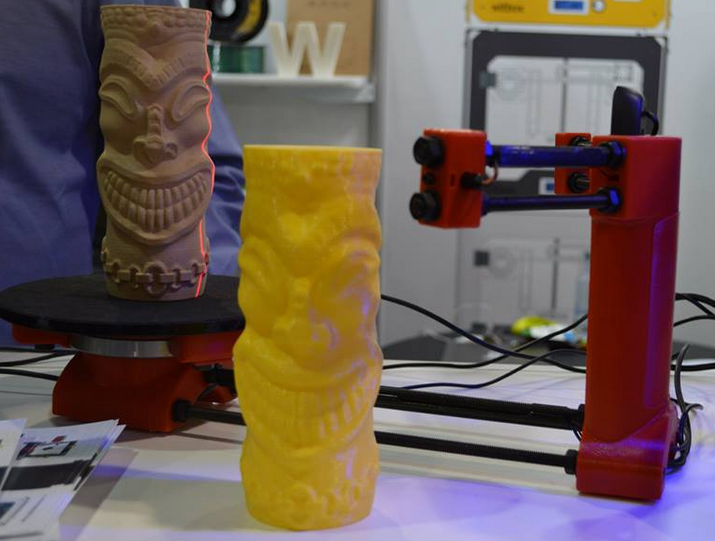
Bq manufactures smartphones, tablets, E-readers, 3D Printers, and now 3D scanners, and was present at CES to showcase several products, including their new Ciclop 3D scanner. The scanner, which utilizes laser triangulation methods and a rotating turntable, is actually 3D printed itself.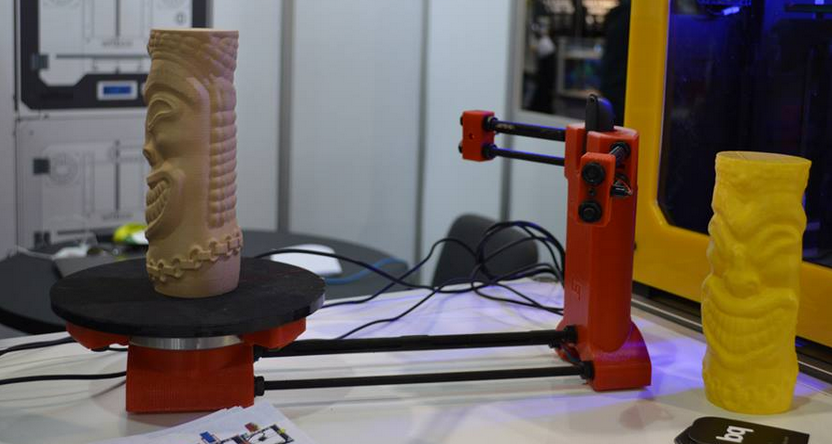
We were told that the Ciclop is not available for purchase as of yet but will be later this year for under $500. Additionally, the design is entirely open source, and the files one can use to 3D print its main components will be made available online free of charge. This means that anyone equipped with a 3D printer and a bit of mechanical skill can build the Ciclop within a few hours, quite affordably, by only purchasing the electronic components.
The machine itself, once built, is quite a capable 3D scanner. Below you will find some of its specifications:
- Scanner size: 450 x 330 x 230 mm Dim
- Scanning area. 205 x 205 mm
- Scanner Weight: ~ 2kg
- Precision scanning: 0.5, 5 mm
- Scanning speed: 3-4. Min approx
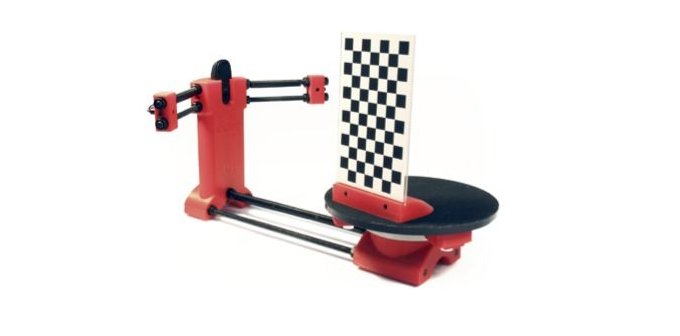
- Steps per rotation: 1600, 160
Electronics:
- Logitech C270 HD 1280 x 960 – Two Laser
- Power Supply: 12V 1.5A micro USB Cable
- Controller board: ZUM BT-328 Power Plate
Mechanics:
- Bipolar stepper motor Nema (1.7A 1.8 deg/step)
- Non-slip surface
- Threaded Rods
Software:
- Free Horus Software
- Output files: ply, stl
- Compatible with Linux: ubuntu, fedora Windows: 7 and 8
As the 3D scanning space heats up, it appears that the market will break down into three segments: portable/hand held, desktop, and high end. It will be interesting to see if the end results of each process eventually converge on one another as scan qualities improve rapid. Let’s hear your thoughts on bq’s latest scanner in the Ciclop forum thread on 3DPB.com.
Subscribe to Our Email Newsletter
Stay up-to-date on all the latest news from the 3D printing industry and receive information and offers from third party vendors.
Print Services
Upload your 3D Models and get them printed quickly and efficiently.













You May Also Like
Kickstarter is Testing the Next Wave of Desktop 3D Printing
3D printers are raising serious money again…on Kickstarter, that is. Over the last few months, a new group of 3D printer campaigns has attracted millions of dollars and thousands of...
Stratasys vs. Bambu Lab: What’s Really Behind the $27.6M Patent Verdict?
Editor’s note: This is Part 1 of a two-part series by Xu Fanglei examining the technology and patent issues behind the Stratasys-Bambu Lab dispute. Part 1 looks at the U.S....
Bambu Lab and SUSAN FANG 3D Print for London Fashion Week
At London Fashion Week, some of the more unusual pieces on the runway came from 3D printers. Chinese fashion designer SUSAN FANG presented her Spring/Summer 2027 Air-Illusion collection at the...
Stratasys Wins $27.6M in Patent Case Against Bambu Lab; Bambu Challenges Verdict
Update, September 21, 2026: This article has been updated with a statement from Bambu Lab responding to the verdict, along with additional information about the company’s ongoing patent challenges against...