How the EU is Banking on AM to Advance in the Space Race

On September 5, German space startup Isar Aerospace achieved a major milestone, for its own reputation and for the entire space industry in the European Union (EU), when it executed the first successful launch from continental Europe. Around the same time, The Exploration Company (TEC), a German-French company, announced a $450 million Series C, the largest funding round in the history of the European space industry.
Both Isar Aerospace and TEC are serious AM users, which is essentially required to compete in the industry. Meanwhile, earlier in the summer, SWISSto12, a satellite manufacturer (and metal AM specialist) based in Switzerland, landed $70 million in its own Series C. The EU is dead-set on being taken seriously in the commercial space race, and the AM industry is a major beneficiary of the economic community’s approach to accomplishing that goal.
As everyone familiar with the Pentagon’s AM buildout knows, the next thing the EU needs is to accelerate qualification, and that is precisely what it’s in the process of doing. Also in September, the European Space Agency (ESA) began a project called DIQAM: Digital Qualification Framework for Additively Manufactured Space Components, and amsight, a software provider and Fraunhofer IAPT spin-off, has been chosen to lead the twelve-month project.
amsight has ample experience with industries requiring the most rigorous qualification processes, including semiconductor capital equipment (semicap), and, notably, it has experience involving multiple different partners for real-world production environments. amsight is one of the companies that exists to help AM users manage the digital thread, a topic that looks poised to keep gaining in relevance alongside rising demand for AM parts.
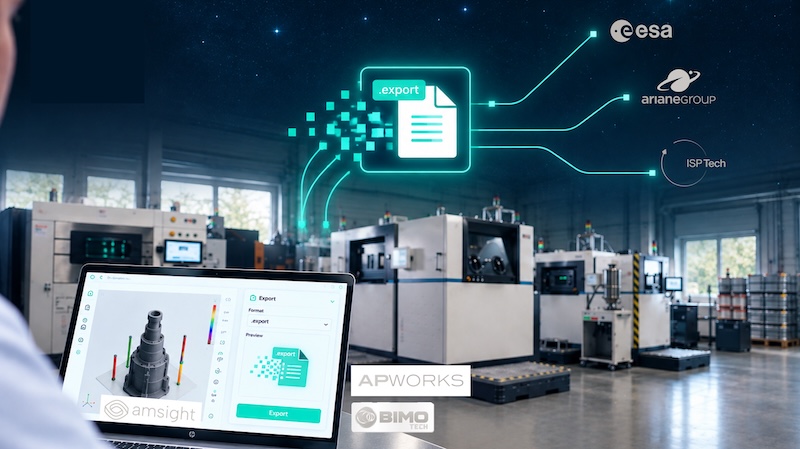
The amsight software combines all AM quality data in one software. You can check the data for compliance against customer specifications with one click.
amsight’s partners on the project are notable, as well: in addition to Fraunhofer IAPT, the DIQAM project includes Bimo Tech, a Polish advanced metals specialist; APWORKS, a German AM services firm; InSpace Propulsion Technologies (ISPTech), another German spin-off (from the German Aerospace Center); and, most importantly, ArianeGroup, a French joint venture between Airbus and Safran. The project revolves around qualifying components for two industrial demonstrators, one of which is a Phase Change Material container for Ariane’s latest-generation (Ariane 6) launch vehicle, and a propellant tank for an ISPTech CubeSat propulsion system.
Aside from its connections to two of the EU’s largest aerospace/defense firms, the involvement of ArianeGroup in this project is such a big deal because Hélène Huby, founder and CEO of TEC, started at ArianeGroup (as did a great number of other players in the EU space industry, for that matter). The TEC/ArianeGroup connection goes well beyond that one detail, and includes collaborations like the deal that TEC signed with Arianespace for the latter to launch TEC’s Nyx space capsule. Moreover, when TEC closed its Series C round, it also announced that it had received a 760 million euro (~$840 million) contract with the ESA for cargo services.
All of this suggests that the work on the DIQAM project should bear directly on the activities of the largest company in the EU space industry, which is an excellent position to be in if you’re amsight. Further, it gives us insight into how the EU space industry will likely evolve. I pointed out in my post about TEC’s Series C that, while SpaceX operates according to a peak vertical integration model, there’s no reason to think that horizontal integration can’t be just as effective a way of executing launch missions, and that the EU is a perfect test-bed for proving out this concept.
This will require the ESA to succeed at initiatives like DIQAM in similar fashion to how the US Navy, for instance, has succeeded at accumulating the gains from years of qualification projects into the Digital SEA platform. This parallel is more fitting than it might at first seem: while the EU and the Pentagon are very different beasts, they do have certain overlaps in terms of being unwieldy labyrinths of convoluted bureaucratic redundancies. If the US Navy can move AM from the lab to a digitized commercialization ecosystem, there is hope for the ESA. A digital thread capable of supporting that aim is the first step towards making a horizontally-integrated EU space industry a reality.
Images courtesy of amsight
Subscribe to Our Email Newsletter
Stay up-to-date on all the latest news from the 3D printing industry and receive information and offers from third party vendors.
Print Services
Upload your 3D Models and get them printed quickly and efficiently.













You May Also Like
3D Printing News Briefs, August 22, 2026: Polymers for CubeSats, Animal Mobility Devices, & More
We’re starting with defense news in this weekend’s 3D Printing News Briefs, before moving on to polymers for CubeSats and 3D printed prosthetics. We’ll end with a story about engineering...
Pusan National University & ORNL Develop Elastomeric Liquid Crystal Actuators
Researchers from Korea’s Pusan National University and Oak Ridge National Laboratory (ORNL) have developed 3D printed elastomeric actuators. In a paper published in Nature, the team used elastomeric liquid crystal...
Scientists Use BMF to 3D Print Seal Whiskers That Track Prey Long After It’s Gone
Seals use their whiskers to hunt. Not Navy Seals, although they may in some way also, but this article is about lowercase seals. Not Seal the musician either; as far...
Harvard’s Jennifer Lewis Lab Is 3D Printing Artificial Muscles That Twist and Bend on Demand
Researchers at Harvard John A. Paulson School of Engineering and Applied Sciences (SEAS) have developed a new way to 3D print materials that can move on their own, bending, twisting,...