Haddy’s Continued Attention to 3D Printed Drone Boats Shows Why It’s Becoming a Legit Dual-Use Contender


At some point last year, I stumbled across what has been, for me, the most valuable explanation of what ‘dual-use’ means, in this War on the Rocks article from January 2025, whose argument is summed up adequately enough in the title (but I still recommend the whole article): “Dual-Use Is a Strategy, Not a Category (Nor a Trap)“. A company isn’t being terribly informative when it says its products can be used in both defense and civilian markets. But a company demonstrating that its overall business model applies to both defense and civilian markets provides observers with very clear criteria for gauging its success.
Haddy, based in Florida and serving Disney and defense contractors alike, has emerged as an unexpectedly genuine contender amongst all the many companies out there claiming their dual-use credentials. Haddy uses robotic arm 3D printers integrated with CNC milling functions, from the Dutch company CEAD, to produce parts at its 30,000-square-foot facility. Haddy has also provided infrastructure services to Red Cat Holdings, a US drone manufacturer, to enable the latter to print drone boats at a Georgia site.
Following up on that, Haddy just announced that it has printed another vessel called the TF-179 for an undisclosed customer, and it’s possible the company was simply demonstrating the availability of a modular hull for an autonomous vessel at a moment when drone boats are reportedly experiencing “organic demand“, against the backdrop of multiple war games in the Indo-Pacific, one of which included the US military’s largest ever advanced manufacturing demonstration. As I just wrote concerning that topic, 3D printed drone boats were arguably the star of the show during this summer’s tech exhibition by the US military.
Haddy’s business model is a concise representation of why dual-use can in fact be a helpful concept. It’s pretty straightforward how and why the business model is applicable for both defense and civilian markets, when you consider the products that the company makes — in addition to drone boats, those include furniture and fixtures used in theme park design (the Disney connection) — and the process it uses to make them. Defense customers and civilian customers both have needs for large-format goods made from composites, and Haddy tailored its production capacity and competencies towards efficiently manufacturing those goods currently driving demand growth in the defense and civilian markets for composites.
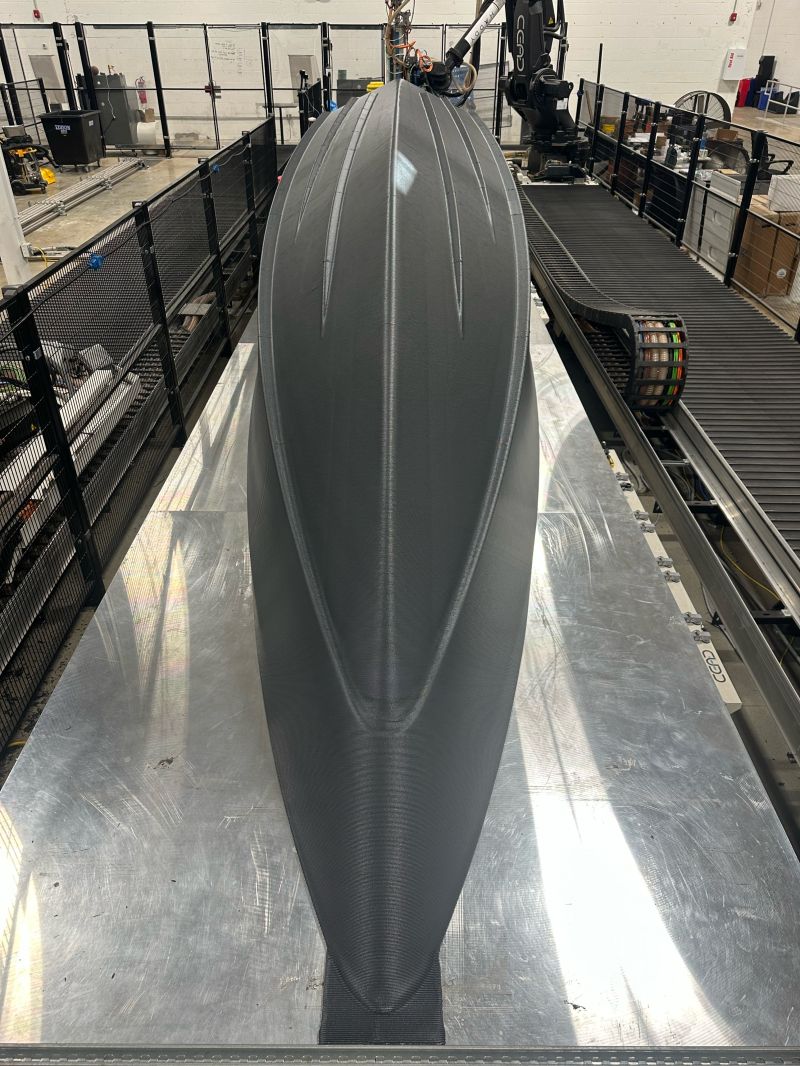
3D printed drone boat.
It’s that simple, which is what makes it work. Now, as both the defense and civilian markets progress, Haddy will have to build on that simple foundation with more complex capabilities in order to remain competitive in a market that is sure to become more and more saturated (there are lots of robotic arm composite companies out there and they all have fairly similar approaches).
Aside from the diversity and legitimacy of its clientele, Haddy is already on the right track in terms of differentiating itself, evidenced by how it’s providing manufacturing infrastructure services to Red Cat. Another step in the right direction would involve Haddy developing a strategy to target the commercial market for drone boats, moving its dual-use strategy from the process side alone to embracing both processes and products.
This is no doubt a market in its very early stages, but that’s arguably a plus for a company like Haddy, which is so early to the space overall. Personally, I think that drone boats for delivery could end up being just as viable a market in their own right as whatever ultimately becomes of the aerial drone delivery market. I don’t think everyone has put enough thought into the social and cultural implications of living in an environment with low-altitude airspace populated by flying machines. By comparison, delivery drones in a maritime setting would seem to me much less disruptive from a societal perspective.
There are plenty of other potential applications as well, with purposes similar to the civilian applications for aerial drones, such as industrial and environmental monitoring. And of course, there are opportunities beyond maritime drones that Haddy can pursue to advance its dual-use strategy. But drone boats are becoming pretty buzzy.
Images courtesy of Haddy via LinkedIn
Subscribe to Our Email Newsletter
Stay up-to-date on all the latest news from the 3D printing industry and receive information and offers from third party vendors.
Print Services
Upload your 3D Models and get them printed quickly and efficiently.













You May Also Like
3DPOD 310: Metal LPBF Under $10k with Tom Bakker, Metal-Base
Tom Bakker is a talented engineer who has worked in LPBF, custom machine building, and on semiconductor equipment. Now he wants to make LPBF metal printing cheap. With Metal Base,...
3D Printing News Briefs, August 8, 2026: Seawall Funding, Defense Capabilities, Supports, & More
We’re starting with business in this weekend’s 3D Printing News Briefs, then moving on to defense. We’ll move on to young 3D printing entrepreneurs, and finish with some research out...
3DPOD 309: 3D Printed Aquarium Pumps and a Lot More with Kristian Cleven
Kris Kleven has spent decades in engineering. First, he did demanding engineering projects for Schlumberger, Emerson, and others in the oil and gas industry. Later, he worked at NBC Universal...
3DPOD 308: Engineering Design with Matthew Shomper, Not a Robot and F13LD
Matthew Shomper has worked on 3D printed medical devices for many years. There, he specialized in new geometries, cutting-edge designs, designing implants, FEA optimization, approval processes, 510(k) submissions, textures, and...