MetalBase: An Engineer’s €10,000 LPBF Machine

Slowly, we’re coming to grips with low-cost LPBF. Companies like Xact Metal and One Click are making machines available for under $100,000. Easy to use, these are expanding the market. Meanwhile, Chinese firms are working on machines priced at $50,000 and even $25,000. But, what about a €10,000 (around $12,000) LPBF machine? Frankly, I would not have thought it possible. That is, until I interviewed Tom Bakker of Metal Base.
Tom is the founder of Metal Base, a company that wants to completely redefine what low-cost LPBF is.

Before this, Tom worked as a System Integrator at the well-regarded specialty mechatronics and machinery builder MTA. MTA makes things like microsurgery robots, nonporous thin-layer manufacturing machines, the AM Flow sorting and AI detection line, and a robot that replaces nurses in drawing blood. Before this, he worked for four years for Additive Industries as a mechatronics design engineer. I initially thought that Tom was naive, but he is not. And I assumed that he didn’t know what he was doing. But he does know what he’s doing. Indeed, given his career, he is highly qualified to engineer an LPBF machine. But, still, €10,000? Twelve grand? I didn’t even think it was possible.

Tom loved his work at VDL, which he described as taking place at the intersection of precision, hard work, and creativity. Because of his love for mechatronics and LPBF, he started experimenting at home with a 30W laser to print metal. Initially, Tom was his own recoater, manually recoating layers. But it worked… kind of. Then he experimented with a 60W laser. When he’d finished the prototype, he saw real potential. He iterated and improved his initial designs. Now Tom has sold five machines to five different customers. Tom’s goal is not to make a M290 that’s as cheap as possible; he wants to reimagine LPBF. He wants to make the process as accessible as possible.
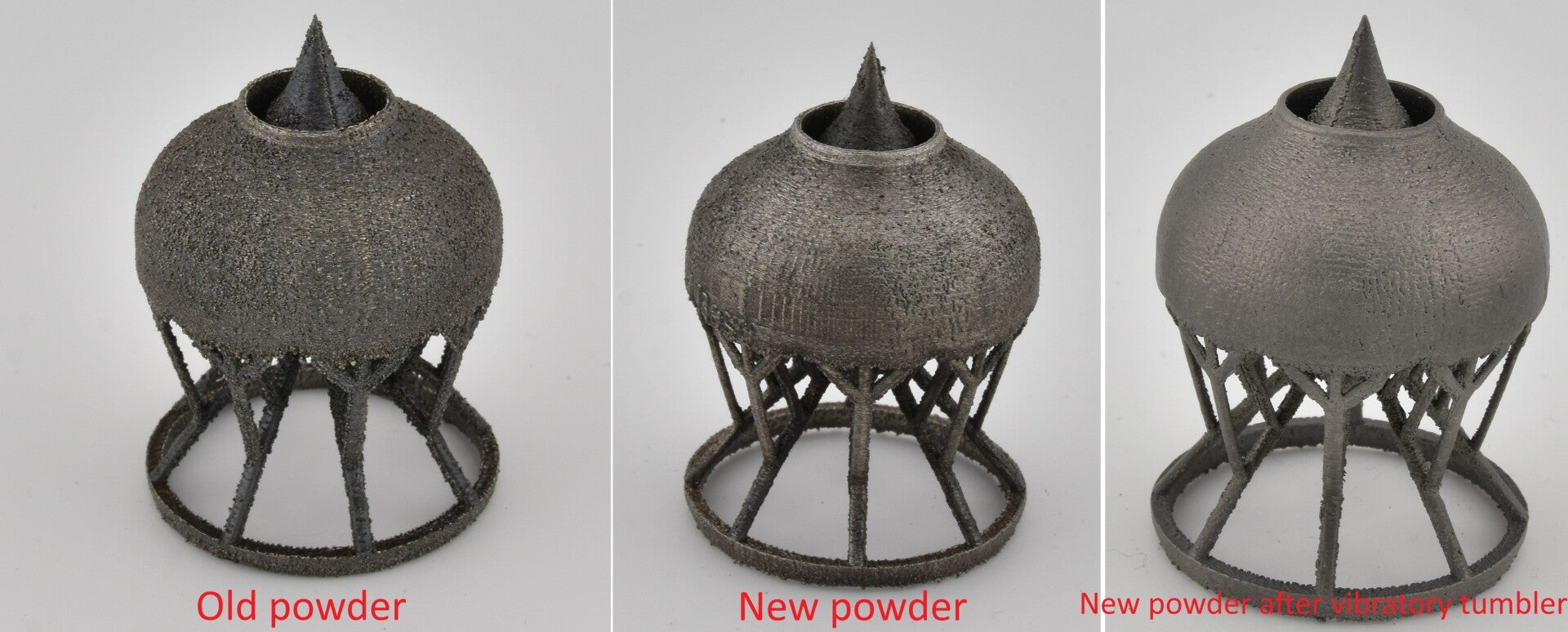
Tom thinks that a 100,000 is simply too much for an LPBF machine. He told us, “There are too many out there that wish to print metal but can’t spend that kind of money.” He’s not aiming to equal what other machines do. He freely admits that the path he’s chosen won’t deliver the results other systems do. He says, “This is not for space companies but for industries that do not have access to technology. This is for handlebars, not rocket engines.” The way he has engineered his machine, from first principles, makes it much more radically low-cost than others. And… It’s a kit.
The machine plugs into a standard wall outlet and uses Klipper as well as Orcaslicer The printer does not print titanium Instead, he’s optimized it for 316L stainless steel, bronze, and Inconel The densities and tensile strengths he can get are comparable to those of industrial machines for Inconel and 316L For bronze, he’s at 94% density; copper is at 80% density Build volume is 128 by 100 mm, and build speed is 1.5 cm³/h.
You can see a video of how it prints Inconel below.
Here you can see a thermal and tensile test of a printed part.
Here is a year-old video of parts of the machine.
A Nitrogen generator is an extra option. The laser is a 445 nm, 60 W diode laser on an XY gantry. Making this work is key to the machine’s success, but Tom thinks that too many people making LPBF machines are focusing on the laser.
He says, “focus needs to happen, how the light I send hits powder, is important. But it’s not the most important thing. having a short optical path close to the melt pool, good gas circulation, good airflow, not getting the optics not dirty and the actual laser power on your bed…are more important.”
Now, to me, this is worrying because he’s starting to make sense. I’m going from thinking this is unbelievable to thinking that I may have to buy one. In his setup, he’s currently getting 20 to 30 joules per cubic mm in a controlled way. This is compared with industrial fiber laser machines, which typically use around 80 to 100 joules per cubic mm. In his low-cost LPBF system, efficiency is key Tom has used input shaping to reduce damping effects. Most of his engineering time was spent on flow dynamics.
The system is incredibly simple. But it has a HEPA filter and additional filtration, and also includes laser, oxygen, and door monitoring, as well as CE. There is also a powder overflow system. The systems in customers’ hands are doing well. A fabled user, an LPBF expert, a manufacturing firm, and a 3D printing service are among his first customers. He’s taken feedback from them between May and December of 2025 and pumped this into his new machine. He’s now doing the Kickstarter, hoping to sell around 10 to 20 systems. He wants to spend the Kickstarter money and time on documentation. Tom is “not looking for a unicorn startup…just to make metal printing more accessible.” He suggests that a well-outfitted workshop is needed to assemble and operate the machine, and stresses that everyone should always wear PPE. The cost of the system is €8,500 (excluding VAT), and it will require 30 hours of assembly. A Nitrogen generator costs €1,200. Welcome to the future, folks, it’s going to be a wild ride.
Subscribe to Our Email Newsletter
Stay up-to-date on all the latest news from the 3D printing industry and receive information and offers from third party vendors.
Print Services
Upload your 3D Models and get them printed quickly and efficiently.













You May Also Like
Solukon Goes Big with New SFM-AT850 Depowdering System
Solukon has released the SFM-AT850 depowdering system. The German depowdering specialist has updated its product line, and this machine replaces the SFM-AT800-S and SFM-AT1000-S. Rather than many small parts, this...
The Hidden Economics of Powder Bed 3D Printing: Closing the Loop in Powder Management
Automation is a very topical thing in additive manufacturing at the moment. With renewed scale, some clients are fervently looking to automate production. Other business cases only make sense with...
Oerlikon Adds ATLIX’s xBUILD 5000, Plans More for 2027
Oerlikon has installed a new ATLIX xBUILD 5000 metal 3D printer at its facility in Huntersville, North Carolina, marking the first production deployment of the system worldwide. The machine will...
The Science Lab You Can 3D Print
Researchers at Sweden’s Umeå University have shown how desktop 3D printers can be used to make lab equipment, giving scientists a cheaper way to build tools for their research. The...