AM Demand Signals: Global Grid Resilience

We’re one year and a few days removed from the DeepSeek meltdown that rocked U.S. equity markets, not to mention the de facto U.S. AI brain trust, with fears that AI may not be nearly as energy-hungry as investors had initially anticipated. While that sounds like it should’ve been welcome news, the disruptive thesis undercut the rationale behind many billions of dollars that sectors across the economy had already designated for AI infrastructure spend.
Both fortunately and unfortunately, the idea appears to be mostly bunk, as many voices argued at the time. As I noted in an AM Research report, AM for Data Centers: a 3D Printing Market Opportunity, published exactly one month after the DeepSeek crash, many commenters, like Microsoft CEO Satya Nadella, debunked the premise behind the selloff by citing the Jevons paradox: the observation by a 19th century English economist that, in the long run, efficiency gains tend to result in increased consumption, not increased conservation.
While Nadella was of course not speaking from an unbiased position, the context appears to involve a perfect example of this paradox at work, and the unrelenting rise of household electric bills across the U.S. is one data point bearing that out. As AI models become cheaper to train, usage has increased, but growth in U.S. power grid capacity, as well as growth in fuel production, have lagged. This has contributed to events like a spike of the U.S. Henry Hub natural gas benchmark price of over 100 percent this past week, as surging demand met supply that plummeted in the face of an Arctic blast.
Another thing that happened last week was the World Economic Forum in Davos, the yearly event when our beloved financial overlords meet in Switzerland to decide our fate. As is his wont, Donald Trump sucked up all the air in the room with his attention-seeking tariff threats. But the subtle backdrop for the event was the theme of energy security, with EU-aligned participants convincingly arguing that a transition to a low-carbon economy and a focus on energy security represent much the same objective.
This is an argument I’ve been harping on for years, and I think it’s a perfect role for the AM industry to play in the broader economy. Earlier this month, the Danish Technological Institute (DTI) released a case-study that reinforces precisely why AM is a definitive ‘sustainability-as-security’ solution. Produced in collaboration with Danish company Heatflow, as well as two other partners (Fraunhofer IWU and Open Engineering), the case study is about a passive data center cooling component produced with metal AM.
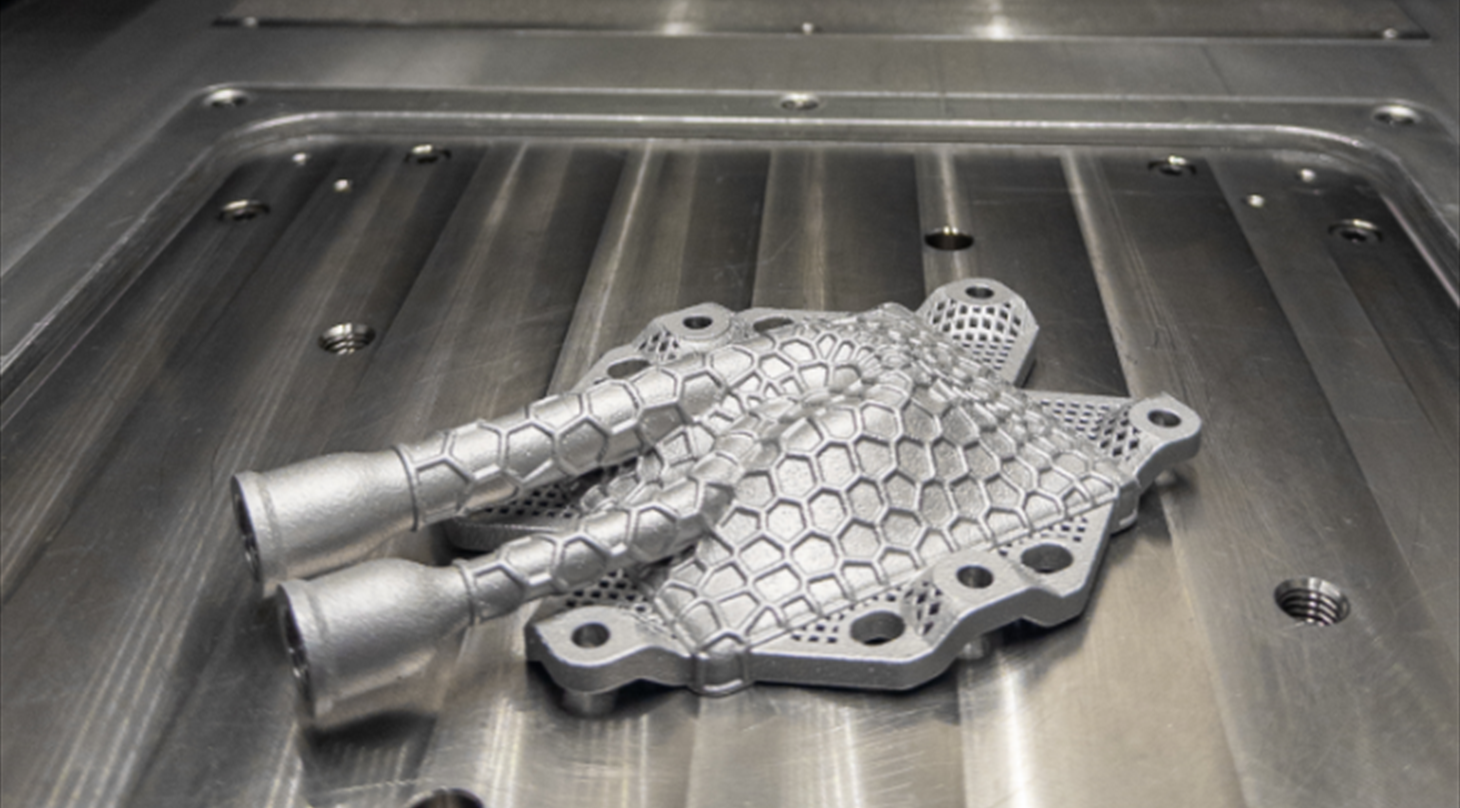
Image courtesy of Danish Technological Institute
The reason this matters so much is because the more powerful that the chips enabling the AI boom get, the more power data centers use, with an increased proportion of that higher power load going towards cooling. To be specific, new data centers typically spend more than 40 percent of their power budget on cooling. By creating a cooling component that doesn’t require pumps or fans—just coolant, geometry, and gravity—DTI and Heatflow have created the sort of innovation that could help the data center boom from becoming the latest generational source of environmental destruction.
The DTI and Heatflow work is supported by AM2pC, a project funded by European innovation fund M-ERA.net with the express goal of using AM to create passive cooling components for data centers. That this project exists, and that a company like Heatflow, which has targeted the niche of leveraging AM for heat exchangers, exists, should serve as a reminder that the industrial ingenuity hasn’t disappeared from the European continent.
Tying all of this together, it’s both deeply ironic and highly troubling that this particular innovation should come from exactly the nation that the White House chose to start beef with. If the U.S. were smart, we’d be seeking out partnerships with companies like Heatflow, and emulating M-ERA.net, not alienating the very nations to which we need to sell our energy products.
The EU was right to announce a trade deal with India just after Davos, and savvy to call it “the mother of all deals” in a not-so-subtle jab at the U.S. president. This is the sort of pact that the U.S. should be trying to get in on, because we haven’t done such a good job at reshoring, thus far. That’s not solely because our government has been enacting policies that run precisely counter to revitalizing a manufacturing sector, but because the task is too difficult to accomplish alone, and people don’t enjoy when you solicit their cooperation by bullying them.
One thing the U.S. did do a good job at, though, was the winterization of the Texas power grid in response to the catastrophic consequences of Winter Storm Uri in 2021. This time around, while Winter Storm Fern itself may not have been quite as severe, the consensus as of now seems to be that the policies enacted in response to the freeze from five years ago prevented a far worse outcome than would’ve otherwise been the case.
Among the many different solutions that Texas used in combination in order to prepare, equipping the grid with access to a diversification of energy sources was a primary method. Texas, of all places, bolstered its grid with wind energy and batteries. That’s sustainability as security.
This is the sort of project that can help unify the U.S. with its allies, and there are plenty of use-cases out there illustrating how AM can work as a pillar of international industrial cooperation.
Featured image courtesy of Heatflow
Subscribe to Our Email Newsletter
Stay up-to-date on all the latest news from the 3D printing industry and receive information and offers from third party vendors.
Print Services
Upload your 3D Models and get them printed quickly and efficiently.











You May Also Like
Cybersecurity: A Necessity in a Maturing Additive Manufacturing Industry
Additive Manufacturing is no longer an experimental technology operating on the margins of industrial production. Over the past decade, it has become an integral part of how OEMs design, produce,...
How Metal Additive Manufacturing Is Reshaping the Future of Aerospace and Defense Engineering
Additive manufacturing (AM) is steadily changing the way we think about producing metal parts for aircraft. Whilst aerospace and defense companies have been using metal AM for over twenty years,...
The AM Adoption Problem No One Models
Through its short history, Additive Manufacturing has been presented to the investment community as a classic high growth technology story. Manufacturing is a multi-trillion-dollar market. Even a small percentage looks...
The Business of Customized Sports Equipment: How 3D Printing Is Changing Athletic Gear
For years, 3D printing in sports has been linked mostly with prototypes, concept shoes, and one-off experiments for elite athletes. Helmets, cleats, and footwear midsoles often took over the headlines,...