HeyGears Launches Reflex 2 Series 3D Printers to Go Beyond Prototypes


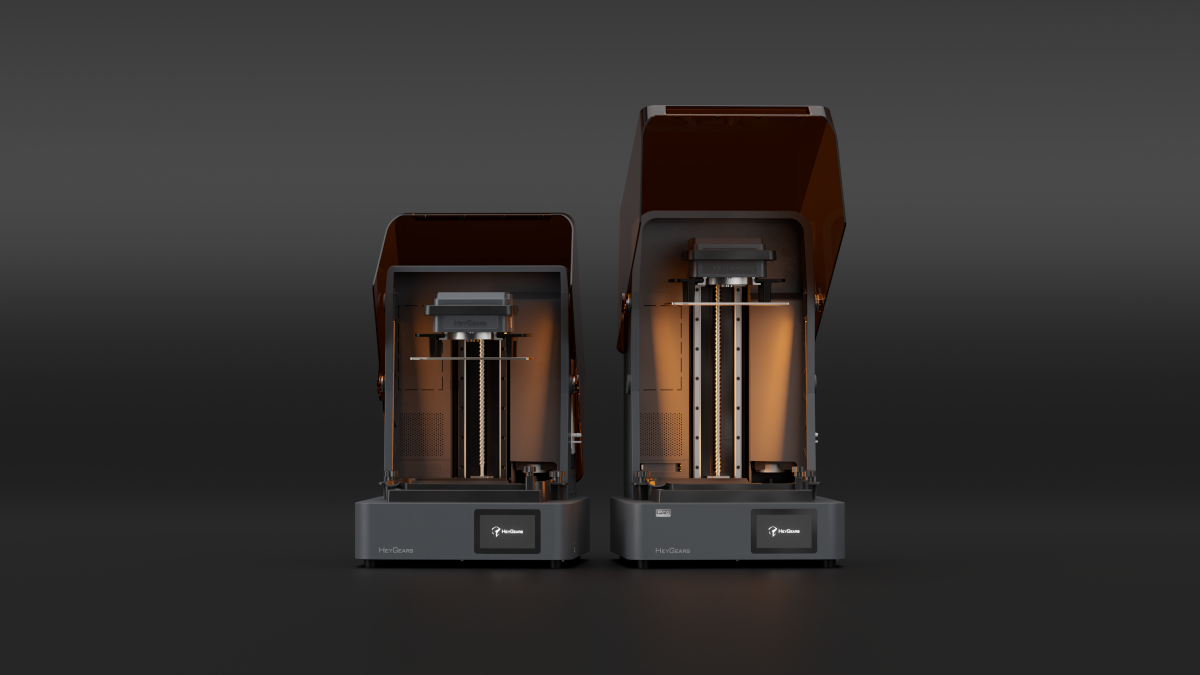
HeyGears has launched its new Reflex 2 Series of resin 3D printers, which are designed to cater to the diverse production requirements of industry professionals and creative studios. The Reflex 2 Pro and Reflex 2 3D printers offer enhanced productivity, reliability, and scalability for a variety of 3D printing applications.
Reflex 2 Pro: Go Beyond Prototypes, Start Production
The Reflex 2 Pro is built to cover a range of professional production scenarios, including prototype validation and the production of end-use parts. It features a build volume that is 2.3 times larger than its predecessor and has a Z-height of 35 cm: 230×144×350 mm (9.1×5.7×13.8 in). This expansive volume makes it suitable for 3D printed footwear, orthotics, prosthetics, and sports protective gear.
At the core of the Reflex 2 Pro is its 1032 OptiZone Light Engine, which incorporates 1032 individually controlled light zones. This technology facilitates precise light projection, ensuring consistent surface quality and optimal curing while minimizing resin residue and improving production efficiency. Its new Amber Screen Pro achieves a high 10% energy transmission rate, while also significantly enhancing durability with over 6,000 hours of operational life.
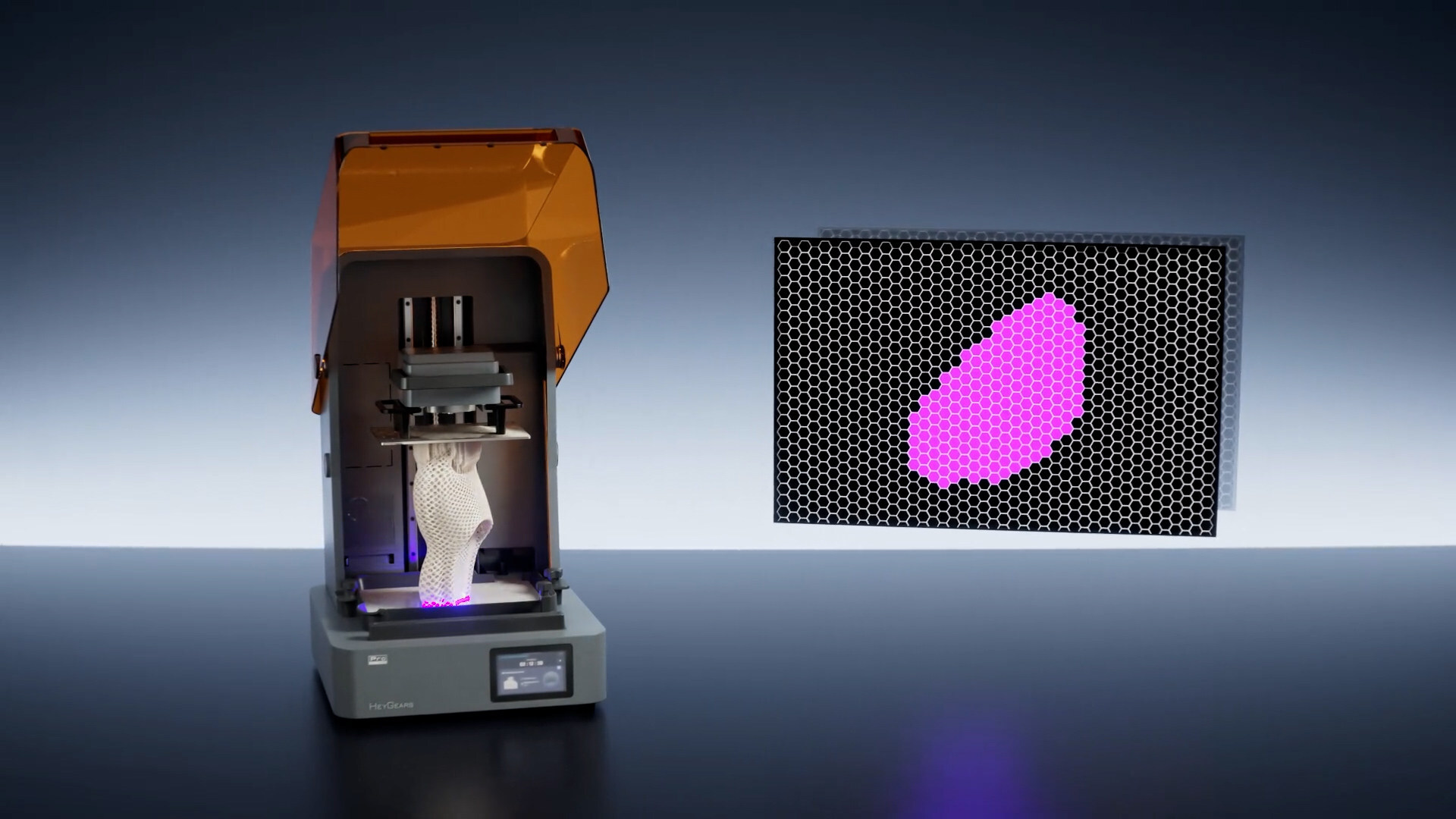
HeyGears Reflex 2 Pro.
The Reflex 2 Pro is also equipped with a precision FOC Motor Module, ensuring high-precision positioning with 25,600 microsteps per revolution. This supports stable 3D printing under high load and speed, making it suitable for reliable batch production.
Additionally, the intelligent scraper-assisted temperature control system optimizes printing success rates by efficiently heating the resin, reducing wait times, and preventing sedimentation, thereby maintaining optimal printing conditions.
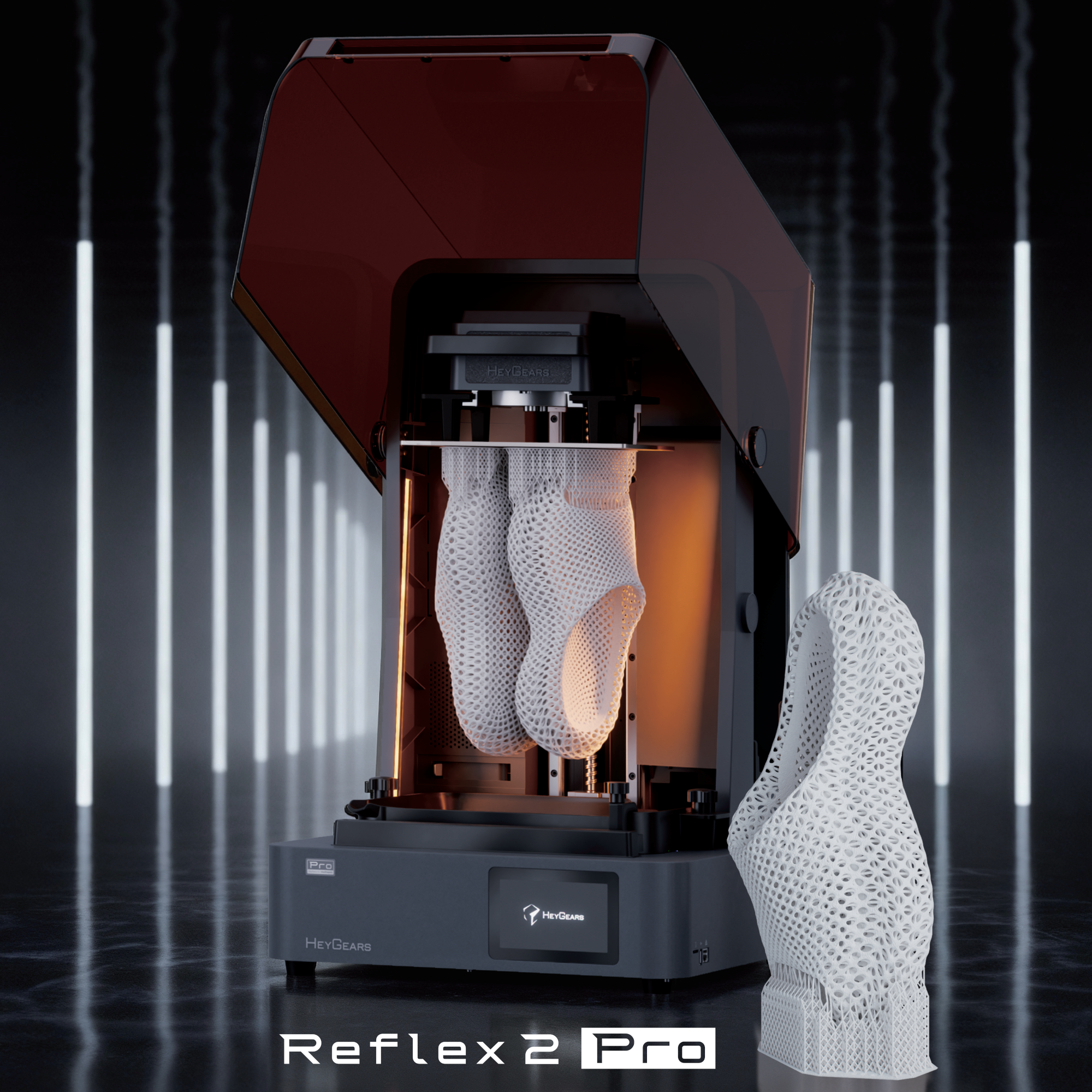
HeyGears Reflex 2 Series makes shoes.
Reflex 2: Complete Production Empowered
The Reflex 2 3D printer features a build area of 230×144×230 mm (9.1×5.7×9.1 in). It utilizes an 161 OptiZone Light Engine along with the same Amber Screen Pro technology as the Reflex 2 Pro, ensuring reliable results for product designers, studios, and companies that depend on 3D printing as a critical tool for prototyping and creation.
Both 3D printers in the Reflex 2 Series support a diverse range of high-performance materials, including the newly introduced PAH270 resin, which offers high deformation resistance and thermal resistance up to 270°C.
With the Reflex 2 Series, HeyGears aims to enhance the capabilities of 3D printing technology, providing professionals and creatives with the tools necessary to bring their ideas to fruition.
To learn more about HeyGears 3D printers, visit https://bit.ly/3IWiSQc
All images courtesy of HeyGears
Subscribe to Our Email Newsletter
Stay up-to-date on all the latest news from the 3D printing industry and receive information and offers from third party vendors.
Print Services
Upload your 3D Models and get them printed quickly and efficiently.











You May Also Like
The Great AM Reset: Why Applications Will Decide Who Survives
For decades, the AM industry has been powered by an exciting narrative of endless growth and disruptive potential. We celebrated every new technology, every injection of capital, and every bold...
3D Printing Financials: Materialise Reports Strong Finish to 2025, Led by Medical Growth
Materialise (Nasdaq: MTLS) closed out 2025 with a solid fourth quarter, showing stronger profitability, steady revenue growth, and continued momentum in its medical business. While some parts of the company...
The 3D Printing Pioneers’ Journey from HZG Group: From Bavaria to the World
In Lichtenfels, two hours’ drive north of Munich, there is a globally recognized 3D printing center with a modern infrastructure and many companies focusing on this future technology. At the...
Additive Manufacturing’s Next Chapter: From Prototype Tool to Operating Model
Additive manufacturing is shedding its legacy reputation. While it remains the go-to for prototyping, its potential now extends beyond. Today, it’s increasingly used to support real production requirements, helping teams...