AML3D Lands $3M 3D Printer Deal with Newport News Shipbuilding

Over the summer, Australian additive manufacturing (AM) original equipment manufacturer (OEM) AML3D announced that the U.S. Navy had issued a letter of intent (LOI) to the company which signaled the maritime branch’s interest in acquiring more AML3D hardware in the near future, part of the Navy’s planned AM ramp-up through 2030. Now, AML3D has announced that Virginia’s Newport News Shipbuilding (NNS), a division of Huntington Ingalls Industries (HII), has purchased two custom ARCEMY systems, the ninth and tenth systems that will be dedicated to U.S. Maritime Industrial Base (MIB) applications.
AML3D states that the total value of the machines purchased by NNS is A$4.5 million, or just under US$3 million. The custom machines are based on AML3D’s largest-format model, the ARCEMYX, but modified with what the company describes as “a 10,886 kg positioner” that enables a heavy build capacity. According to AML3D, these will be the second and third such machines that the company has sold.
NNS is one of just two companies in the U.S. that designs and builds nuclear-powered submarines, the other being General Dynamics Electric Boat (GDEB), a company which has also been steadily increasing its large-format metal AM adoption in recent years. In September 2023, NNS and GDEB announced they were partnering to print a copper-nickel deck drain assembly for Virginia-class submarines, the first phase in a broader partnership to accelerate AM usage for U.S. submarine production.
The Trump administration has thus far demonstrated a more ambiguous stance than its predecessor on the Australia-UK-US (AUKUS) trilateral partnership, an arrangement that nuclear-powered submarines are at the center of. But Australia’s potential increased cooperation with the U.S. on critical minerals is being viewed as a key bargaining chip that Prime Minister Anthony Albanese could leverage to ensure AUKUS’ longstanding objectives remain on track. While AML3D has continued to benefit from sales to the U.S. MIB regardless of the status of AUKUS, a clear show of support by the Trump administration would obviously present another catalyst in the company’s favor.
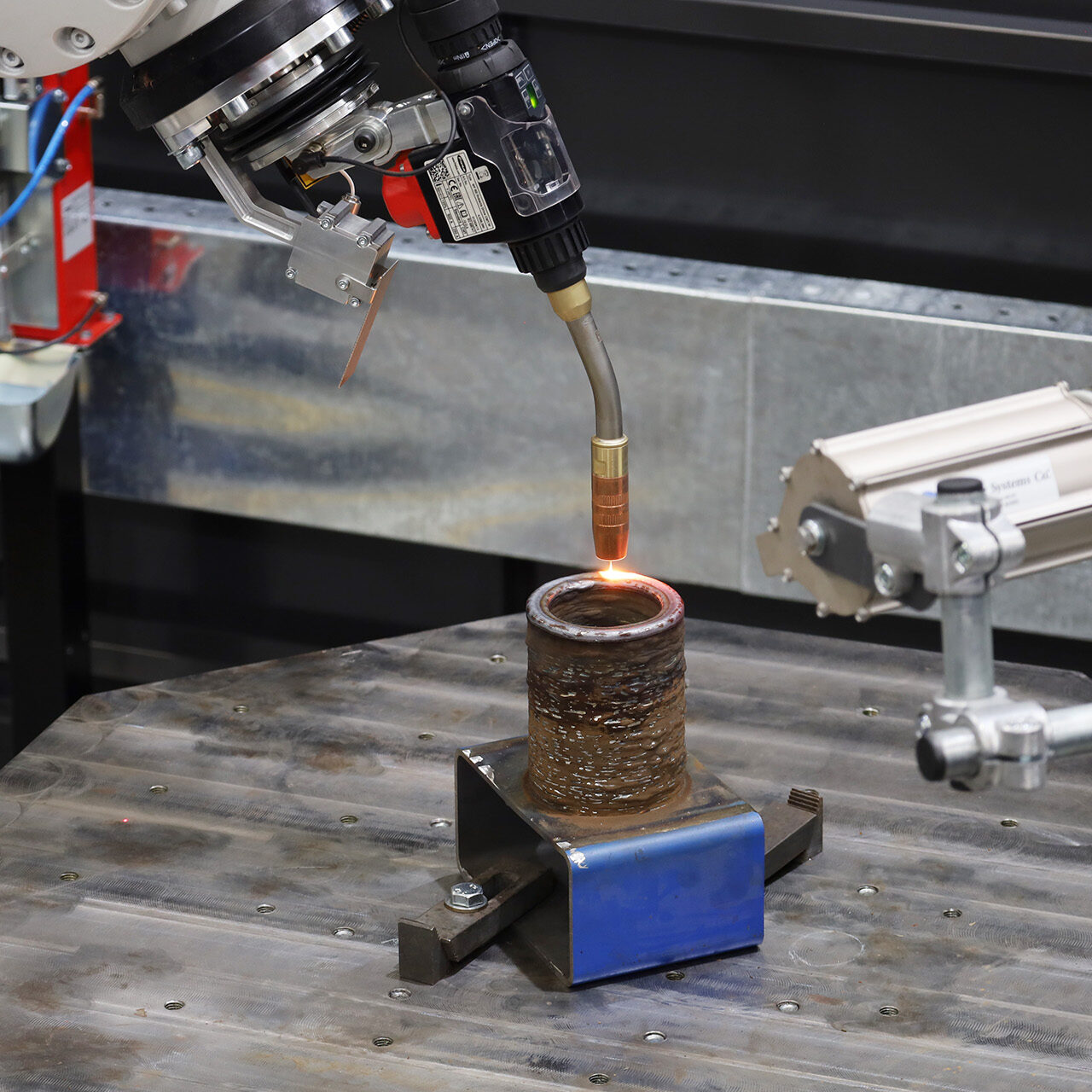
In a press release about AML3D’s sale of two custom machines to NNS, the CEO of AML3D, Sean Ebert, said, “During my recent visit to our U.S. operations it was clear AML3D had a huge opportunity to build on our success supporting the U.S. Navy submarine program and expand into U.S. Navy shipbuilding and munitions as part of U.S. Government’s ‘Make Shipbuilding Great Again’ initiatives. These custom large capacity ARCEMY X systems are similar in scale to the ARCEMY X that we recently brought online for another U.S. Defense shipbuilding prime contractor. It is pleasing to see demand for our technology across the U.S. and other globally significant defense markets is continuing to accelerate.
“In parallel, we are making progress on our strategic goal to access additional non-defense sectors. Our U.S. operations recently delivered a large capacity ARCEMY X to the Tennessee Valley Authority, the largest public utility in the USA. Having an established U.S. manufacturing base means AML3D is advantaged when supporting U.S. customers as the U.S. Government’s tariff policy evolves. AML3D is also well positioned to accelerate our entry into the UK and other European Defense markets and expand our defense and non-defense work in Australia.”
Even as AML3D consistently makes inroads into the defense world, I think the sale the company made to the Tennessee Valley Authority (TVA), announced in December 2024, is perhaps just as much reason for optimism as the much larger quantity of business that AML3D has done for maritime applications. Generally, I believe that, in the long run, the biggest impact of AM sales to the U.S. military and associated contractors will be the validation of the relevant technologies for other sectors, rather than the business represented by the defense market itself.
One reason for that has to do with the past, and another reason has to do with the future. Historically, industries centered around disruptive technologies that relied on the U.S. military as an early customer ultimately did best when they pivoted beyond that initial success into markets with much wider societal appeal. Semiconductor device manufacturers are the classic example: the U.S. military was the first major customer for U.S. chipmakers, but companies like Intel used that as a foundation to transition into B2B sales and ultimately consumer electronics.
Looking forward, while investments in the defense sector in the U.S. and other nations around the world seem poised to continue expanding, far greater demand drivers exist for strategic investments in a number of other critical infrastructure sectors. The need to revitalize the U.S. electric grid is chief among these factors, with electric utilities providers expected to invest over a trillion dollars in the grid through the end of the decade.
In constructing a dual-use strategy for an AM hardware company, one could do much worse than a plan to target both shipbuilders and utilities providers. If AML3D can capitalize on that first sale to the TVA in the same way as it has done with its sales growth in the U.S. defense space, the company will be difficult to compete with in the large-format metal wire market.
Images courtesy of AML3D
Subscribe to Our Email Newsletter
Stay up-to-date on all the latest news from the 3D printing industry and receive information and offers from third party vendors.
Print Services
Upload your 3D Models and get them printed quickly and efficiently.













You May Also Like
The Manufacturing Race Behind the Drone Revolution
We are in the middle of a major manufacturing shift focused on the production speed and payload capacity of uncrewed aerial systems (UAS), or drones. A recent Manufacturing Dive article...
ADDMAN to Buy Up to $10.8M in Nickel 718 Powder from 6K Additive Over 30 Months
After years of buildup, we’re finally starting to see what the US metal additive manufacturing (AM) market could look like at scale. To be sure, it’s still not quite there,...
Metal AM in a Multipolar World, Part 2: How PBF and DED Could Change by 2035
The first decades of PBF development were heavily shaped by machine capability: more power, more lasers, larger build volumes, better recoating, and improved process monitoring. These developments will continue, but...
Advanced Manufacturing at IMTS 2026: 3D Printing and AI and Drones, Oh My!
Last week’s International Manufacturing Technology Snow (IMTS) in Chicago welcomed over 90,000 attendees to the jungle that is McCormick Place. With over 1.17 million square feet of exhibit space, and...