BYU Engineers Make 150 3D Printed Microscopic Replicas of LDS Temples


This year, Brigham Young University (BYU) in Utah, the flagship institution of the Church of Jesus Christ of Latter-day Saints (LDS) Church Educational System, is celebrating its 150th anniversary. In honor of this exciting milestone, engineers from the university decided to celebrate in a unique way: with tiny 3D printed temples.
Greg Nordin, an electrical and computer engineering professor in the Ira A. Fulton College of Engineering at BYU, normally focuses his research on nanofabrication, microfluidics, MEMS, and lab-on-a-chip devices, which essentially miniaturize and integrate laboratory functions onto one tiny chip. But he decided to take his expertise and put it towards a very different kind of microscopic object.
Together with student Callum Galloway, Nordin 3D printed 150 microscale replicas of existing LDS temples around the country, including the San Diego Temple, Washington D.C. Temple, the St. George Temple, Provo City Center Temple, and the Salt Lake Temple. Each one sits on a 12mm x 19mm microchip, and their length is less than a single grain of rice.
Nordin said, “When we heard about the sesquicentennial ‘Beacons of Light’ celebration, we thought, can we use this super high-resolution 3D printing capability that we’ve developed to create something special?”
According to BYU, Nordin and Galloway used “a carbon-backbone-based material” to 3D print all 150 of the tiny LDS temples, using UV light to build up the layers of each temple using a method called photopolymerization. In this chemical process, which is used often in 3D printing techniques like DLP and SLA, light causes the small molecules in the materials to link together and form a solid object; in this case, the temples.
“These temples probably won’t last 1,000 years, but there are some materials we could use with our 3D printing process that would last that long. Maybe we need to get some of those materials,” Nordin said.
Each one of the tiny 3D printed LDS temples is different. Galloway, a computer engineering major at BYU, did some research to find 150 temples—to celebrate the 150th anniversary, of course—with unique floor plans. He was a relatively new member in Nordin’s lab when the idea for 3D printing 150 microscopic temples came about, but had prior experience with the technology. In Nordin’s words, the student took the idea and “ran with it.”
“It’s rewarding how we can enjoy this technology that we’re using in both an artistic and a spiritual way. Engineering is inherently art and the best art and the best engineering are born out of passion. That’s something I see very much in this lab,” Galloway said.
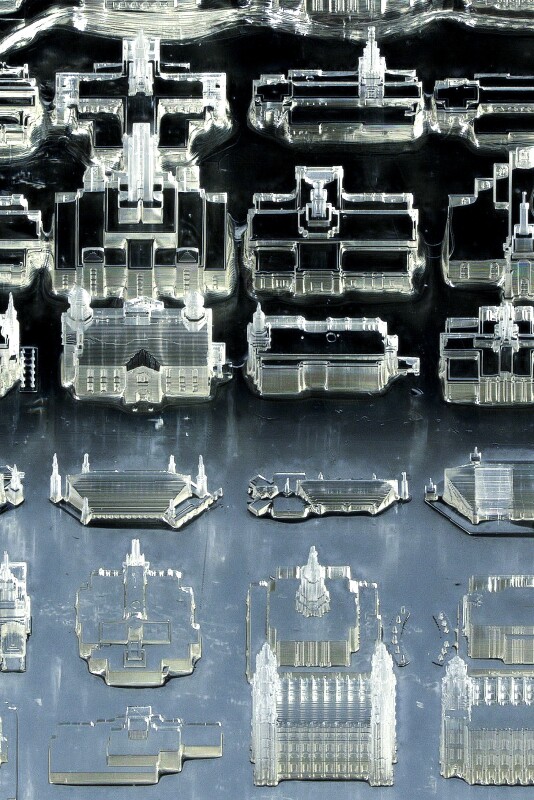
Photo courtesy of Callum Galloway, BYU
That’s what’s so great about using real-life manufacturing technologies in the classroom. It provides practical experience for students who will one day join the workforce, but it can also be a really fun and rewarding experience when they use their skills to make something that’s not part of a final project.
Subscribe to Our Email Newsletter
Stay up-to-date on all the latest news from the 3D printing industry and receive information and offers from third party vendors.
Print Services
Upload your 3D Models and get them printed quickly and efficiently.













You May Also Like
HeyGears Reflex RS Turbo Sets a New Standard for Resin 3D Printing
When creating highly detailed resin prints, speed only matters if the finished result still captures the details that made the model worth printing in the first place. The HeyGears Reflex...
IFA 2026 Shows Where Multicolor 3D Printing Is Headed
Innovation For All (IFA) is best known for televisions, appliances, and consumer electronics. But this year’s show in Berlin also gave 3D printing companies plenty of room to show where...
3D Printing News Briefs, September 12, 2026: Rebranding, Cybersecurity, Project Call, & More
We’ve got a lot of business news from ATLIX to start off this weekend’s 3D Printing News Briefs, with a new identify for its additive manufacturing (AM) portfolio and some...
Quickparts Builds a Four-Country 3D Printing Network for Space and Defense
For manufacturers trying to win more space and defense work, adding 3D printers is only part of the challenge. They also need to make the same parts to the same...