Largest American Shipbuilder Installs 3D Printed Assembly on Aircraft Carrier

Shipbuilder Huntington Ingalls Industries (HII) has announced that Newport News Shipbuilding has installed a 3D-printed valve manifold assembly on an aircraft carrier. The company stated, “The use of certified 3D-printed parts has the potential to accelerate the construction and delivery of vessels to the U.S. Navy by reducing lead times and improving the manufacturing quality of critical components.”
The part is notable not only for its significance but also for its size—measuring over 150 cm in length and weighing more than 453 kg, this is far from an ordinary component.
It was manufactured by DM3D Technology, a leading directed energy deposition (DED) service provider that also collaborates with NASA and the U.S. Army. DM3D has qualified over 30 materials and can produce parts up to three meters in size. The company has built three-meter-tall rocket nozzles and utilizes two to four deposition heads on its massive machine.
DM3D employs a closed-loop process, mounting its large components on a rotary table while angling deposition heads to expand the range of manufacturable geometries. In addition to producing parts, the company has designed its own machines and holds more than 40 relevant patents. Alongside its large-scale system, DM3D integrates DED heads on robotic arms and enclosed gantry systems. It also offers in-house HIP, CNC, CT scanning, and coating capabilities. The company is certified by Naval Sea Systems Command (NAVSEA).
“What started as a proof of concept quickly turned into a tangible result that is making a meaningful difference to improve efficiencies in shipbuilding. The benefits of this innovation will extend well beyond Enterprise (CVN 80), as we incorporate our expertise in additive manufacturing into the fundamentals of shipbuilding,” said Dave Bolcar, Newport News Shipyards vice president of engineering and design.

Operation and sustainment costs for the U.S. Navy amount to approximately $17 billion per year, while a proposed plan to acquire an additional 85 vessels is projected to cost $1 trillion. To put that into perspective, the current estimated global GDP is $95 trillion, and a stack of $100 bills totaling $1 trillion would reach 1,015 kilometers high.
One key limiting factor in constructing new Navy vessels is the shortage of skilled and willing workers, while another is the overall slow construction timeline. An aircraft carrier takes about eight years to build, whereas an Arleigh Burke-class destroyer can take two to three years. The Arleigh Burke class, which has been under continuous production since 1991, costs approximately $2 billion per ship, with 74 vessels built and 19 more on order. This makes it one of the fastest examples of ship construction. When it comes to repairs, only about 30% of ships are completed on time, and shipyards are experiencing significant backlogs.
3D printing could help address this issue by reducing the time required to cast or forge a part from months to weeks. It could also lower costs and, by accelerating repairs, prove to be an invaluable asset. This particular part is therefore a significant development.
The component in question is a fluid distribution valve located in the pump room of a Gerald R. Ford-class aircraft carrier currently under construction. The Enterprise—a 100,000-tonne (90 million-kilogram) carrier capable of deploying up to 50 aircraft and 20 helicopters—is being built in part using recycled steel from its predecessor. The previous Enterprise fought in Vietnam in the 1960s, participated in the U.S. invasion of Afghanistan, and was the Navy’s first nuclear-powered aircraft carrier. The Enterprise before that is widely considered one of the most important ships in U.S. naval history, having played a crucial role in nearly all major naval battles in the Pacific during World War II.
The new Enterprise is notable for being the first aircraft carrier designed entirely using CAD. With a rotating crew of 4,660, it will play a vital role in U.S. military operations for decades to come.
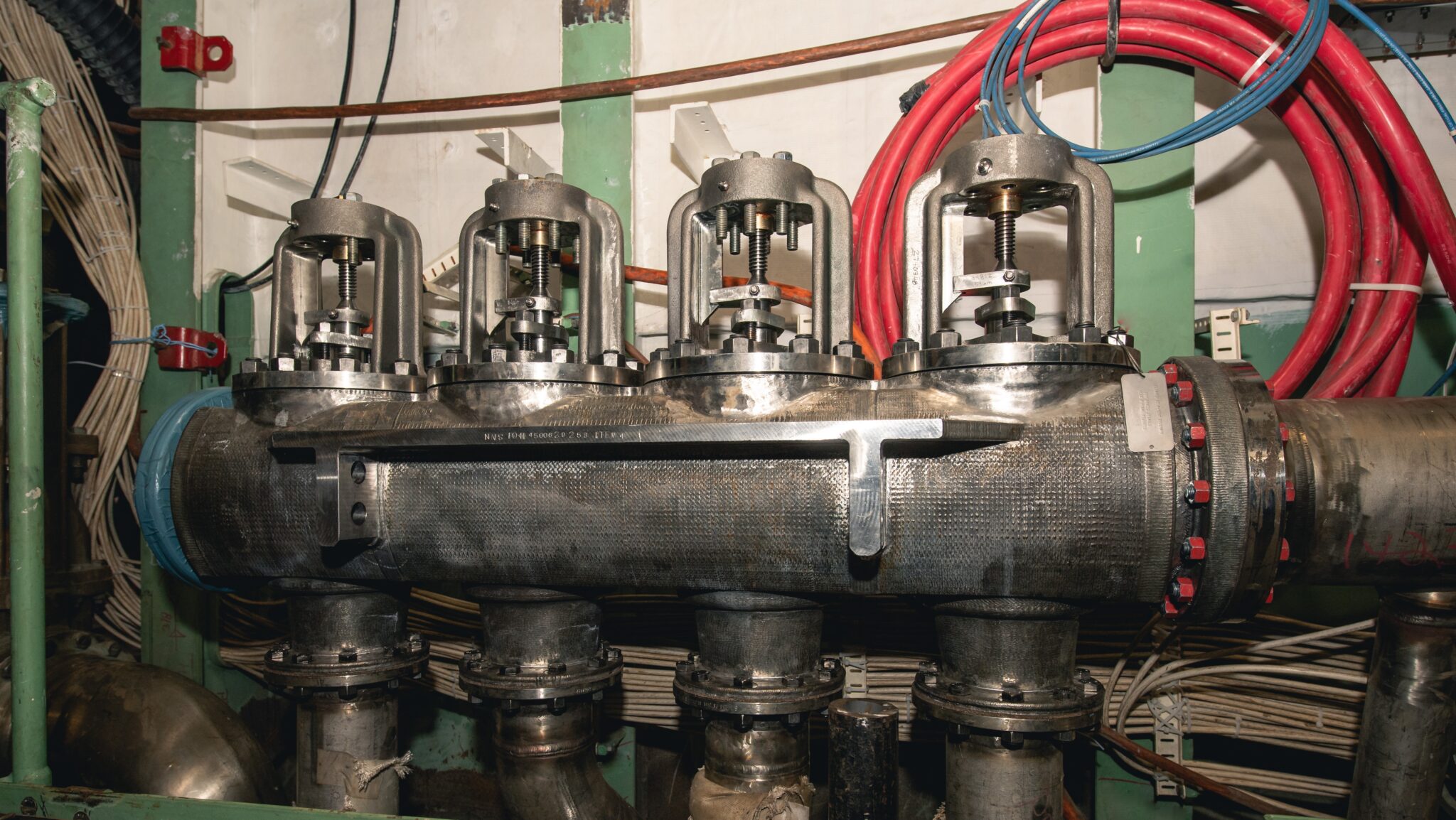
The 3D printed valve manifold.
This will not be the only manifold, as another carrier, the Doris Miller, is also utilizing 3D-printed manifolds. HII has disclosed that it has installed 55 3D-printed parts on various vessels and aims to produce 200 components this year. This is a monumental development in its own right and should serve as a wake-up call to the immense possibilities of naval 3D printing, both in the U.S. and worldwide.
Subscribe to Our Email Newsletter
Stay up-to-date on all the latest news from the 3D printing industry and receive information and offers from third party vendors.
Print Services
Upload your 3D Models and get them printed quickly and efficiently.













You May Also Like
AMAsia Pulse: AM Investment Picks Up Across Asia-Pacific
The first half of September brought fresh investment and expansion activity across Asia-Pacific’s additive manufacturing sector. China’s Xinjinghe secured funding for an aerospace AM hub, South Korea’s Lincsolution outlined plans...
3D Printing News Briefs, August 26, 2026: Meshy 7, 4D Printed Implants, & More
We’re kicking things off today with software news, as the new Meshy 7 is now live. Then we’ll move on to business, with ExOne and voxeljet now operating as a...
AMPulse Asia: India’s Orbital Launch Headlines a Busy Second Half of July
The second half of July brought major developments across Asia’s additive manufacturing sector. Highlights included India’s first private orbital launch powered by 3D printed engines, a billion-yuan ownership change at...
3D Printing News Briefs, July 9, 2026: RIMPAC 2026, Software, Housing, & More
In today’s 3D Printing News Briefs, Massivit continues its focus on aerospace and defense manufacturing, and Meltio is collaborating with Phillips Corporation for RIMPAC 2026. Moving on to software, AMIS...