First Order of 3D Printed Weldable Headlight Tabs Shipped by Auto Additive

After its launch earlier this year, Auto Additive has begun shipping its 3D printed products for auto repair. Specifically, the 3D printing and engineering services company has sent the first order for weldable headlight tabs to one of its founding partners, Headlights.com, as it begins initiating its go-to-market strategy for later in the year.
The Chicago-based company has engineered these tabs in collaboration with Headlights.com, using advanced polypropylene material compatible with OEM requirements. This material meets GM’s GMW18647 worldwide standards, ensuring the tabs are not only durable but also fully compatible with existing repair techniques, offering a viable alternative to traditional methods like two-part epoxy, shaping putty, and industrial-grade welding rods.

The news is part of Auto Additive’s broader strategy to harness 3D printing for automotive repairs, a move supported by the company’s foundational role in the 3D Printing in Auto Repair Task Force. This initiative, endorsed by industry experts and corporate partnerships, including HP and Forecast 3D, aims to integrate additive manufacturing into everyday automotive repair jobs effectively. The move also highlights the practical applications of 3D printing technologies in providing innovative repair solutions, significantly impacting maintenance, repair, and overhaul (MRO) operations within the industry.
Auto Additive’s initiative is a direct response to the industry’s slow adoption of 3D printing for end part production and MRO tasks. Despite the technology’s potential, its application in auto repair has been limited. The recent introduction of these 3D printed parts is expected to change this narrative by providing more efficient, cost-effective solutions that reduce waste and enhance repair quality.
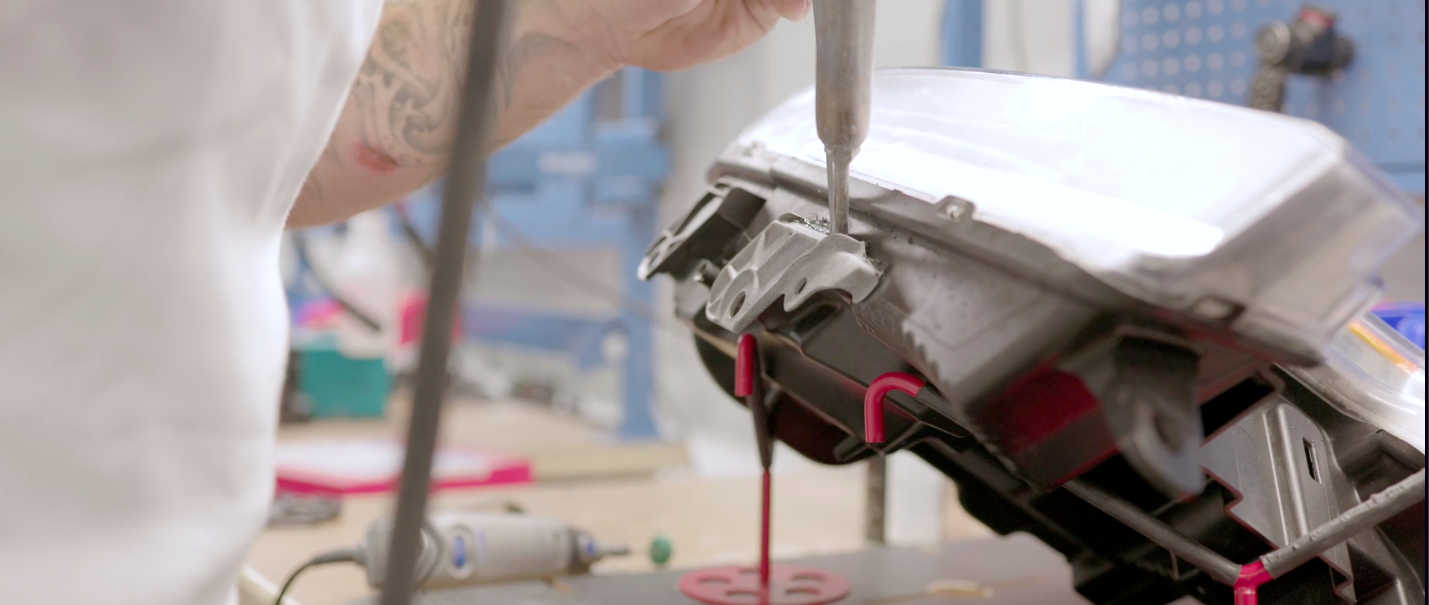
3D printed headlight tabs
The company’s efforts align with the industry’s move towards more sustainable and innovative repair methods, championed by the 3D Printing in Auto Repair Task Force’s recent findings and the strategic direction provided by industry veterans like Harold Sears. This holistic approach towards integrating 3D printing into the automotive sector is not just about innovation but also about setting new standards and practices that could eventually influence global automotive repair techniques. We’ll start to get a sense of exactly how by the end of the year, as Auto Additive is set to launch these parts to a broader market by November 2024.
Mirroring efforts by groups like Mobility | Medical goes Additive, we could ultimately see the use of 3D printing for MRO in automotive complement adoption across just about every vertical. 3D printing’s strength in producing individual parts on demand could parallel the Right to Repair movement at a time when reusing resources overtakes virgin material manufacturing, thus leading to a more circular and sustainable production paradigm.
Subscribe to Our Email Newsletter
Stay up-to-date on all the latest news from the 3D printing industry and receive information and offers from third party vendors.
Print Services
Upload your 3D Models and get them printed quickly and efficiently.











You May Also Like
EOS Invests $3M In Its Texas Manufacturing & Logistics Facilities to Serve North American Customers
The trajectory of reshoring under President Trump has been largely a mixed bag so far. While tariffs still seem to be doing more harm than good to the U.S. domestic...
At AIAA SciTech 2026, 3D Printing Was Part of the Workflow — Part I
The AIAA SciTech Forum 2026 brought much of the aerospace community together in one place. With roughly 6,000 attendees, 115 exhibitors, 21 sponsors, and nearly 3,000 technical paper presentations, the...
3D Printing News Briefs, January 21, 2026: Scanning Inspection, Manufacturing Upskilling, & More
In 3D Printing News Briefs, we’ll start with 3D scanning news from Artec 3D. Then, Nanoscribe opened a demolab in Shanghai, and The Ohio State University Center for Design and...
Camp Lejeune’s II Marine Expeditionary Force Innovation Campus: An Existing Model for the U.S.’s Future in Additive Manufacturing
A recent article in Military.com highlights the II Marine Expeditionary Force (MEF) Innovation Campus, located at Marine Corps Base Camp Lejeune in North Carolina. It provides a good touchstone for the...