Charleston, WV’s 3D Printed Holiday Ornaments Raise Awareness About Local Charities and 3D Printing

Charleston, West Virginia has an interesting history caught up in the throes of the Civil War and its aftermath. And it looks like it has a brighter economic future since it is leading the state and region in 3D printing and additive manufacturing initiatives. In an effort to highlight the region’s embracing of 3D printing and additive manufacturing capabilities, a local flexible manufacturing institute has teamed up with the local newspaper and charities to raise money by selling a 3D printed holiday ornament featuring the iconic capitol building’s gold dome.
The gold dome is quite a symbol in the state and region, standing at 300 feet in height with intricate Greek and Roman architectural influences. The people of West Virginia believed that the state’s controversial and embattled history deserved representation by such a majestic structure. The state of West Virginia was established in 1863 (two year before the official end of slavery in 1865), representing those who did not agree with Virginia’s secession from the Union. Initially, West Virginia’s capitol alternated between Wheeling and Charleston, finally settling on Charleston. The current capitol building was dedicated in 1932, and it stands today as a strong reminder of West Virginia’s rich historic legacy.
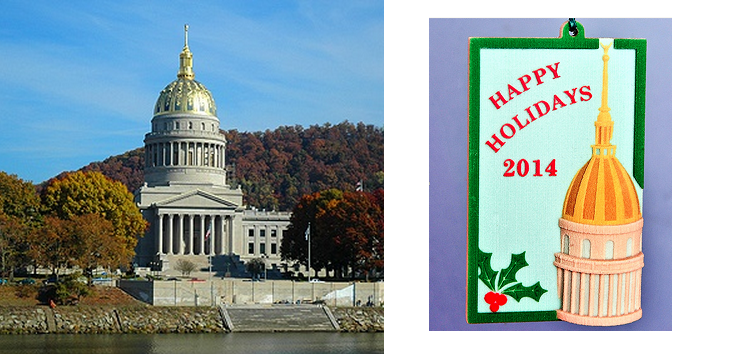
It is exactly this symbolic history that the city’s daily newspaper, the Charleston Daily Mail, is honoring in its sale of 3D printed Christmas ornaments to benefit local charities. This ornament features West Virginia’s capitol dome, and it is designed specifically to highlight its 3D printed nature. Representing a collaboration between local Marshall University, government officials, the business community, and charities, the ornament blends historic tradition with the new manufacturing initiatives that 3D printing represents. And it also reminds people that Charleston is ready for the economic future, as it embraces new 3D printing and additive manufacturing technologies.
This is the second year in a row that the Daily Mail has sponsored a 3D printed charity benefit ornament featuring the capitol building. Last year’s ornament celebrated West Virginia’s 150th birthday; it had fireworks and was emblazoned with the words “WV 150” on the top. This year the ornament features the gold-topped dome of the capitol building with the simple message “Happy Holidays 2014.” You can really see the 3D elements in this year’s ornament — as the spherical dome emerges from the bottom right hand corner. During the ornament’s design, it was an intentional focus “to get the 3D nature to show up on the design.”
The ornament was designed by Ron Cabacar, a design engineer with Marshall University’s Robert C. Byrd Institute of Advanced Manufacturing Technologies (renamed the Robert C. Byrd Institute for Advanced Flexible Manufacturing). The Institute also printed the ornaments on a Z-Corporation 3D printer, printing 200 ornaments overall — 18 in a batch — which took about four and a half hours per batch. With 3D printers at three locations, the Institute offers training in 3D printing/ additive manufacturing technologies with the goal of meeting the new demands of the global economy. This institute is a valuable local resource, and its presence and increasing relevance to West Virginia and the region’s economy is also spotlighted by the 3D printed charity ornaments.
Martin Spears, the associate director of public information for the Robert C. Byrd Institute, summarizes two goals for this ornament project:
“We are happy to be able to extend our services to Charleston Newspapers this year to make people aware of not only of the 3D printing and technology in this state, but also to help these charitable causes.”
In its first year, $1,500 was raised and divided between the Daily Mail’s Neediest Cases Appeal  and Gazette Charities. The Daily Mail’s Neediest Cases Appeal is a service offered by the paper that highlights local residents facing economic hardship, and the newspaper will feature them in a story and also provide the means for people to make contributions. Gazette Charities has supported over 200 nonprofit organizations since 1999–focusing on health and human services, education, environment, public life, and arts and cultural initiatives.
It appears West Virginia is off to a good start bringing media, academia, manufacturing industries and technologies, the business community, and charities in collaborations, like the charitable 3D printed ornament project, and other exciting 3D related activities throughout the state. The ornaments are available for $20.00, here, and can purchased at Charleston Newspapers’ front desk at 1001 Virginia Street E. in Charleston. Let us know your thoughts on this story in the 3D Printed Ornament forum thread on 3DPB.com.
Subscribe to Our Email Newsletter
Stay up-to-date on all the latest news from the 3D printing industry and receive information and offers from third party vendors.
Print Services
Upload your 3D Models and get them printed quickly and efficiently.












You May Also Like
Flashforge Bets on Meshy AI as Desktop 3D Printing Battle Intensifies
Competition in desktop 3D printing is brutal. Whereas before, firms competed through value engineering, Prusa clones now have an integrated hardware, sensor, and software setup that is making all the...
Ford Uses Binder Jet 3D Printing to Make Boat Propellers for Sharrow Marine
Ford’s Advanced Industrial Technology and Platforms (ATP) group has helped Sharrow Marine make a boat propeller in two weeks rather than 130 days. Thanks to the Michigan Central program, Ford...
Skuld to Work on DARPA’s Rubble to Rockets (R2R) Program
Skuld will work on the Defense Advanced Research Projects Agency’s (DARPA) Rubble to Rockets (R2R) Program, which turns scrap metal into missile components. Skuld will help with alloy design, characterization, and...
From “Magic” to Metal: How Intrepid Automation Wants to Make 3D Printing Matter at Scale
Ben Wynne still talks about 3D printing the way people do when they’ve felt that “wow” moment up close. Back in the early 2000s, he was working at HP’s advanced...