US Navy Chooses Interos for Supply Chain Digitalization

Interos, a Virginia-based software development company specializing in operational resilience solutions, announced that it has been chosen by the US Navy to develop the first navy-wide, supply chain risk management (SCRM) platform. Interos will work closely with the navy’s Program Executive Office Integrated Warfare Systems (PEO IWS) unit to develop the platform.
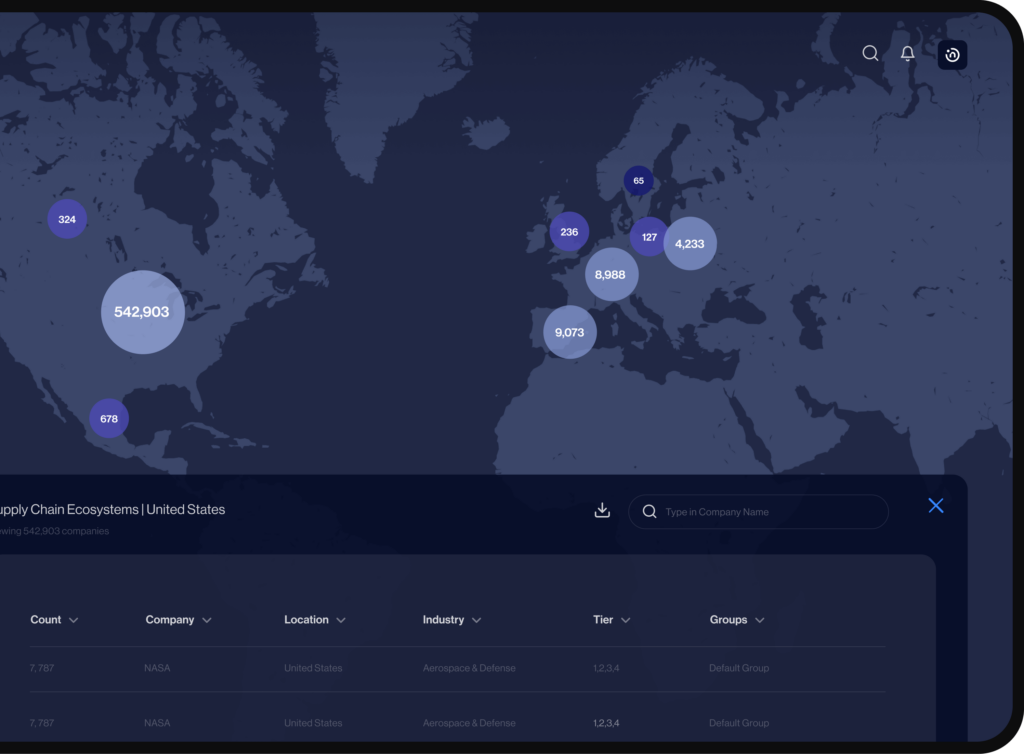
While quite lofty in its objectives, the fundamental premise of Interos’ signature tech is fairly simple to explain: the company uses AI and machine learning to create a living global map of an enterprise’s total operations. To be sure, every purveyor of workflow automation software for supply chain management makes a claim along those same lines.
Aside from the company’s working relationship with corporate data collection giants like MasterCard and Equifax — as well as endorsements from customers like defense contractor L3Harris Technologies — Interos’ key differentiator lies in the Interos Knowledge Graph (IKG). According to the company, the IKG is “the world’s largest business relationship graph repository.” That may sound a bit dry to qualify as a game-changing asset in a singularly transformative field, but it’s what allows Interos’ software to track and constantly update the full range of risks that an enterprise’s supply chains are exposed to.

In a press release about the selection of Interos to create a Navy-wide SCRM software platform, Robert Stukes, the PEO IWS Chief Logistician at the US Navy’s Acquisitions Office, commented, “Our enterprise approach enables a whole-of-government information sharing strategy to standardizing and scaling next generation SCRM capabilities essential to defense procurement and force readiness. Working with Interos’ SCRM visibility and resilience technology is accelerating our transition from analyzing lagging to leading risk indicators to protect the weapons system supply chain from concentration risk, foreign intrusions, restricted entities, and other national security concerns.”
Virginia member of the House of Representatives, Don Beyer (D), said, “This is an important moment for strengthening the navy’s supply chain resiliency and enabling the navy to be intentional about where it sources its needs, along every step of its supply chain.”
Given its surging additive manufacturing (AM) activity in recent years, which seems poised to continue expanding well into the future, the Navy is the ideal branch to serve as a coordinator for the rest of the US military’s advanced manufacturing efforts. As such, both the Navy and Interos should benefit from this partnership, and it could significantly accelerate the entire military’s push to secure and update its industrial base.
Above all, the military will benefit from the enhancements to its manufacturing cybersecurity that Interos will provide. In the summer of 2021, the Navy issued a report warning about the many vulnerabilities of its AM data. As I mentioned in my post about the Navy report, this was almost certainly overblown at the time, precisely to catalyze the demand for the sort of services Interos is offering. But the more that armed forces around the planet commit to making their advanced manufacturing programs a reality, the more necessary it will be for those organizations to ramp up cybersecurity efforts, and to do so before any equivalent ramping up of their digital supply chains.
Images courtesy of Interos
Subscribe to Our Email Newsletter
Stay up-to-date on all the latest news from the 3D printing industry and receive information and offers from third party vendors.
Print Services
Upload your 3D Models and get them printed quickly and efficiently.











You May Also Like
Scaling Beyond 10 Printers: When Support Becomes a Bottleneck
The leap to industrial-scale 3D printing is a support problem, not a hardware problem. A 3D print farm is a centralized facility that uses a large number of 3D printers...
Reshoring Requires Rules of Engagement
Reshoring manufacturing in the U.S. is a stated national priority. Policymakers, industry leaders, and defense planners agree that domestic production capacity is essential for economic resilience, national security, and long-term...
When a Factory Stops Being a Building and Starts Being a Machine
Metal manufacturing still carries the layout and logic of an older industrial age. Most factories run as a collection of isolated disciplines, each with its own equipment, staff, and data....
Bridging the Gap: 2D to 3D AI in Manufacturing
For decades, the early stages of manufacturing have been defined by a simple, frustrating trade-off: you can have it precise, or you can have it fast. AI just broke that...