Nexa3D Acquires AddiFab for Freeform Injection Molding Technology

In a move that would seem to have been in the works for some time, California-based Nexa3D has purchased Addifab, the developer of Freeform Injection Molding (FIM). The process makes it possible to 3D print polymer tooling for short-term injection molding of parts, meaning that users don’t have to shift over to an entirely new technique or material for making the end parts. They can, instead, rely on the same injection molding they normally would, only with temporary molds.
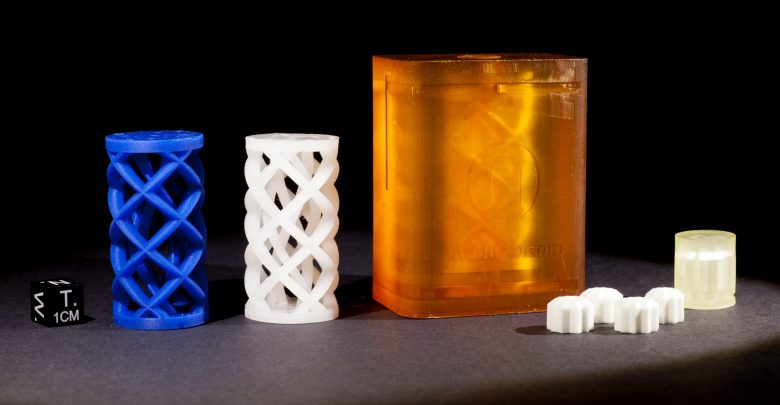
Parts made using the FIM process. Image courtesy of AddiFab.
Despite Addifab’s interesting technique, which relies on a unique material chemistry for 3D printing durable, but dissolvable molds for injection molding, FIM has taken some time to take off. The company was able to find a powerful partner in Mitsubishi Chemical, but it wasn’t until a partnership with Nexa3D that Addifab gained much traction in the marketplace. One of its largest public case study so far has been with Pepsi as a customer, who used FIM to rapidly create bottle caps in record time. Additionally, Wilson Sporting Goods was able to speed up the development of youth baseball bats, testing multiple designs simultaneously using final manufacturing materials.
“Soon after teaming up with Nexa3D, it became increasingly apparent that our combined solution unlocks tremendous opportunities for customers looking to create complex injection molding tools quickly and affordably. A year into our enormously successful commercial collaboration and dozens of customer implementations with the likes of PepsiCo and Wilson Sporting Goods, I’m thrilled that we are officially joining forces,” said Lasse G. Staal, Co-founder and Business Development Leader at Addifab.
Nexa3D was a logical partner for Addifab, as the rapid speed with which the company’s masked stereolithography technique operates adds significant value to any application. In the case of Pepsi, the entire process of creating injection molded bottle caps totaled just 1-4 days, a pace that was accomplished in part thanks to the ability of Nexa3D’s technology to 3D print the molds in just 24 minutes. In addition to the resins, Nexa3D will own Addifab’s intellectual property and CAD-to-Tool software generator. Addifab’s Copenhagen facility will now become Nexa3D’s Customer Experience Center, including a product showroom, service and support hub for its European customers, as well as a warehouse and logistics center for Nexa3D’s European activities.
“We are very excited to welcome the entire Addifab team to the growing Nexa3D family of people, products and partners democratizing access to dissolvable tooling for same day complex molded parts using the entire range of industrially proven plastics,” said Avi Reichental, Co-founder, Chairman and CEO of Nexa3D. “We believe that the market validated strategic fit between our businesses and products, combined with the expanded capabilities in product development, next-gen resin formulation, channel coverage, manufacturing and marketing, will result in significant revenue and accretive growth,” said Reichental.
There are few comparable technologies on the market to what Addifab offers, aside from Collider, which introduced a complete system for both 3D printing and injection molding parts in a single, multi-step build process. The firm was on the verge of an acquisition by Essentium, but the deal fell through when Essentium’s own move for a SPAC merger also fell through. Therefore, the purchase of Collider has been a possibility for Addifab competitors for some time.
Nexa3D, itself, is growing rapidly. After performing layoffs that were made to withstand an uncertain financial climate, the company has returned to expansion mode. Most recently, it purchased the selective laser sintering (SLS) assets of XYZprinting, a division of contract manufacturer New Kinpo Group. This allowed Nexa3D to broaden its own SLS portfolio, while Addifab boosts its vat photopolymerization capabilities. It will, therefore, be interesting to see what comes next for the company in terms of inorganic growth.
Subscribe to Our Email Newsletter
Stay up-to-date on all the latest news from the 3D printing industry and receive information and offers from third party vendors.
Print Services
Upload your 3D Models and get them printed quickly and efficiently.












You May Also Like
Heating Up: 3D Systems’ Scott Green Discusses 3D Printing’s Potential in the Data Center Industry
The relentless rise of NVIDIA, the steadily increasing pledges of major private and public investments in national infrastructure projects around the world, and the general cultural obsession with AI have...
3DPOD 260: John Hart on VulcanForms, MIT, Desktop Metal and More
John Hart is a Professor at MIT; he´s also the director of the Laboratory for Manufacturing and Productivity as well as the director of the Center for Advanced Production Technologies....
Etsy Design Rule Change Reduces Selection of 3D Printed Goods
Online marketplace Etsy has implemented a rule change requiring all 3D printed goods on the site to be original designs. The update to the site’s Creativity Standards states, ¨Items produced using...
E-Beam OEM Wayland Additive Partners with USC Racing to 3D Print Titanium Exhaust Collector
Every year, standards organization SAE International holds a competition called Formula SAE, in which students from both undergraduate and graduate programs design, build, and race small formula-style race cars. For...