Metal 3D Printing to Yield $50B in Parts by 2030


SmarTech Analysis has some bold numbers for the metal additive manufacturing (AM) market. The leading firm dedicated to 3D printing market analysis and consulting has projected that the segment for metal 3D printed parts will reap $50 billion annually by 2030.
In its latest iteration of a flagship research product, the “Metal AM Parts Produced 2021“ report, the firm again looks at the production volumes of metal 3D printed components and the resulting market values. The report includes a database of metal AM market projections for metal AM parts ranging from prototypes, tools, and tooling to end-use production components. These items span eight major industries and dozens of part categories, such as aircraft and helicopter engine parts in aerospace to nuclear reactor components in the energy sector.
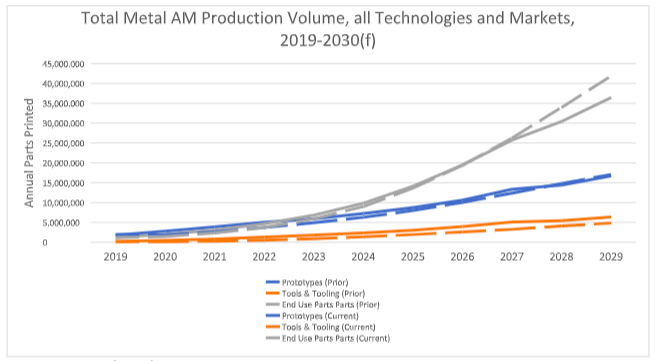
Source: SmarTech Analysis.
SmarTech notes how the supply chain disruptions caused by COVID-19 brought global attention to AM once more. As a digital manufacturing technology, it has been seen as a possible method for overcoming obstacles related to centralized manufacturing. In turn, according to the market research firm, the metal AM market is undergoing a new evolution.
At the same time, all manufacturers, including metal AM providers, have had to handle the issues associated with the pandemic. This hit the dental industry in particular, SmarTech noted, saying “almost all activity halted for between four to seven weeks of the year, and was depressed for nearly the entirety of the rest of the year after early healthcare lockdowns ended.”

A350 titanium cable mount on the front spar of the vertical stabilizer made with EOS 3D printer. (Image courtesy of EOS.)
Nevertheless, there is robust investment in metal 3D printing adoption and development. SmarTech concluded that the tooling segment saw increased activity in 2020, with service providers and “advanced users of AM for tooling production” relied on metal 3D printing as a stopgap measure in production stops and delays caused by the pandemic. Moreover, aside from the dental industry, end-use part production for metal AM increased throughout 2020.
Other analyses found in the report include the fact that, while metal powder bed fusion will continue to be used most often for production in the next few years, bound metal printing, particular metal binder jetting, will be widely adopted for production by the end of the projection period. Specifically, these technologies will be used mainly for steel, nickel and titanium and will be leveraged for production. We can already see that foreshadowed by Ford and Volkswagen, which have both announced the use of metal binder jetting for end part production.
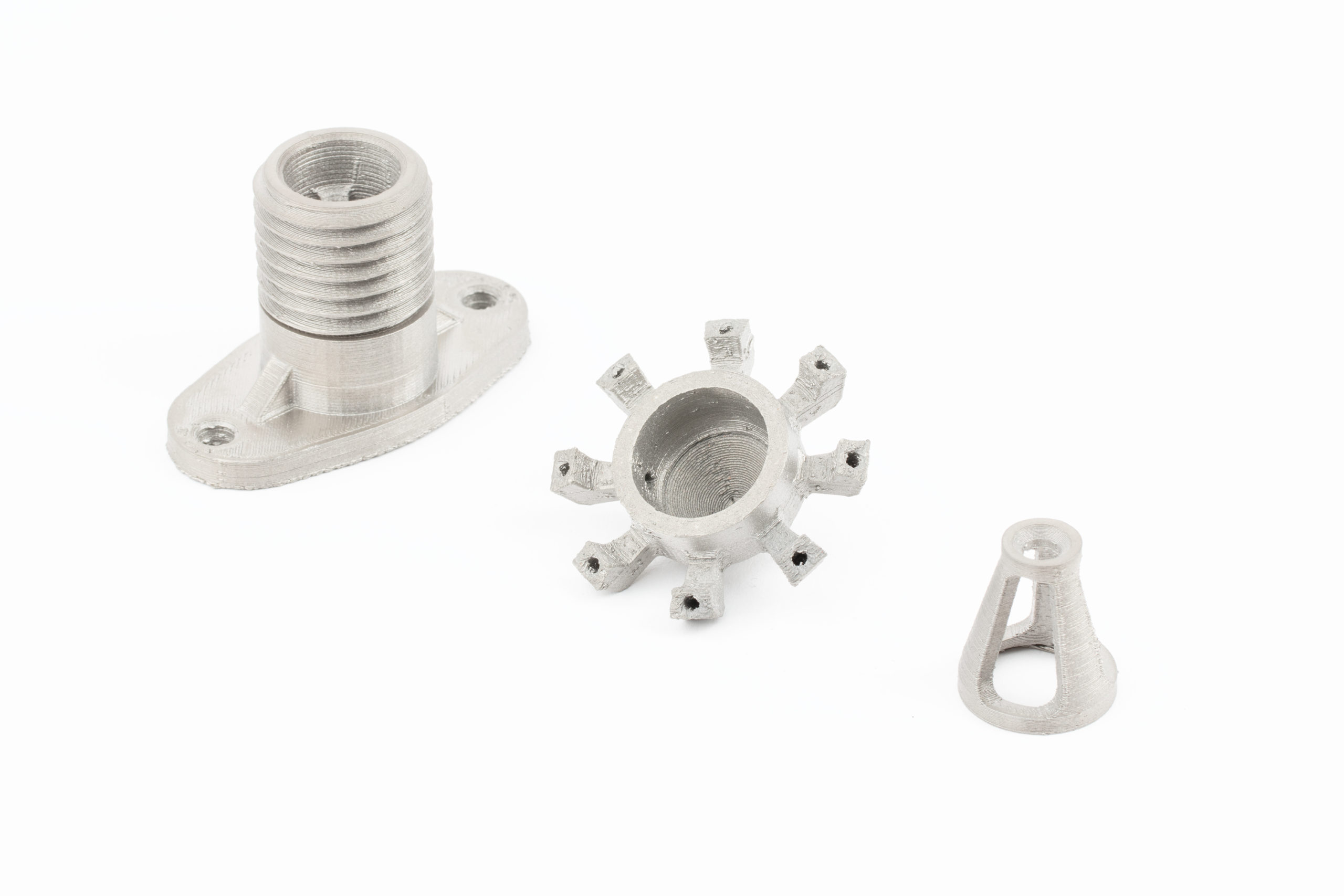
From left to right, a drone coupling, a fuel injector nozzle, and a telescope focus ring 3D printed in titanium with the Studio System 2. Image courtesy of Desktop Metal.
In this author’s opinion, this is one of the most interesting report series from SmarTech, as it tells us, using a variety of metrics, how many and what types of parts are being made with metal AM, the technology segment that reveals the most about the adoption of 3D printing for end part production. This latest issue breaks down the bound metal technology area into metal binder jetting and bound metal extrusion. It also divides application categories into specific part opportunities, revealing what value there is in each industry use case.
The state of AM overall will be discussed in more depth at the upcoming SmarTech – Stifel AM Investment Strategies 2021 summit on September 9, 2021. The half-day online event focused on 3D printing market activity is free to attend. Register at the summit website here.
Subscribe to Our Email Newsletter
Stay up-to-date on all the latest news from the 3D printing industry and receive information and offers from third party vendors.
Print Services
Upload your 3D Models and get them printed quickly and efficiently.













You May Also Like
3D Printing News Briefs, October 10, 2026: Drones, WAAM, Ceramics, & More
We have a packed 3D Printing News Briefs for you this weekend! First, America Makes celebrated the recent National Manufacturing Day with 3D printed drones, and then it’s on to...
3D Printing News Briefs, October 3, 2026: Hypersonics, Hotends, & More
We’re starting off with defense in this weekend’s 3D Printing News Briefs, as Titomic was awarded a $5 million U.S. defense contract, and VulcanForms announced a partnership with Specter Aerospace...
The Part Is Only Half the Story: Why 3D Printing Needs a Digital Thread
A 3D printed part can generate a lot of information. The challenge is keeping track of it. Manufacturers need to know which design was used, what material went into the...
Advanced Manufacturing at IMTS 2026: 3D Printing and AI and Drones, Oh My!
Last week’s International Manufacturing Technology Snow (IMTS) in Chicago welcomed over 90,000 attendees to the jungle that is McCormick Place. With over 1.17 million square feet of exhibit space, and...